| A | B |
|---|
| Parameters | In the equation y = ax^2 + bx + c 'a', 'b', and 'c' are called ____. |
| Axis of Symmetry | The line which divides a parabola into two congruent parts. |
| Roots | The solutions to a quadratic equation. |
| Vertex | The minimum or maximum value of a quadratic equation. |
| Opens upward | When a > 0 the graph of the equation y = ax^2 +bx + c ____. |
| Opens downward | When a < 0 the graph of the equation y = ax^2 +bx + c ____. |
| Narrows | When the absolute value of 'a' increases the parabola ____. |
| Widens | When the absolute value of 'a' decreases the parabola ____. |
| Translates downward | When the value of 'c' decreases the parabola ____. |
| Translates upward | When the value of 'c' increases the parabola ____. |
| One Solution | A graph of a parabola that just touches the x axis indicates the equation has ____. |
| Two Solutions | A graph of a parabola that intersects the x-axis in two places indicates the equation has ____. |
| No Solutions | A graph of a parabola that does not intersect the x-axis indicates the equation has ____. |
| On the TAKS Formula Chart | The quadratic formula can be found ____. |
| Quadratic Formula | This is used to find solutions of quadratic equations without graphing. |
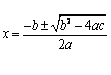 | Quadratic Formula |
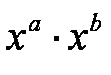 | 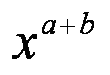 |
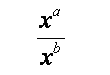 |  |
 |  |
 |  |
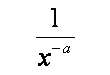 | 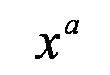 |
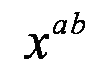 | 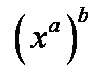 |



