| A | B |
|---|
What does "A" in this graph represent?,  | Energy of activation without an enzyme present, |
| What does "B" in this graph represent?, | The lowered energy of activation due to an enzyme being present, |
| What does "C" in this graph represent?, | The change in free energy (∆G) for this reaction, which would be negative, indicating an exergonic reaction, |
What is the name of this molecule and which part of it does "A" represent?,  | "A" represents the three phosphate groups in ATP, |
What concept is this diagram showing and what does the blue molecule represent?,  | competitive inhibition, competitive inhibitor, |
The graph below shows the change in free energy for a(n) _____ reaction.,  | endergonic, |
| The change in free energy is ____ for this reaction., | positive, |
The letter "A" represents a(n) ____.,  | active site, |
| The letter "B" represents a(n) ____., | enzyme, |
| The letter "C" represents a(n) ____., | substrate, |
The graph below shows the change in free energy for a(n) _____ reaction., 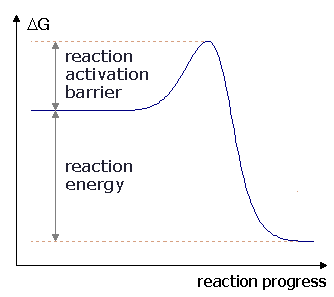 | exergonic, |
| The change in free energy is ____ for this reaction., | negative, |
The molecules labeled "A" are known as the _____.,  | reactants, |
| The molecules labeled "C" are known as the _____., | products, |
| The arrow labeled "D" shows the ______., | change in free energy (∆G) for the reaction (which is negative indicating an exergonic reaction), |
| The difference in free energy between A and B is called the ____., | energy of activation, |
This diagram shows a type of metabolic regulation called _____.,  | feedback inhibition, |
This diagram shows _____ inhibition. The red molecule is a(n) _______ inhibitor.,  | non-competitive inhibition, allosteric inhibitor, |
| A substance that reduces the activity of an enzyme by entering the active site in place of the substrate whose structure it mimics is called a(n) ______. | competitive inhibitor |
| The reactant on which an enzyme works is called the _____. | substrate |
| ______ energy is energy stored by matter as a result of location or spatial arrangement. | Potential energy |
| A protein serving as a catalyst is called a(n) ____. | enzyme |
| Any substance, organic or inorganic, that speeds up the rate of a reaction without being consumed by the reaction is called a(n) _____. | catalyst |
| The specific portion of an enzyme that attaches to the substrate by means of weak chemical bonds is called _____. | the active site |
| A metabolic pathway that synthesizes a complex molecule from simpler compounds is called a(n) ______ pathway. | anabolic |
| A series of chemical reactions that either builds a complex molecule (anabolic pathway) or breaks down a complex molecule into simpler molecules (catabolic pathway) is called a(n) _______ | metabolic pathway |
| A metabolic pathway that releases energy by breaking down complex molecules to simpler compounds is called a(n) _____. | catabolic pathway |
| A substance that reduces the activity of an enzyme by binding to a location remote from the active site, changing its conformation so that it no longer binds to the substrate is called a(n) ____. | non-competitive (or allosteric) inhibitor |
| A temporary complex formed when an enzyme binds to its substrate molecule(s). | enzyme-substrate complex |
| The amount of energy that reactants must absorb before a chemical reaction will start. | Energy of activation (or activation energy) |
| A type of regulation that involves the binding of a molecule to a protein that affects the function of the protein at a different site. | allosteric regulation |
| A spontaneous chemical reaction, in which there is a net release of free energy. | exergonic reaction |
| The energy of motion, which is exponentially related to the speed of that motion is called ____ energy. Moving matter does work by imparting motion to other matter. | kinetic |
| A quantitative measure of disorder or randomness is called ____. | entropy |
| A method of metabolic control in which the end product of a metabolic pathway acts as an inhibitor of an enzyme within that pathway. | feedback inhibition |
| In cellular metabolism, the use of energy released from an exergonic reaction to drive an endergonic reaction | energy coupling (the reactions would be called coupled reactions) |
| A non-spontaneous chemical reaction, in which free energy is absorbed from the surrounding. | endergonic reaction |
| A molecule that has been the recipient of a phospate group is said to have been ____. | phosphorylated |
| The portion of a system's energy that can perform work when temperature and pressure are uniform throughout the system is called ___. | free energy |


