| A | B |
|---|
| agora/stoa | market |
Column type?, 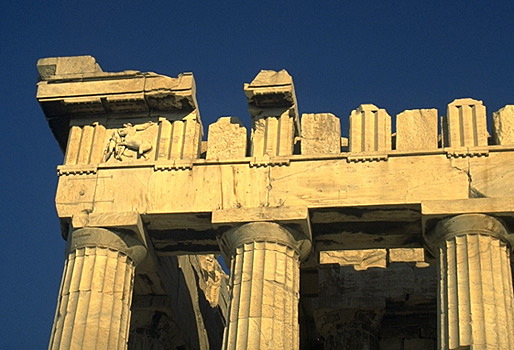 | Doric |
Column type?, 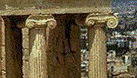 | Ionic |
column type?, 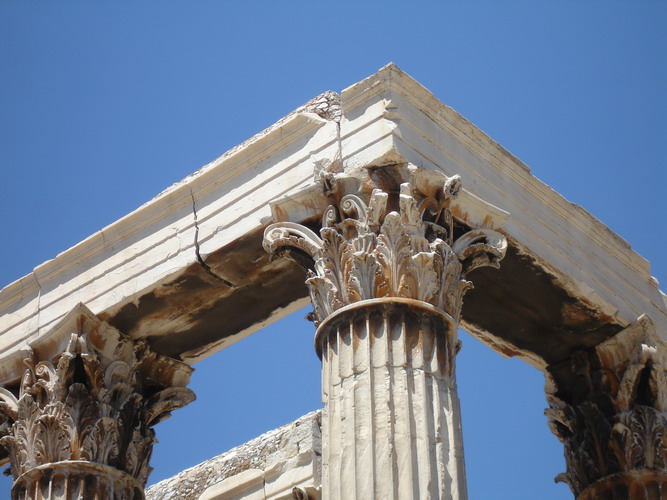 | Corinthian |
| Athens | First democratic state |
| Athenian Assembly would meet here | Pnyx |
| Athenian citizen | Men born to Athenian parents, who own land and are not slaves |
| Athenian council | made up of 500 citizens, 50 per tribe |
| Unpopular Athenian politicians could be | ostracized |
| Athenian jury consisted of | over 200 citizens |
| Popular strategoi | Pericles |
| Athens was named for | Athena |
| Strongest military power in Greece | Sparta |
| Spartan women | kept fit by training |
| Spartan government included | two kings, council of elders, and an Assembly |
| Spartan council included | two kings and 28 elected men over 60 |
| Spartan assembly | would vote by shouting yes or no |
| Three classes in Sparta | Spartans, Helots, farmers/craftsman |
| Peloponnesian War | Sparta conquered Athens |
| Democracy | People + Power |
| philosophos | men who like to be wise |
| Olympic games began | 776 BCE |
| Plato | opened 1st school of philosophy |
| Aristotle discovered | the scientific method |
| Socrates taught by | asking questions |
| Homer | retold the story of the Trojan War |
| Marathon | 26.2 mile run after victory of Persian War |
| 550 BCE | First plays performed |
| Paradox | two sides to every question |
| Syllogism | Mrs. Harp is a teacher, teachers are patient, therefore Mrs. Harp is patient. |
| Alexander the Great | Student of Aristotle |
| Oligarchy | Government ruled by a few people |
| Monarchy | rule by one |
| Tyranny | obtaining rule by overthrowing the previous ruler |



