| Left Side |
Right Side |
Page 26 :Extra Page for Notes
|
Page 27: The Big Bang Theory

- Read pages 360-362
- Complete a meta log for your reading.
.
|
Page 24 :Model Life Zones Reflection

- Copy the questions
- Answer in FCS, giving examples!!
|
Page 25: Galaxies

- Tape Galaxy Sort worksheet into notebook flappie style
- Complete the in-class activity and fill in the data tables.
- Answer the reflection questions on the notebook page under your worksheet
Galxy pictures to be classified
Galaxy Descriptions from Hubble
Galaxy Sort Handout
|
Page 22 :Model Life Zones Questions

- Answer the questions using the kidsastronomy.com/stars website.
- Be sure to write in FCS, restating the question as part of your answer.
|
Page 23: Model Life Zones

- Tape Model Life Zones worksheet into notebook flappie style
- Complete the in-class activity and fill in the data table.
- See page 22 at left for the next step ...
.
|
Page 20 : Stars Foldable

- Make your foldable following the guidelines above.
- Draw and color pictures of each star stage on the outside (front) of flappie
- Inside each flap, add notes and descriptions from the texts of each stage
- Make a pocket for the page, and store your foldable inside the pocket
|
Page 21: Stars Review
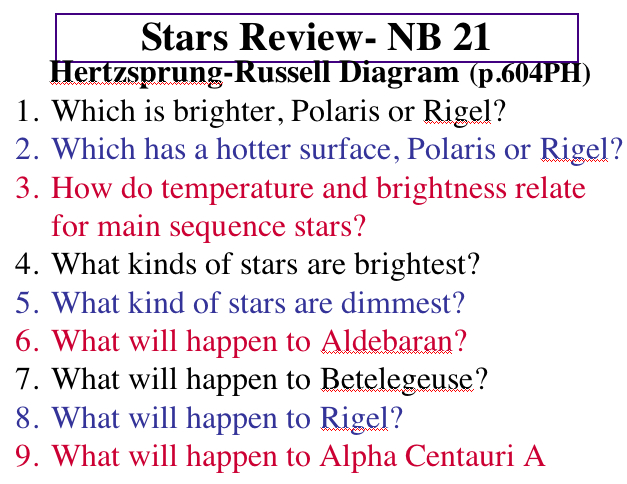
- Read page 604-605 in PH science text
- Copy and answer the questions using the text and previous readings to help you.
This is the diagram we were looking at:

STAR TYPE READING
- Set up a piece of binder paper for E-I notes: Title the page Star Type Reading, then divide the page from top to bottom into two columns.
- Label the left column What I read and the right column What I thought about it.
- Read the Star Type Reading article. Write at least one note for each paragraph. In the left column, copy a quote from the article that seems important to you. In the right column, write your interpretation of the quote. Use your green Sentence Starter bookmark in the back of your notebook for inspiration.
- On the back of the binder paper, answer the questions from the reading in FCS.
- Fold the completed page in half hamburger style and tape in to the notebook page flappie style so we can read the other questions as well
.
|
Page 18 :

|
Page 19: HR Diagram

- Tape handout to your notebook page flappie style
- graph in the stars (at least 30) to the HR Diagram
- Star Cards for graphing
- color stars to match graph
|
Page 16 : Stars Reflection

Set up NB pg. 16 as shown above:
|
Page 17: Stars Reading

- Set up the notebook page as shown above.
- Tape a Metacognitive Bookmark to the last page of your notebook
- Read CPO pages 338, 340-341, filling in the E-I Notetaker as you go
- As you read, look for things in the text you think are important or confusing.
- Quote that text in the left side Evidence column.
- In the right column, interpret what you quoted using a sentence starter from the bookmark.
- Today, focus on the starters for Questioning and Making Connections, although you can use any of the starters that help you.
|
Page 14 : Stellar Travel Times
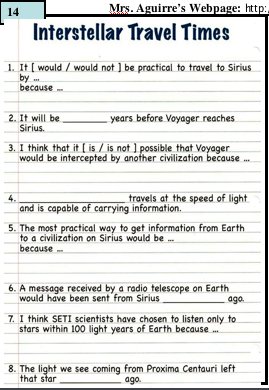
Set up NB pg. 14 as shown above:
- Tape the questions in flappie style
- answer the questions in FCS
|
Page 15: Bike Years

-
Set up the notebook page as shown above.
- Read page 339 to complete the questions
- Copy the sentence starters/questions and other information shown and complete it from the reading.
- Tape the Interstellar Travel Times table on the bottom of the page.
- Complete the table using the handout:
Bike Years Activity Directions
|
Page 12 : Reading Analysis
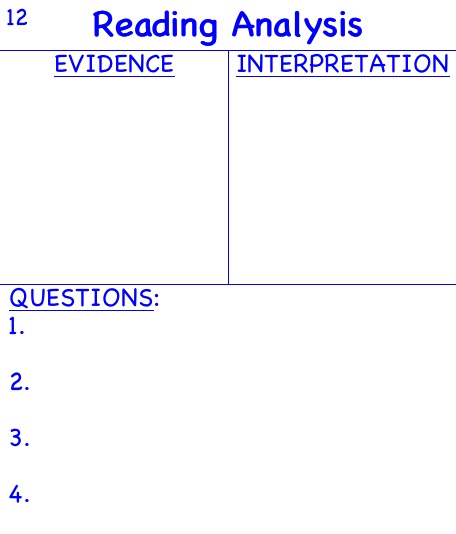
Set up NB pg. 12 as shown above:
- Read the two articles provided – you will be looking for evidence as to which is scientific and which is sensationalized.
- Write any evidence you find (quote the article) on the left and your interpretation of it on the right.
- When you have read both articles, respond to the questions below using FCS.
Which article was scientific?
How did you know? (Cite your evidence.)
Which article was sensationalized?
How did you know? (Cite your evidence.)
|
Page 13: Critical Reading
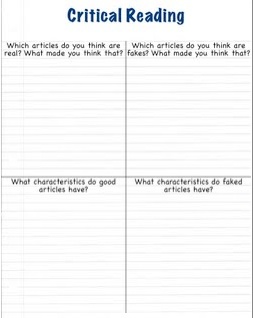
-
Set up the notebook page as shown above.
- Read each of the Four Articles. As you read them, decide if each article is scientific or sensationalized.
- For the scientific articles, list their titles in the top left box and explain
what specific things you noticed that made you think the article was scientific.
- Repeat step 3 for the senstationalized articles in the top right box.
- In the bottom left box, make a list of the general characteristics that scientific articles would have.
- In the bottom right box, repeat step 5 for sensationalized articles.
|
Page 10 :

- Use the sources in the class and on my ASTRONOMY PAGE
page to complete the fact sheet.
Fact Sheet
|
Page 11: Habitability

- Tape the Habitability worksheet flap-style into the notebook.
- Read the front and highlight the main idea in each section that a world would need to be habitable.
- Complete the graphic organizer on the back using the habitability cards (in class)
Habitability Worksheet
|
Page 8 : Gravity Lab Reflection Questions
Look carefully at your gravity Lab Worksheet (on page 9),
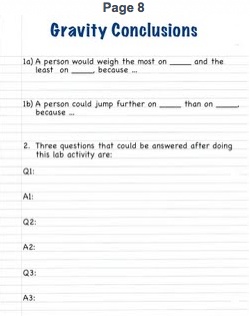
- Answer the conclusion questions from the back of the worksheet on page 9 on this page. Use the sentence starters provided.
- Write three questions that could be answered after doing this lab activity. Be sure to include answers for each.
|
Page 9: Gravity Lab

- Tape the Gravity Exploration worksheet flap-style into the notebook.
- Complete the Part A table by filling in the column Weight on Earth with either your weight or 100 lb. (you will need to write the same number eight times -- once for each row of the table). Determine the Calculated Weight by multiplying the weight times the gravity.
- Complete the jump table by doing five standing long jumps and recording the distance in cm. Determine the average of these distances by adding the five numbers together and dividing by five. Be sure to include the units (cm)!
- Complete Part B by filling in the column Average Length on Earth with your jump average (you will need to write the same number eight times -- once for each row of the table). Determine the Length by dividing the distance by the gravity.
Gravity Lab Worksheet
|
Page6 : The Pattern of Planets/ SS in One Page Worksheet
Look carefully at your solar ruler,
Read pages 313 & 317 in your text.
Respond to these three questions:
- What patterns do you notice in the planets?
- What do you see that makes you say that? (evidence)
- What more can you say?
NB Layout for pages 6-7: Solar Ruler
Tape in the Solar System Worksheet over your reflection questions
SS Worksheet

|
Page 7: Solar System Ruler

|
Page 4
|
Page 5:Astronomy Unit page

- On top half of page, respond to pre-assessment prompt
- On bottom half of page, fill in the Table of Contents
- (It changes daily- check the chart on Mrs Aguirre's wall)
|
Page 2
|
Page 3:Leave blank for now
|
In side Front Cover
|
Page 1:Title Page 9/4/12

- At the top of the page, replace “First Last” with your first and last names. Be sure to include your period number as well.
- At the bottom of the page, include the subject “Physical Science” and my name.
- In the space left in the middle of the page, draw a picture or pictures about things that mean something to you (e.g., a soccer player may draw a picture of a soccer ball or herself playing).
Page 1: Title Page
|


