Unit 2: Atoms and Periodic Table- 2103-2014
Page 46 :

- Section 4: Use your periodic table with electron levels (notebook page 44) to answer questions a-c. For each question, look at the group specified and the elements in it and determine what their electron arrangements have in common. Example elements are provided for each.
- Section 5: Use your answers from section 4 to figure out this section.
- Section 6: For each list of elements, determine if they are part of a period or a group.
- Section 7: Determine whether each statement describes a physical or chemical property.
|
Page 47:

- Copy the notes at the top of the page into your notebook.
- Section 1: Copy the sentence and fill in the two blanks using the choices provided. Look on notebook page 44 to help you figure out whether or not the outer electron shell / energy level is completely full. Don't forgot to complete the "because ..." portion as well. Copy sentence starter about the video and find two examples in the videos (Alkali Metals and Sodium) that support your claim about the alkali metals' reactivity.
- Sections 2 & 3: Repeat step two using the appropriate videos to find your examples (Halogens & Noble Gases).
|
Page 44:

After you have finished notebook page 45 and identified the main ideas in the reading:
- Tape the Electron Levels worksheet sideways on the left side of the notebook page.
- For each box, label with the element symbol and atomic number (you should get to element 18, argon). Hydrogen and lithium have been done for you.
- In each box, bubble in each filled electron spot. Remember that the number of electrons matches the atomic number and to always fill the inside (lower energy) levels / shells first. Every element should have a different number of electrons. Hydrogen and lithium have been done for you.
- Respond to the prompts on the right side of the page. The first three are from the reading. The last two require you to look for patterns in the electron arrangements across groups and periods. Both your answers should include the word "electrons".
|
Page 45:

- Tape the reading The energy levels in an atom sideways into your notebook.
- Preview the reading and put boxes around any words or terms that you think will cause you problems.
- As you read, use Talking-to-the-Text. Focus your "talking" on the annotations shown below (click on the image to see larger). Your page should have LOTS of marking on it by the time you are done.

|
Page 42 :Metals
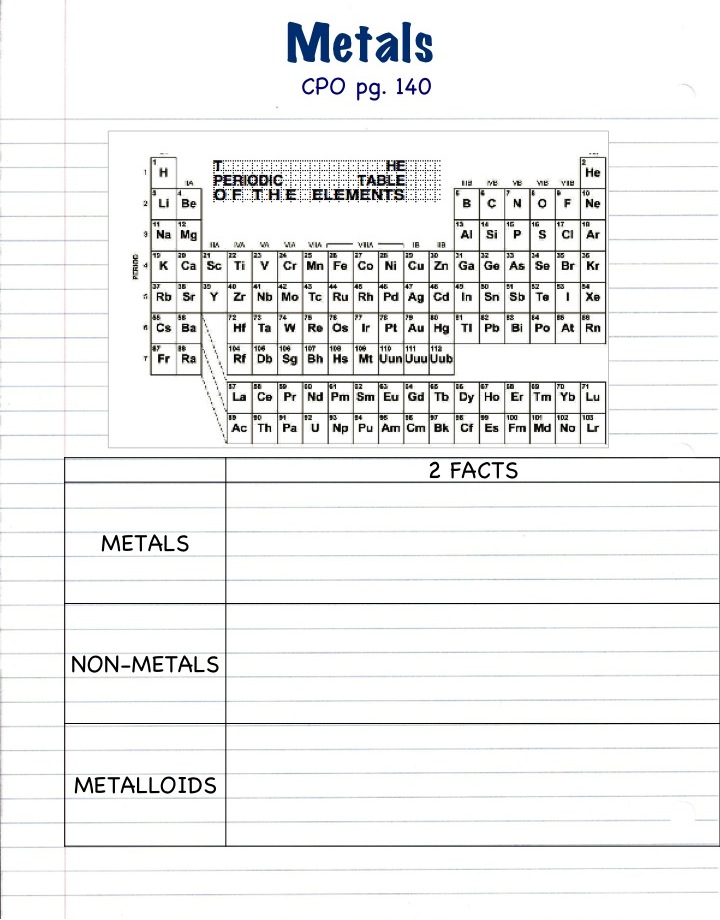
Cut out both periodic tables from the worksheet. Tape in one table at the top of pages 42 and 43.
- Set up the note-taking table using the rest of the page.
- Read CPO page 140.
- For each section of the periodic table (Metals, Non-Metals,Metalloids) write at least two facts from the reading.
- Use the diagram on CPO page 140 as a guide for coloring in your periodic table for the three sections. Be sure to color in the sections' name square in the notes table to serve as a key (see the Carbon Group example on notebook page 43).
|
Page 43: Families

See notebook page 42 instructions step 1.
- Set up the note-taking table using the rest of the page.
- Read CPO pages 142 and 149.
- For each section of the periodic table (Halogens, Noble Gases, etc.) write at least two facts from the reading.
- Use the diagram on CPO page 142 as a guide for coloring in your periodic table for the five sections. Be sure to color in the sections' name square in the notes table to serve as a key (see the Carbon Group example).
|
Page 40 :Notes Periodic Table Families

- Copy template
- Use the textbook to complete the notes
|
Page 41: Building Periodic Table

- Copy template
- Complete the questions using your textbook and notes to guide you
|
Page 38 :Notes pages 118-124

- Copy template
- Use the textbook to complete the notes
|
Page 39: Atomic Structure Review

- Copy template
- Complete the chart using your periodic table and notes to guide you
Questions for each box:

|
Page 36 :Q's for Inv 6A

Tape in Worksheet
Questions for Investigation 6A
Use this link to get the investigation manual pages:
Inv Manual pages 25-27
|
Page 37: Atomic Labels

- Copy in notes
- Answer the questions using CPo book pages 141, 139-140
|
Page 34 :Modelling Atoms

|
Page 35: What's Inside an Atom

.
|
Page 32 :Bill Nye Atoms Worksheet
Worksheet for Bill Nye Atoms
|
Page 33: Atoms Reading Notes

- Read pages 120
- Complete a meta log for your reading.
.
|
Page 30 :Rutherford's Conclusion

|
Page 31: Hit the Nucleus

.
|
Page 28 :Extra Page
|
Page 29: Atoms Unit Page
.
|


