
Read the story then click on the links below it to do the exercises.
PESACH
THE SEDER
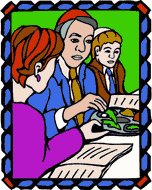
What is the Seder?
The Hebrew word ‘seder’ means ‘order’. We eat a special meal on the first two nights of the Pesach festival (one in Israel).
During the seder we read the Pesach story in a special order from the book called a Haggadah. 'Haggadah' means 'the telling' and we tell the story of the Israelites in Egypt.
The Haggadah

The Haggadah has been the foundation of the Pesach seder for thousands of years. It contains blessings, stories, instructions and everything that is needed for us to relive the Pesach story.
There are different parts of the seder with symbolic foods that remind us of the time the Jewish people spent as slaves for Pharaoh. We remind ourselves that we are now free.
The Haggadah contains the order of the seder. The steps of the seder are spelled out in detail.
A Demonstration Seder
Let's take a closer look at what happens during the Pesach seder. We will be looking at these parts: Kadesh, Yahatz, Maggid and Barekh.
*Kadesh - first cup of wine and Kiddush
Mother lights and blesses the holiday candles. We thank God that our family and friends can be together to celebrate Pesach.
Lighting the candles

Baruch atah Adonai
eloheynu melech haolam
asher kidshonu b'mitzvosov
v'tzivonu l'hadlik ner shel
Yom Tov.
Blessed are You, Lord our God,
King of the Universe,
Who sanctified us by commanding us to
light the holiday candles.
Baruch atah Adonai
eloheynu melech haolam
shehechiyanu vekiyemanu vehigianu
lazman hazeh.
Blessed are You, Lord our God,
King of the Universe,
Who has given us life, sustained us and enabled us to reach this day.
The leader of the seder then makes kiddush. This is the blessing for the wine. We drink wine as it is a special drink used on holidays and Shabbat. During the seder everyone has to drink 4 cups of wine or grape juice.
Baruch atah Adonai
eloheynu melech haolam
borei pri hagafen.
Blessed are You, Lord our God,
King of the Universe
Who creates the fruit of the vine.
Baruch atah Adonai
eloheynu melech haolam
shehechiyanu vekiyemanu vehigianu
lazman hazeh.
Blessed are You, Lord our God,
King of the Universe,
Who has given us life, sustained us and enabled us to reach this day.
After kiddush everyone drinks the first cup of wine while leaning to the left.

*Yahatz - break the middle matzah
Inside the matzah cover are three matzot. Just as the poor man sets aside something for his next meal, we remember being poor slaves and set aside a portion for the future.
The middle matzah is set aside as the afikoman. The person leading the seder breaks the middle matzah and hides the larger half in a serviette. The remaining 2 matzot symbolise the double portion of manna that fell in the desert on Shabbat and festivals.
*Maggid - tell the story of Pesach
Each person at the seder table takes turns to tell the story of Pesach. An important part of the maggid is the asking of the four questions.
1. Every other night we eat bread or matzah. Why do we eat only matzah tonight?
2. Every other night we eat all sorts of vegetables. Why do we eat maror tonight?
3. Every other night we eat vegetables as part of the meal. Why do we eat parsley dipped in salt water and maror dipped in chopped fruit before we even start the meal tonight?
4. Every other night we may sit upright or lean at the table. Why do we only lean tonight?
The youngest child at the seder has the honour of leading the singing of "Mah Nishtana" which is the asking (in Hebrew) of these four questions.
Mah Nishtana
Mah nishtana halaylah hazeh mikol haleylot?
Shebechol halaylot anu ochlin chametz umatzah, halaylah hazeh kulo matzah?
Shebechol halaylot anu ochlin shear yerakot, halaylah hazeh maror?
Shebechol halaylot en anu matbilin afilu paam echat, halaylah hazeh shete peamimm?
Shebechol halayot anu ochlin ben yoshevin uven mesubin, halaylah hazeh kulanu mesubin?
Everyone joins in to sing Avadim Hayinu, a joyful song that celebrates being free.
Avadim Hayinu
Avadim hayinu
hayinu
ata bnei chorin
bnei chorin
avadim hayinu
ata, ata, bnei chorin!
We were slaves
now we are free!
The Ten Plagues
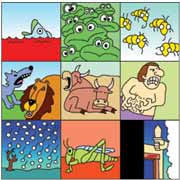
Why do we take out a small amount of wine with our little finger as we repeat the ten plagues? Because we don't want our cups to be full when we tell about other people's pain. It is wrong to rejoice when other people die - even if they are bad people.
We remember that we are all God's creations. Therefore we take off a little wine from our cup, a little of our happiness.
1. dam
2. tzfardea
3. kinim
4. arov
5. dever
6. shchin
7. barad
8. arbeh
9. choshech
10. makat bechorot
blood
frogs
lice
wild beasts
pestilence (sickness of cattle)
boils
hail
locusts
darkness
death of the first born
Everyone at the seder now remembers the miracles God sent the Israelites in order to set them free. We sing Dayenu.
Ee-lu, ee-lu, ho-tzee-anu
ho-tzee-anu mi-mistzrayim
v'lo asa va-hem sh'fa-tim
Dayenu
Ee-lu, asa va-hem sh'fa-tim
ve'lo asa vei-lo-hei-hem.
Dayenu
*Barekh - blessings after eating
Now we pour a cup of wine for the prophet Elijah and open the door to let him in. Elijah was a famous prophet who tried to make the Jews in ancient Israel stop worshiping idols and behave kindly towards each other. Today we invite him to many of our happy occasions, including brit milah and the Pesach seder. We want him to see how we keep Judaism alive. We also believe that he will bring the Messiah with him one day.
We sing Eliyahu Hanavi as the wine is poured for him.
Eliyahu Hanavi
Eliyahu ha Tishbi
Eliyahu, Eliyahu
Eliyahu, Ha Giladi
Bimheira yavo eileinu
Im Mashiach ben David
Elijah the prophet
Elijah from Tisbe
Elijah from Gilead
May he come soon to us
Together with the Messiah.
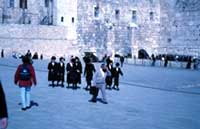
The seder is concluded with the hope "L’shanah haba-ah b’Yerushalayim!" Next year in Jerusalem!
|
|



