
Read the information then click on the links below it to do the exercises.
PESACH
SYMBOLS OF THE SEDER
What is the Seder?
The Hebrew word ‘seder’ means ‘order’. We eat a special meal on the first two nights of the Pesach festival (one in Israel).
During the seder we read the Pesach story in a special order from the book called a Haggadah. 'Haggadah' means 'the telling' and we tell the story of the Israelites in Egypt.
The Haggadah
The Haggadah has been the foundation of the Pesach seder for thousands of years. It contains blessings, stories, instructions and everything that is needed for us to relive the Pesach story.
There are different parts of the seder with symbolic foods that remind us of the time the Jewish people spent as slaves for Pharaoh. We remind ourselves that we are now free.
The Haggadah contains the order of the seder. The steps of the seder are spelled out in detail. The order is as follows:
*Kadesh - first cup of wine and Kiddush
*Urhatz - 1st washing of hands, no blessing
*Karpas - dip vegetable in salt water
*Yahatz - break the middle matzah
*Maggid - tell the story of Pesach
*Rachatz - 2nd washing of hands, with a blessing
*Motzi-Matzah - 1st and 2nd blessings over the matzah
*Maror- dip maror in charoset
*Korekh - eat sandwich of bitter herbs and matzah
*Shulhan Orekh - eat the festive meal
*Tsafun - eat the afikoman
*Barekh - blessings after eating
*Hallel - psalms of praise
*Nirtzah - concluding prayer and songs
The seder is concluded with the hope "L’shanah haba-ah b’Yerushalayim!" Next year in Jerusalem!
The seder plate
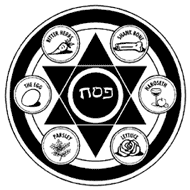
There are many symbolic objects upon the seder table. Of great importance is the seder plate, on which special foods are placed.
Maror (bitter herbs)
We eat bitter herbs to remind us how hard and bitter the lives of the Jews were when they slaves in Egypt.
Charoset (a mixture of nuts and wine)
Charoset represents the mortar used to build the Egyptian cities.
Karpas (vegetable)
The vegetable represents spring and rebirth.
Zeroa (shankbone)
This represents the offerings at the Temple in Jerusalem that was destroyed in 70 C.E. The shankbone is used because God brought us out of Egypt with an "outstretched arm".
Beitzah (roasted egg)
The egg is also a symbol of the offerings at the Temple. It is also a symbol of mourning and is used instead of a second piece of meat.
What else is on the seder table?
As well as the seder plate there are other symbolic objects on the seder table. These are the four cups of wine, Elijah's cup of wine, salt water and matzah. Again, each of these things have a special meaning during Pesach.
The four cups of wine
Each cup symbolizes our joy and gladness and recalls one of the four verses in the Torah concerning our redemption from Egypt (Exodus 6:6-7).
-"I will bring you out…"
-"I will deliver you…"
-"I will redeem you…"
-"I will take you…"
Elijah’s Cup
This is a fifth cup of wine that we set on the table in the hope that the prophet Elijah will grace our table and speak of the coming of the Messiah, a time of universal peace. Elijah’s cup also symbolizes our hope of welcoming others, especially those in need, hungry or even just lonely into our home to share in our joy during Pesach.
Salt water
Symbolize the tears shed during our enslavement under Pharaoh.
Matzah

Three matzot are placed on the seder table. Two because two loaves of challah are required, just like on every chag and Shabbat, and a third to be broken in two with half being hidden as the afikoman to be found at the conclusion of the meal. It is customary for an adult to hide the afikoman during the meal so that the children can find it at the end. This is example of how important the rabbis felt including the children in the seder to be.
The seder concludes with the words, "L’shanah haba-ah b’Yerushalayim!" Next year in Jerusalem!
|
|
|
|
| My Quia activities and quizzes |
|
https://www.quia.com/rd/29445.html |
|
https://www.quia.com/cm/50591.html |
|
https://www.quia.com/pa/14061.html |
|
|
|
|
| Last updated 2009/04/07 13:15:08 AEST | Hits 7442 |
|
|



