
Read the information then click on the links below it to do the exercises.
YOM HaATZMA'UT
THE HOLY LANGUAGE GOES MODERN
What is Yom HaAtzma’ut?
The name ‘Yom HaAtzma’ut’ means ‘Independence Day’. On the fifth of Iyar, 5708 (14th May 1948), the ancient land of Israel became the new State of Israel. Yom HaAtzma’ut is a national holiday in Israel and is also celebrated by Jews around the world. Israel is the only country in the world where Hebrew is the main language. It is a vital link between ancient Israel and the modern State of Israel.
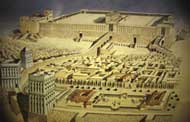
King Solomon's Hebrew meets the space age.
If King Solomon dropped into a Tel Aviv cafe for a cup of coffee he'd be in big trouble. He wouldn't know how to use the forks and teaspoons and he'd be amazed by the sunglasses and tight blue jeans of the other customers. But worst of all he wouldn't understand what people were saying. Well, at first he wouldn't understand. After a second cup of coffee King Solomon, the wisest of people, would surely begin to catch on to Modern Hebrew.
You may be wondering why Solomon, a great Hebrew poet and writer of the Biblical Song of Songs, should have trouble understanding Hebrew. The answer is that Modern Hebrew is very different from Biblical Hebrew. An important reason for the difference is the work of one man - Eliezer Ben Yehudah. To explain how it all happened, let's go back to King Solomon.
When King Solomon wrote his poetry 2,400 years ago there were about 7,500 words in the Hebrew language. They were quite enough for him and the Jewish people to run their farms, worship at the Holy Temple and buy and sell in the marketplaces.
When large numbers of Jews began to return to Israel 100 years ago they wanted to be free, proud citizens of the Jewish land. But how could they build a homeland together when they spoke many different languages? Here's where Eliezer Ben Yehuda came in.
Ben Yehuda came from Russia and settled in Jerusalem in 1881 with his wife and little son. He was determined to turn the ancient language into the daily language of all the people of the Jewish homeland. "How can I go shopping for a kerosene heater or a bicycle or even a newspaper?" protested Mrs. Ben Yehuda, "There are no Hebrew words for such things."
"Don't worry," said Ben Yehuda. "We'll make up words and publish a Hebrew newspaper to teach everybody the new words. You and I will show the way. In our home only Hebrew will be spoken. Our son Itamar will be the first Hebrew-speaking child in 1,700 years!"
Poor Itamar! He was a lonely little boy. The kids in the neighbourbood spoke only Yiddish and they laughed at him and mimicked his Hebrew. The neighbours scolded the Ben Yehudahs for using the holy language of the Bible for everyday needs. They even threw stones at the Ben Yehudah family.
But the idea of a Modern Hebrew language began to spread. In 1890 Ben Yedudah gathered a group of scholars into a language council (Va-ad Ha-Lashon), which developed modern words out of Biblical Hebrew roots. He also began work on a huge Hebrew dictionary. Soon new schools opened where subjects were taught in Hebrew. Children began to play, study and sing in the Hebrew language. Itamar wasn't alone any more.
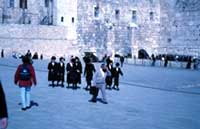
Today the Va'ad HaLashon (Academy of the Hebrew Language)still searches the Bible and other Hebrew writings for words they can reshape to modern meanings.
The English language has been growing and changing for 1,000 years. It has 500,000 words. Modern Hebrew has only 80,000 words. The Va'ad HaLashon must keep hunting through its books and running hard in the race to bring the language of King Solomon into the world of space exploration and computers.
Some useful Hebrew vocabulary for Yom HaAtzma'ut
Let's celebrate Yom HaAtzma'ut by ordering a felafel - Israelis' favourite snack. Felafel is a sandwich of chickpea balls, salads and sauces, placed in pita bread. Learn how to order a felafel by using the Hebrew vocabulary in the role-play below. Then impress your friends and family or even your Hebrew teacher with your Modern Hebrew words.
Shopkeeper: "Shalom"
Child: "Shalom"
Shopkeeper: "Ma ata rotze?" (What do you want?)
Child: "Felafel bevakasha" (Felafel please)
Shopkeeper: "Im salat? (With salad)
Child: "Ken, im salat" (Yes, with salad)
Shopkeeper: "Im chumus?" (With humus?)
Child: "Ken" (Yes)
Shopkeeper: "Hinei" (Here)
Child: "Toda" (Thank you)
Shopkeeper: "B'tayavon" (Enjoy)
Child: "Shalom"
|
|


