CLASSICS at Wilton High School includes the study of both Latin and Ancient Greek. In addition to a main focus on language and literature, students encounter a broad range of topics connected with the ancient Greeks and Romans: English words derived from Latin and Greek, Graeco-Roman mythology, common Latin phrases and abbreviations, Roman history, government, and daily culture.
LATIN is a comprehensive four year program which begins with the Cambridge Latin Course in the first and second years of study. In third and fourth year Latin, students read selections from the Carmina (lyric and elegiac poems) of Catullus, Ovid's Metamorphoses and Vergils' Aeneid.
ANCIENT GREEK is an accelerated, 1.0 credit Independent Study offered at levels I through IV. Please contact Mr. Gabrielson in room 312 if you wish to undertake the study of Ancient Greek.
Students typically begin with Athenaze, an Attic Greek textbook. In the fourth quarter of year 1, students take up A Reading Course in Homeric Greek. Greek II students continue with this textbook, which culminates in the Cyclops episode from Book 9 of the Odyssey, an extended passage of approximately 400 lines of original Greek. Advanced students continue with further readings from The Odyssey or The Iliad followed by either a tragedy of Sophocles or Euripides, Plato's Apology of Socrates or The Histories of Herodotus.
RESULTS OF 2026 WHS CLASSICAL EXAMINATIONS. Results are posted here for exams listed below.
2026 NATIONAL CLASSICAL ETYMOLOGY EXAM AWARDS.
This challenging examination tests a student's knowledge of English words derived from Latin and Greek words. This was the tenth consecutive year in which WHS students sat for this examination, earning a total of eleven medals.
GOLD MEDALISTS
Cooper Rekow
Blake Baumel
Henry Snow (highest score)
Melina Tsirikou
Arav Gupta
SILVER MEDALISTS
Quintus Furman
J.P. Wax
Greg Pinchbeck
Gopika Kaimal
BRONZE MEDALISTS
Riley Griffin
Lauren Yang
RESULTS OF 2025 WHS CLASSICAL EXAMINATIONS. Students this year earned numerous awards in state and national exams offered each year in Greek, Latin and related topics. Results are posted here for exams listed below.
National Greek Exam
Medusa Mythology Exam
Connecticut State Latin Exam
National Latin Exam
National Classical Etymology Exam
2025 NATIONAL GREEK EXAMINATION AWARDS.
This is the twenty-fourth consecutive year in which this exam has been offered at WHS. Special congratulations this year go to Caleb Sharp, who has earned High or Highest Honors on this challenging exam in each of the four years of his WHS enrollment.
HOMERIC EXAM: ODYSSEY
Green Ribbon (Merit Award): Caleb Sharp
HOMERIC EXAM: ILIAD
Red Ribbon (High Honors) Caleb Sharp
INTRODUCTORY ATTIC GREEK
Red Ribbon (High Honors): Arav Gupta
Green Ribbon (Merit Award): Gopika Kaimal
2025 MEDUSA MYTHOLOGY EXAMINATION AWARDS.
Fifteen students won awards in this year's contest. Special congratulations this year go to Caleb Sharp, who earned his fourth straight Gold Medal on this exam. Caleb is the first WHS student to earn four consecutive Gold Medals on this challenging test, which has been offered at WHS for over twenty years.
SUMMA CUM LAUDE (GOLD MEDALISTS)
Henry Snow, Cooper Rekow, Melina Tsirikou, Caleb Sharp, J.P. Wax
MAXIMA CUM LAUDE (SILVER MEDALISTS)
James Lillis, Kendall Kazan
MAGNA CUM LAUDE (BRONZE MEDALISTS)
Quintus Furman, Matthew Morano, Annie McMahon, Milan Petrosyan
CUM LAUDE
Anya Corio, Riley Griffin, Adrian Monin, Blake Baumel
2025 CONNECTICUT STATE LATIN CONTEST AWARDS. In this year's contest, students won 16 medals!
LATIN IV (Poetry)
Gold Medals (Summa Cum Laude): Aiden Sharp, Caleb Sharp
Cum Laude (Bronze Medal): Milan Petrosyan
LATIN III
Gold Medal (Summa Cum Laude): Albert "Quintus" Furman
Silver Medals (Magna Cum Laude): Adrian Monin, Samantha McDonnell
Cum Laude (Bronze Medal): Riley "Maestro" Griffin
LATIN II
Gold Medals (Summa Cum Laude): Blake Baumel, Henry Snow, William Rowley, Kendall Kazan, Pieper Markowski
Silver Medals (Magna Cum Laude): Cooper Rekow, J.P. Wax
Bronze Medal (Cum Dignitate): John Frisbee, Wyatt Hoffstatter
2025 NATIONAL LATIN EXAMINATION AWARDS.
On this year's exam, students earned a total of 17 awards, including 10 medals: 7 Gold (Summa Cum Laude) and 3 Silver (Maxima Cum Laude).
LATIN IV
Gold Medalists (Summa Cum Laude): Aiden Sharp, Caleb Sharp
Magna Cum Laude: Milan Petrosyan
LATIN III
Silver Medalists (Maxima Cum Laude): Albert "Quintus" Furman
Magna Cum Laude: Riley Griffin
Cum Laude: Adrian Monin
LATIN II
Gold Medalists (Summa Cum Laude): Henry Snow, Melina Tsirikou, Pieper Markowski
Silver Medalists (Maxima Cum Laude): Blake Baumel, Kendall Kazan
Magna Cum Laude: William Rowley
Cum Laude: Wyatt Hofstatter, James Wax, John Frisbee
LATIN I
Gold Medals (Summa Cum Laude): Gopika Kaimal, Arav Gupta
2025 NATIONAL CLASSICAL ETYMOLOGY EXAM AWARDS.
This challenging examination tests a student's knowledge of English words derived from Latin and Greek words. This was the tenth consecutive year in which WHS students sat for this examination, earning a total of fifteen medals.
GOLD MEDALISTS
Henry Snow
Melina Tsirikou (highest score)
SILVER MEDALISTS
Caleb Sharp
Aiden Sharp
Riley Griffin
Annie McMahon
Milan Petrosyan
Adrian Monin
BRONZE MEDALISTS
JoAnna Therency
Matthew Morano
Quintus Furman
Blake Baumel
William Rowley
RESULTS OF 2024 WHS CLASSICAL EXAMINATIONS. Students this year earned numerous awards in state and national exams offered each year in Greek, Latin and related topics. Results are posted here for exams listed below.
National Greek Exam
Medusa Mythology Exam
Connecticut State Latin Exam
COLT Poetry Recitation Contest
National Latin Exam
National Classical Etymology Exam
2024 CONNECTICUT STATE LATIN CONTEST AWARDS. In this year's contest, students won 21 medals!
LATIN V (Prose)
Gold Medals (Summa Cum Laude): George Huberty, Nick Huberty
LATIN IV (Poetry)
Gold Medal (Summa Cum Laude): Sydney Gow
Cum Dignitate: Jenna Peterson
LATIN III
Gold Medals (Summa Cum Laude): Aiden Sharp, Caleb Sharp
Silver Medal (Magna Cum Laude): Milan Petrosyan
LATIN II
Gold Medal (Summa Cum Laude): Quintus Furman
Silver Medals (Magna Cum Laude): Adrian Monin, Samantha McDonnell
Cum Dignitate: Riley Griffin
LATIN I
Gold Medals (Summa Cum Laude): Blake Baumel, Pieper Markowski, John Frisbee, Wyatt Hofstatter, Caitlyn Lentner, William Rowley, Melina Tsirikou
Silver Medals (Magna Cum Laude): Henry Snow, Kendall Kazan
Bronze Medal (Cum Laude): Will Andriuk, Georgina Pascarella, J.P. Wax
Cum Dignitate: Fiona Lee, Cooper Rekow
2024 MEDUSA MYTHOLOGY EXAMINATION AWARDS.
Fourteen students won awards in this year's contest, the theme for which was "What Happens in Tartarus..."
SUMMA CUM LAUDE (GOLD MEDALISTS)
Caleb Sharp, Abbie Fang tied for top score with 36/40)
MAXIMA CUM LAUDE (SILVER MEDALISTS)
Quintus Furman, James Lillis
MAGNA CUM LAUDE
Nicholas Huberty, Elizabeth Crocitto, Aiden Sharp, Melina Tsirikou, John Frisbee
CUM LAUDE
Aidan Alberino, Riley Griffin, Milan Petrosyan, Henry Snow, Samantha McDonnell
2024 NATIONAL GREEK EXAMINATION AWARDS.
This is the twenty-third consecutive year in which this exam has been offered at WHS. Students earned eight ribbons.
HOMERIC EXAM: ILIAD
Blue Ribbon (Highest Honors) Caleb Sharp
Red Ribbon (High Honors): Agni Tsirikou
Green Ribbon (Merit Award): Aiden Sharp
HOMERIC EXAM: ODYSSEY
Red Ribbon (Highest Honors) Caleb Sharp, Agni Tsirikou
BEGINNING ATTIC GREEK
Blue Ribbon (Highest Honors): George Huberty
Red Ribbon (High Honors): Abbie Fang
Green Ribbon (Merit Award): Nicholas Huberty
2024 NATIONAL LATIN EXAMINATION AWARDS.
On this year's exam, students earned a total of 22 awards, including 13 medals: 8 Gold (Summa Cum Laude) and 5 Silver (Maxima Cum Laude). Special congratulations to Caitlyn Lentner, Henry Snow and Quintus Furman for their perfect (40/40) scores!
LATIN V
Silver Medalists (Maxima Cum Laude): George Huberty, Nick Huberty
LATIN IV
Cum Laude: Sydney Gow
LATIN III
Silver Medalists (Maxima Cum Laude): Caleb Sharp, Milan Petrosyan
Cum Laude: Santiago Torres
LATIN II
Gold Medalists (Summa Cum Laude): Quintus Furman (perfect score), Riley Griffin, Adrian Monin
Silver Medalist (Maxima Cum Laude): Samantha McDonnell
Magna Cum Laude: Matthew Morano
LATIN I
Gold Medalists (Summa Cum Laude): Caitlyn Lentner (perfect score), Henry Snow (perfect score), Blake Baumel, Pieper Markowski, John Frisbee,
Magna Cum Laude: James Czick, J.P. Wax
Cum Laude: William Rowley, Wyatt Hofstatter, Clara Fielden, Kendall Kazan
2024 CONNECTICUT ORGANIZATION OF LANGUAGE TEACHERS POETRY RECITATION CONTEST AWARDS. Memorizing a poem in Greek or Latin requires patience, persistence, and attention to detail! Congratulations to this year's WHS classics students who demonstrated a high degree of excellence by earning a total of four medals in both Latin and Greek.
HS Greek IV:
Agni Tsirikou, Gold Medal
HS Latin III:
Caleb Sharp, Silver Medal
HS Latin II:
Riley Griffin, Gold Medal
HS Latin I:
Kendall Kazan, Bronze Medal
2024 NATIONAL LATIN EXAMINATION AWARDS.
On this year's exam, students earned a total of 22 awards, including 13 medals: 8 Gold (Summa Cum Laude) and 5 Silver (Maxima Cum Laude). Special congratulations to Caitlyn Lentner, Henry Snow and Quintus Furman for their perfect (40/40) scores!
LATIN V
Silver Medalists (Maxima Cum Laude): George Huberty, Nick Huberty
LATIN IV
Cum Laude: Sydney Gow
LATIN III
Silver Medalists (Maxima Cum Laude): Caleb Sharp, Milan Petrosyan
Cum Laude: Santiago Torres
LATIN II
Gold Medalists (Summa Cum Laude): Quintus Furman (perfect score), Riley Griffin, Adrian Monin
Silver Medalist (Maxima Cum Laude): Samantha McDonnell
Magna Cum Laude: Matthew Morano
LATIN I
Gold Medalists (Summa Cum Laude): Caitlyn Lentner (perfect score), Henry Snow (perfect score), Blake Baumel, Pieper Markowski, John Frisbee,
Magna Cum Laude: James Czick, J.P. Wax
Cum Laude: William Rowley, Wyatt Hofstatter, Clara Fielden, Kendall Kazan
2024 NATIONAL CLASSICAL ETYMOLOGY EXAM AWARDS.
This challenging examination tests a student's knowledge of English words derived from Latin and Greek words. This was the tenth consecutive year in which WHS students sat for this examination, earning a total of eleven medals.
GOLD MEDALISTS
Adrian Monin
Caleb Sharp
SILVER MEDALISTS
Annie McMahon
Aidan Alberino
Milan Petrosyan
George Huberty
BRONZE MEDALISTS
Quintus Furman
Aiden Sharp
Riley Griffin
Gabe Cronley
Daniel Taylor
RESULTS OF 2023 WHS CLASSICAL EXAMINATIONS. Students this year earned well in excess of 100 awards in the state and national exams offered each year in Greek, Latin and related topics. Results are posted here.
National Greek Exam
Medusa Mythology Exam
Connecticut State Latin Exam
COLT Poetry Recitation Contest
National Latin Exam
National Latin Vocabulary Exam
National Classical Etymology Exam
National Hellenic Civilization Exam
National Roman Civilization Exam
2023 NATIONAL GREEK EXAMINATION AWARDS.
This is the twenty-second consecutive year in which this exam has been offered at WHS. Students earned ten ribbons.
ATTIC PROSE EXAM:
Green Ribbon (Merit Award): Lukas Koutsoukos
HOMERIC EXAM: ILIAD
Red Ribbon (High Honors): Avni Gupta
Green Ribbon (Merit Award): Agni Tsirikou
HOMERIC EXAM: ODYSSEY
Green Ribbon (Merit Award): Avni Gupta, Agni Tsirikou
BEGINNING ATTIC GREEK
Red Ribbon (High Honors): Caleb Sharp
Green Ribbon (Merit Award): Aiden Sharp
INTRODUCTORY ATTIC GREEK
Red Ribbon (High Honors): Abbie Fang, Nicholas Huberty
Green Ribbon (Merit Award): Adeeva Ghuman
2023 MEDUSA MYTHOLOGY EXAMINATION AWARDS.
This year's theme was "The Ichor of Zeus." This year there were twenty award winners!
SUMMA CUM LAUDE (GOLD MEDALISTS)
Lukas Koutsoukos (WHS top score 34/40), Dylan Bernheim, Caleb Sharp
MAXIMA CUM LAUDE (SILVER MEDALISTS)
Ava Migliaccio, Thomas Robins, Quintus Furman, Riley Griffin, Milan Petrosyan
MAGNA CUM LAUDE
Ulysses Squitieri, Gayathri Kaimal, Adrian Monin, Grace Ratcliffe, Sean Wilock, John Carpi, Elizabeth Crocitto, Marianna Ramirez
CUM LAUDE
Nicholas Huberty, Sydney Gow, George Huberty, Matthew Morano
2023 CONNECTICUT STATE LATIN CONTEST AWARDS. Students won 20 awards, including 15 medals. Special congratulations this year go to the five students in Latin IV who earned Gold Medals -- Of eight (8) Gold Medals earned statewide on this exam, five (5) were WHS students. This is the highest number of "summa cum laude" awards won at this level ever!
LATIN IV
Gold Medals (Summa Cum Laude): Nick Huberty, George Huberty, Gayathri Kaimal, Aaron Griffin, Dylan Bernheim
Silver Medal (Magna Cum Laude): Aiden Durkee
Cum Dignitate: Colton Hall
LATIN III
Gold Medal (Summa Cum Laude): Sydney Gow
Silver Medal (Magna Cum Laude): Drew Lane
Cum Dignitate: Ulysses Squitieri
LATIN II
Silver Medals (Magna Cum Laude): Aiden Sharp, Caleb Sharp
Bronze Medals (Cum Laude): Imran Mazzarulli, Milan Petrosyan
Cum Dignitate: Thomas Robins, Santiago Torres
LATIN I
Gold Medal (Summa Cum Laude): Quintus Furman
Silver Medals (Magna Cum Laude): Riley Griffin, Ava Migliaccio
Bronze Medal (Cum Laude): Samantha McDonnell
2023 CONNECTICUT ORGANIZATION OF LANGUAGE TEACHERS POETRY RECITATION CONTEST AWARDS. This was the second consecutive year in which WHS students won medals at all levels of Ancient Greek! Our students won a mind-blowing seven medals in total in both Latin and Greek. Special congratulations go this year to Middlebrook eighth grade student Melina Tsirikou, the first MB winner of a COLT Poetry award!
MS Greek I
Melina Tsirikou: Silver Medal
HS Greek I
Abbie Fang: Silver Medal
HS Greek II
Caleb Sharp: Bronze Medal
HS Greek III
Agni Tsirikou: Silver Medal
HS Greek IV
Gayathri Kaimal: Gold Medal
HS Greek V
Lukas Koutsoukos: Gold Medal
HS Latin IV
George Huberty: Silver Medal
2023 NATIONAL LATIN EXAMINATION AWARDS.
On this year's exam, students earned a total of 18 awards, including 14 medals: 6 Gold (Summa Cum Laude) and 8 Silver (Maxima Cum Laude).
LATIN IV
Gold Medalist (Summa Cum Laude): George Huberty
Silver Medalist (Maxima Cum Laude): Nick Huberty
Cum Laude: Gayathri Kaimal
LATIN III
Silver Medalist (Maxima Cum Laude): Marianna Ramirez
LATIN II
Gold Medalists (Summa Cum Laude): Milan Petrosyan, Caleb Sharp, Aiden Sharp, Imran Mazzarulli
Silver Medalist (Maxima Cum Laude): Thomas Robins
Magna Cum Laude: Santiago Torres
LATIN I
Gold Medalist (Summa Cum Laude): Quintus Furman
Silver Medalists (Maxima Cum Laude): Riley Griffin, Adrian Monin, Ava Migliaccio, Samantha McDonnell, Matthew Morano
Cum Laude: John Carpi, Annie McMahon
2023 NATIONAL LATIN VOCABULARY EXAM AWARDS.
This challenging examination tests a student's general knowledge of Latin words, including such information as noun gender and declension number, verb conjugations, and principal parts. This year's results were impressive: 15 students won awards! The exam level for each student is indicated in parentheses.
GOLD MEDALISTS
Riley Griffin (Latin 1/2)
Milan Petrosyan (Latin 1)
Aiden Sharp (Latin 1)
Caleb Sharp (Latin 1)
Aaron Griffin (Latin 3)
George Huberty (Latin 3)
SILVER MEDALISTS
John Carpi (Latin 1/2)
Quintus Furman (Latin 1/2)
Santiago Torres (Latin 1)
Sydney Gow (Latin 2)
Luke McKay (Latin 3)
Lukas Koutsoukos (Latin 3)
BRONZE MEDALISTS
Matthew Morano (Latin 1/2)
Marianna Ramirez (Latin 2)
Dylan Bernheim (Latin 3)
2023 NATIONAL CLASSICAL ETYMOLOGY EXAM AWARDS.
This challenging examination tests a student's knowledge of English words derived from Latin and Greek words. This was the ninth consecutive year in which WHS students sat for this examination, earning a total of twenty medals. Special shout out goes to Avni Gupta who earned her third straight Gold Medal on this Exam!
GOLD MEDALISTS
Aaron Griffin
Avni Gupta
Lukas Koutsoukos
George Huberty
SILVER MEDALISTS
Imram Mazzarulli
Erica Mercede
Nala "Jazzy" Clarke
Dylan Bernheim
Nicholas Huberty
Aiden Sharp
BRONZE MEDALISTS
Lila Fox
Sydney Gow
Caleb Sharp
Jenna Peterson
Annika Aronson
Gayathri Kaimal
Aden Durkee
Scarlet Levy
Milan Petrosyan
Thomas Robins
2023 NATIONAL HELLENIC CIVILIZATION EXAM AWARDS.
This examination was offered for the second time this year by the American Classical League. It tests a student's knowledge of Greek history, language and literature. Eight WHS Ancient Greek students earned medals.
GOLD MEDALISTS
Caleb Sharp
Lukas Koutsoukos
Gayathri Kaimal
SILVER MEDALISTS
Dylan Bernheim
Avni Gupta
Adeeva Ghuman
BRONZE MEDALISTS
Agni Tsirikou
Grace Ratcliffe
2023 NATIONAL ROMAN CIVILIZATION EXAM AWARD
This intensive examination covers a wealth of topics relating to Roman history (Monarchy, Republic, and Empire) and civilization (clothing; living arrangements; food & meals; theater; gladiatorial games; chariot races; religion; holidays and festivals; political and public careers; roads; military; baths; geography; slavery; travel & communication).
BRONZE MEDALIST
Lukas Koutsoukos
RESULTS OF 2022 WHS CLASSICAL EXAMINATIONS. WHS classics students won a total of ninety-six awards this year in a variety of contests and competitive examinations. Results are posted here for the following exams:
Medusa Mythology Exam
National Hellenic Civilization Examination (new this year!)
National Greek Exam
COLT Poetry Recitation Contest
Connecticut State Latin Exam
National Latin Exam
National Classical Etymology Exam
2022 MEDUSA MYTHOLOGY EXAMINATION AWARDS.
This year's theme was "Heroic Helpers." This year there were twenty-two award winners!
SUMMA CUM LAUDE (GOLD MEDALISTS)
Avni Gupta, Caleb Sharp (tied for WHS top score: 34/40), Dylan Bernheim, Lukas Koutsoukos
MAXIMA CUM LAUDE (SILVER MEDALISTS)
Annika Aronson, Faith Wang, Gayathri Kaimal, Emily Mrakovcic, Natasha Ring
MAGNA CUM LAUDE
Dana Wax, Kate Belcher, Marianna Ramirez, Ulysses Squitieri, Aidan Durkee, Alexandra Fordsman
CUM LAUDE
Pamir Canan, Nicholas Huberty, Sydney Kelso, Nike Stefan, Aiden Sharp, George Huberty, Daniel Taylor
2022 NATIONAL HELLENIC CIVILIZATION EXAMINATION.
This examination was offered for the first time this year by the American Classical League. It tests a student's knowledge of Greek history, language and literature. Five WHS Greek students earned medals.
GOLD MEDALIST
Caleb Sharp
SILVER MEDALISTS
Dylan Bernheim
Avni Gupta
Gayathri Kaimal
Lukas Koutsoukos
2022 NATIONAL GREEK EXAMINATION AWARDS.
This is the twenty-first consecutive year in which this exam has been offered at WHS. Students earned eight ribbons. Special congratulations to Agni Tsirikou, who earned a perfect score on the Introductory Greek Exam.
HOMERIC EXAM: ILIAD
Green Ribbon (Merit Award): Lukas Koutsoukos
HOMERIC EXAM: ODYSSEY
Blue Ribbon (Highest Honors): Lukas Koutsoukos
Green Ribbon (Merit Award): Gayathri Kaimal
BEGINNING ATTIC GREEK
Blue Ribbon (Highest Honors): Avni Gupta
INTRODUCTORY ATTIC GREEK
Purple Ribbon (Perfect Score): Agni Tsirikou
Blue Ribbon (Highest Honors): Caleb Sharp
Red Ribbon (High Honors): Aiden Sharp
Green Ribbon (Merit Award): Aaron Griffin
2022 CONNECTICUT ORGANIZATION OF LANGUAGE TEACHERS POETRY RECITATION CONTEST AWARDS. Memorizing a poem of 20-30 lines is hard work! It takes patience, time, and diligence. Special congratulations to all medalists in Greek this year. This was the first time that WHS Greek students won awards at all four levels of Ancient Greek!
Greek I
Caleb Sharp: 2nd place for his recitation of Andromache and Hector's parting in Iliad Book 6
Greek II
Agni Tsirikou: 2nd Place for her recitation from Odyssey Book 1
Greek III
Gayathri Kaimal: 1st Place for reciting a speech of Antigone from the play of the same name
Greek IV
Lukas Koutsoukos: 1st Place for his recitation of Priam's supplication of Hector in Iliad 24
2022 CONNECTICUT STATE LATIN CONTEST AWARDS. Students won 13 awards, including 11 medals.
LATIN IV
Gold Medal (Summa Cum Laude): Alexandra Fordsman
LATIN III
Gold Medal (Summa Cum Laude): George Huberty, Nick Huberty
Silver Medal (Magna Cum Laude): Dylan Bernheim
Cum Dignitate: Aaron Griffin
LATIN II
Bronze Medals (Cum Laude): Sydney Gow, Jenna Peterson, Marianna Ramirez, Lexie Tiche
Cum Dignitate: Erica Mercede
LATIN I
Gold Medal (Summa Cum Laude): Milan Petrosyan
Bronze Medals (Cum Laude): Henry Mazzarulli, Thomas Robins
2022 NATIONAL LATIN EXAMINATION AWARDS.
On this year's exam, students earned a total of 19 awards, including 10 medals: 5 Gold (Summa Cum Laude) and 5 Silver (Maxima Cum Laude). Special congratulations go this year to Milan Petrosyan, who earned a Perfect Score on the Introduction to Latin Exam!
LATIN IV
Gold Medalist (Summa Cum Laude): Dana Wax
Silver Medalist (Maxima Cum Laude): Alexandra Fordsman
Magna Cum Laude: Faith Wang
Cum Laude: Emily Mrakovcic, Natasha Ring
LATIN III
Gold Medalists (Summa Cum Laude): George Huberty, Nick Huberty
Silver Medalist (Maxima Cum Laude): Nike Stefan
Magna Cum Laude: Aaron Griffin
LATIN II
Silver Medalist (Maxima Cum Laude): Sydney Gow
Magna Cum Laude: Lila Fox, Jenna Peterson, Gayathri Kaimal
Cum Laude: Marianna Ramirez
LATIN I
Gold Medalists (Summa Cum Laude): Milan Petrosyan (perfect score), Henry Mazzarulli
Silver Medalists (Maxima Cum Laude): Thomas Robins, Santiago Torres
Cum Laude: Lily Zane
2022 NATIONAL CLASSICAL ETYMOLOGY EXAM AWARDS.
This challenging examination tests a student's knowledge of English words derived from Latin and Greek words. This was the eighth consecutive year in which WHS students sat for this examination, earning a total of twenty-five medals, shattering the previous school record (23 medals).
GOLD MEDALISTS
Pamir Canan
Molly DeLuca
Aaron Griffin
Reina McDermott
Avni Gupta
Aiden Sharp
Erica Mercede
George Huberty
SILVER MEDALISTS
Alexis Tiche
Katherine Belcher
Aidan Durkee
Lukas Koutsoukos
Luke McKay
Stefan Nike
Dylan Bernheim
Gayathri Kaimal
Agni Tsirikou
Caleb Sharp
Alex Cole
Sydney Gow
Jenna Peterson
Marianna Ramirez
BRONZE MEDALISTS
Kaitlyn Gilchrist
Aki Lasher
Nicholas Huberty
RESULTS OF 2021 WHS CLASSICAL EXAMINATIONS.
For the second consecutive year, the COVID 19 pandemic cut short the full cycle of classical examinations. However, several key examinations were offered and results are listed below. Congratulations to all award winners!
National Greek Exam
National Latin Exam
National Classical Etymology Exam
Medusa Mythology Exam
2021 NATIONAL GREEK EXAMINATION AWARDS.
This is the twentieth consecutive year in which this exam has been offered at WHS. Students earned eight ribbons. Special congratulations to Justin Rosenthal and Lukas Koutsoukos for Highest Honors Blue Ribbons on the Beginning Attic Exam!
HOMERIC EXAM: ILIAD
Green Ribbon (Merit Award): Mickey Wilcox
HOMERIC EXAM: ODYSSEY
Green Ribbon (Merit Award): Oliver Sharpe
BEGINNING ATTIC GREEK
Blue Ribbon (Highest Honors): Lukas Koutsoukos, Justin Rosenthal
Green Ribbon (Merit Award): Sophia Flaim, Alexandra Fordsman
INTRODUCTORY ATTIC GREEK
Red Ribbon (High Honors): Avni Gupta
Green Ribbon (Merit Award): Emily Mrakcovcic
2021 NATIONAL LATIN EXAMINATION AWARDS.
On this year's exam, students earned a total of 25 awards, including 13 medals: 3 Gold (Summa Cum Laude) and 10 Silver (Maxima Cum Laude).
LATIN IV
Silver Medalists (Maxima Cum Laude): Ryan McElroy, Justin Rosenthal
Magna Cum Laude: Sophia Flaim
Cum Laude: Mary Emerson, Mickey Wilcox
LATIN III
Gold Medalist (Summa Cum Laude): Alexandra Fordsman
Silver Medalist (Maxima Cum Laude): Dana Wax
Magna Cum Laude: Sydney Kelso, Emily Mrakcovcic, Faith Wang
LATIN II
Silver Medalists (Maxima Cum Laude): Aaron Griffin, Shawn Heggland
Magna Cum Laude: Zach Krawitz, Annika Aronson, Dylan Evershed, Matt Ferencz
LATIN I
Gold Medalists (Summa Cum Laude): Alexandra Cole, Lila Fox
Silver Medalists (Maxima Cum Laude): Sydney Gow, Jenna Peterson, Marianna Ramirez, Mack Jones, Lexie Tiche
Magna Cum Laude: Ulysses Squitieri
Cum Laude: Brody Hess
2021 NATIONAL CLASSICAL ETYMOLOGY EXAM AWARDS.
This challenging examination tests a student's knowledge of English words that are derived from Latin and Greek words. This was the seventh consecutive year in which WHS students sat for this examination, earning a total of eleven medals.
GOLD MEDALISTS
Pamir Canan, Faith Wang (tied for top score: 43/50)
Molly DeLuca
Avni Gupta
Lukas Koutsoukos
Nicholas Huberty
SILVER MEDALISTS
Gayathri Kaimal, George Huberty
BRONZE MEDALISTS
Alexandra Fordsman
Dylan Bernheim
Justin Rosenthal
2021 MEDUSA MYTHOLOGY EXAMINATION AWARDS.
This year's theme was "Monstrous Mutations." Students were required to know numerous stories from advanced classical mythology connected with this theme, including Cadmus and Harmonia, Cercopes, Glaucus, Medusa, Scylla, Echidna’s children, Erinyes, Gigantes, Pegasus, Python, Spartoi, Typhon, Achelous, Achlys/Deathmist, Empousa, Graiai, Medusa, and Proteus.
MAXIMA CUM LAUDE (SILVER MEDALISTS)
Lukas Koutsoukos, Gayathri Kaimal
MAGNA CUM LAUDE (PURPLE RIBBON)
Faith Wang
CUM LAUDE CERTIFICATES
Alexandra Fordsman, Dylan Bernheim
RESULTS OF 2020 WHS CLASSICAL EXAMINATIONS.
Due to the COVID 19 pandemic and subsequent school closure, the full cycle of classical examinations was unfortunately interrupted. Nevertheless, this year several key examinations were offered and results are listed below. Congratulations to all award winners!
National Greek Exam
National Latin Exam
National Classical Etymology Exam
National Roman Civilization Exam
National Latin Vocabulary Exam (cancelled)
Medusa Mythology Exam (cancelled)
CT State Latin Contest (cancelled)
COLT Poetry Recitation Contest (cancelled)
2020 NATIONAL GREEK EXAMINATION AWARDS.
This is the nineteenth consecutive year in which this exam has been offered at WHS. Students earned eleven ribbons. Special congratulations to Lukas Koutsoukos for his perfect score on the Introductory Attic Exam!
HOMERIC EXAM: ILIAD
Red Ribbon (High Honors): Alexander Koutsoukos
Green Ribbon (Merit Award): Thomas Czick, Nicholas Lin
HOMERIC EXAM: ODYSSEY
Red Ribbon (High Honors): Thomas Czick, Alexander Koutsoukos
BEGINNING ATTIC GREEK
Red Ribbon (High Honors): Bronwyn Walsh
Green Ribbon (Merit Award): Mickey Wilcox
INTRODUCTORY ATTIC GREEK
Purple Ribbon (Perfect Score): Lukas Koutsoukos
Red Ribbon (High Honors): Sophia Flaim, Justin Rosenthal
Green Ribbon (Merit Award): Gayathri Kaimal
2020 NATIONAL LATIN EXAMINATION AWARDS.
On this year's exam, students earned a total of 22 awards, including 10 medals: 3 Gold (summa cum laude) and 7 Silver (maxima cum laude).
LATIN IV
Silver Medalist (Maxima Cum Laude): Nicholas Lin
Magna Cum Laude: Thomas Czick
LATIN III
Silver Medalists (Maxima Cum Laude): Sophia Flaim (class high score), Ryan McElroy
Magna Cum Laude: Casey Shu, Justin Rosenthal
Cum Laude: Michael Pien, Mickey Wilcox
LATIN II
Gold Medalist (Summa Cum Laude): Alexandra Fordsman
Silver Medalist (Maxima Cum Laude): Emily Mracovcic
Cum Laude: Kate Belcher, Molly Deluca, Dana Wax, Aki Lasher
LATIN I
Gold Medal (Summa Cum Laude): Avery Schestag, Matthew Ferencz
Silver Medalists (Maxima Cum Laude): Aiden Durkee, Dylan Bernheim, William Drew
Magna Cum Laude: Whitney Hess
Cum Laude: Zachary Krawitz, Luke McKay
2020 NATIONAL CLASSICAL ETYMOLOGY EXAM AWARDS.
This challenging examination tests a student's knowledge of Latin and Greek derivatives and their usage in the English language. This was the sixth consecutive year in which WHS students sat for this examination, earning an incredible total of twenty-three medals -- a new school record!
GOLD MEDALISTS
Alexander Koutsoukos (top score 44/50)
Nicholas Lin
Justin Rosenthal
Simon Alexander
Mickey Wilcox
Michael Pien
Kate Belcher
Gayathri Kaimal
Lukas Koutsoukos
SILVER MEDALISTS
Ryan McElroy
BRONZE MEDALISTS
Sadie Farnworth
Anthony Cascello
Bronwyn Walsh
Sophia Flaim
Casey Shu
Mary Emerson
Rohan Vaddiraju
Pamir Canan
Alexandra Fordsman
Natasha Ring
Lila Fagel
Faith Wang
Dana Wax
2020 NATIONAL ROMAN CIVILIZATION EXAM AWARDS.
This intensive examination covers a wealth of topics relating to Roman history (Monarchy, Republic, and Empire) and civilization (clothing; living arrangements; food & meals; theater; gladiatorial games; chariot races; religion; holidays and festivals; political and public careers; roads; military; baths; geography; slavery; travel & communication). This was the fifth year in which WHS Latin students competed, earning a total of three medals. Congratulations go especially to Ryan McElroy, who achieved a mind-bending score of 47/50!
GOLD MEDALISTS
Ryan McElroy, Lukas Koutsoukos
BRONZE MEDALIST
Alexander Koutsoukos
RESULTS OF 2019 WILTON HIGH SCHOOL CLASSICAL EXAMINATIONS.
This year WHS Greek and Latin students earned numerous medals, ribbons, and certificates in highly competitive national and statewide examinations listed below. Congratulations to all of this year's award winners!
National Greek Exam
National Latin Exam
National Classical Etymology Exam
National Latin Vocabulary Exam
National Roman Civilization Exam
CT State Latin Contest
COLT Poetry Recitation Contest.
2019 CONNECTICUT STATE LATIN CONTEST AWARDS. Students won 19 awards, including 8 medals.
LATIN III
Silver Medal (Magna Cum Laude): Emma Famous
Bronze Medal (Cum Laude): Josh Darkwah
Cum Dignitate: Caroline Hess, William Gioffre, Calvin Nichols
LATIN II
Silver Medal (Magna Cum Laude): Michael Pien, Mickey Wilcox
Bronze Medals (Cum Laude): Simon Alexander, Mary Emerson
Cum Dignitate: Justin Rosenthal, Owen Steckel, Casey Shu, Avi Sardana
LATIN I
Gold Medal (Summa Cum Laude): Ryan McElroy
Bronze Medals (Cum Laude): Alexandra Fordsman
Cum Dignitate: Isadore Palacpac, Natasha Ring, Dana Wax, Amelia Hughes
2019 NATIONAL LATIN EXAMINATION AWARDS.
On this year's exam, students earned a total of 28 awards, including 13 medals: 3 Gold (summa cum laude) and 10 Silver (maxima cum laude). Special congratulations go to Ryan McElroy for earning a perfect score on this challenging test.
LATIN III
Gold Medalists (Summa Cum Laude): Nicky Lin, Anthony Cascello
Silver Medalists (Maxima Cum Laude): Thomas Czick, Josh Darkwah
Magna Cum Laude: Sadie Farnworth, Emmanuel Bazile
LATIN II
Silver Medalists (Maxima Cum Laude): Mickey Wilcox, Ella Kelso, Justin Rosenthal, Alexander Simon, Micheal Pien, Nathan Wang, Casey Shu
Magna Cum Laude: Oliver Sharpe, Rohan Vaddiraju
Cum Laude: Avi Sardana, Owen Steckel
LATIN I
Summa Cum Laude (Gold Medal): Ryan McElroy
Silver Medalists (Maxima Cum Laude): Alexandra Fordsman
Magna Cum Laude: Amelia Hughes, Kate Belcher, Isadore Palacpac, Dana Wax, Samuel Gioffre
Cum Laude: Emily Mrakovcic, Pamir Canan, Natasha Ring, Molly DeLuca
2019 NATIONAL GREEK EXAMINATION AWARDS.
This is the eighteenth consecutive year in which this exam has been offered at WHS. Students earned seven ribbons. Special congratulations to Bronwyn Walsh for her perfect score on the Introductory Attic Exam!
HOMERIC EXAM: ODYSSEY
Green Ribbon (Merit Award): Alexander Koutsoukos, Andreas Tsantilas
BEGINNING ATTIC GREEK
Blue Ribbon (Highest Honors): Tom Czick
INTRODUCTORY ATTIC GREEK
Purple Ribbon (Perfect Score): Bronwyn Walsh
Red Ribbon (High Honors): Adarsh Varghese, Mickey Wilcox
Green Ribbon (Merit Award): Oliver Sharpe
2019 NATIONAL CLASSICAL ETYMOLOGY EXAM AWARDS.
This challenging examination tests a student's knowledge of Latin and Greek derivatives and their usage in the English language. This was the fifth consecutive year in which WHS students sat for this examination, earning an impressive total of nineteen medals -- a new school record.
GOLD MEDALISTS
Alexander Koutsoukos (top score 40/50)
Nicholas Lin
Helen Cherichetti
Justin Rosenthal
SILVER MEDALISTS
Emma Cassell
Josh Darkwah
Emma Famous
Thomas Czick
George Murphy
Bronwyn Walsh
Casey Shu
Mary Emerson
Michael Pien
BRONZE MEDALISTS
Ella Kelso
Reed O'Brien
Chris Porricelli
Mickey Wilcox
Oliver Sharpe
Owen Steckel
2019 NATIONAL LATIN VOCABULARY EXAM AWARD.
This exam tests a knowledge of Latin vocabulary that is relevant to a student's level of Latin. Special congratulations go to Justin Rosenthal, this year's sole medalist.
BRONZE MEDALIST
Justin Rosenthal
2019 NATIONAL ROMAN CIVILIZATION EXAM AWARDS.
This intensive examination covers a wealth of topics relating to Roman history (Monarchy, Republic, and Empire) and civilization (clothing; living arrangements; food & meals; theater; gladiatorial games; chariot races; religion; holidays and festivals; political and public careers; roads; military; baths; geography; slavery; travel & communication). This was the fourth year in which WHS Latin students competed, earning a total of five medals.
SILVER MEDALIST
ALexander Koutsoukos
RESULTS OF 2018 WILTON HIGH SCHOOL CLASSICAL EXAMINATIONS.
This year WHS Greek and Latin students earned well over 100 medals, ribbons, and certificates in highly competitive national and statewide examinations listed below. Congratulations to all of this year's award winners!
National Greek Exam
National Latin Exam
National Classical Etymology Exam
National Latin Vocabulary Exam
National Roman Civilization Exam
Medusa Mythology Exam
National Mythology Exam
CT State Latin Contest
COLT Poetry Recitation Contest.
2018 CONNECTICUT STATE LATIN CONTEST AWARDS. Students won 39 awards, including 30 medals. Congratulations in particular to Latin I students (especially Mr. Graybill's students) who crushed it with a record smashing seven (7) Gold Medals!
LATIN IV (Poetry)
Silver Medal (Magna Cum Laude): Harvey Alexander
Bronze Medal (Cum Laude): Luke Terradista
Cum Dignitate: Emily Ferencz
LATIN III
Gold Medal (Summa Cum Laude): Michael McElroy, Mia Ruefenacht
Bronze Medal (Cum Laude): Jack Cromwell
Cum Dignitate: Sean Carlson
LATIN II
Gold Medal (Summa Cum Laude): Nicholas Lin
Silver Medal (Magna Cum Laude): Thomas Czick, Emma Cassell, Lily Kepner, Olivia Hahn, Emma Famous
Bronze Medals (Cum Laude): Josh Darkwah, Anthony Cascello, Jordan Sayewitz, Adrian DeSimone
Cum Dignitate: Owen McKessy, Will Gioffre
LATIN I
Gold Medals (Summa Cum Laude): Casey Shu, Sophia Ramirez, Sophia Flaim, Michael Roberts, Justin Rosenthal, Caroline Mahony, Leah Cundiff
Silver Medals (Magna Cum Laude): Arman Peters, Michael Pien, Sophia Kaplan
Bronze Medals (Cum Laude): Avi Sardana, Mary Emerson, Simon Alexander, Rohan Vaddiraju, John "Oliver" Sharp
Cum Dignitate: Nathan Wang, Ella Kelso, Owen Steckel, Rory Hess, Mickey Wilcox
2018 NATIONAL MYTHOLOGY EXAMINATION AWARDS.
This examination was offered last year on a "pilot" basis to a small number of students; this year it was offered to all Latin and Greek students in all grade levels; 99 students took the exam. 38 students earned scores above 75%. Under the terms of the exam, medals are only awarded to freshman and students in grades 10-12 who earn a perfect score. Special congratulations to sophomore Alexander Koutsoukos for being the sole perfect score winner. Medalists appear below; all students with scores above 75% are listed for "honorable mention."
GOLD MEDAL
Alexander Koutsoukos
SILVER MEDAL
Ryan McElroy
BRONZE MEDALS
Caroline Mahony, Owen Steckel, Nathan Wang
SENIORS
Emily Ferencz, Mia Ruefenacht, Michael McElroy, Nora Hoch, Amanda Perry, Harvey Alexander, Spencer Thors, Luke Terradista, Chris Chabrier, Ricky Tomasetti, Caroline Wilson
JUNIORS
Emma Driver, Reed O'Brien, Quinn Lupton, Ben Grass, Devin Filaski, Alex Li
SOPHOMORES
Emma Famous, Thomas "Big Tom" Czick, Avi Sardana, Sadie Farnworth, Doug Beach, Anthony "Prime Rib" Cascello, Emma Cassell
FRESHMEN
Sophia Ramirez, Arman Peters, Helen Cherichetti, Omer Orabi, Sophia Flaim, Simon Alexander, Mickey Wilcox, Mary Emerson, Justin Rosenthal.
2018 NATIONAL LATIN EXAMINATION AWARDS.
On this year's exam, students earned a total of 28 awards, including 12 medals: 3 Gold (summa cum laude) and 9 Silver (maxima cum laude).
LATIN IV (Poetry)
Magna Cum Laude: Emily Ferencz
Cum Laude: Reed O'Brien
LATIN III
Gold Medalist (Summa Cum Laude): Mia Ruefenacht
Silver Medalist (Maxima Cum Laude): Jack Cromwell
Magna Cum Laude: Quinn Lupton, Emma Driver
LATIN II
Silver Medalist (Maxima Cum Laude): Thomas "Big Tom" Czick, Nicholas "Little Nicky" Lin
Magna Cum Laude: Josh Darkwah
Cum Laude: Sadie Farnworth, Andrew "Jump Shot" Smith
LATIN I
Summa Cum Laude (Gold Medal): Michael Roberts, Sophia Ramirez
Silver Medalists (Maxima Cum Laude): Allen Connor, Nathan Wang, Alexander Simon, Caroline Mahony, Casey Shu, John "Oliver" Sharpe
Magna Cum Laude: Michael Pien, Justin Rosenthal, Ella Kelso, Arman Peters, Avi Sardana, Sophia Kaplan, Mickey Wilcox
Cum Laude: Owen Steckel
2018 NATIONAL GREEK EXAMINATION AWARDS.
This is the seventeenth consecutive year in which this exam has been offered at WHS. Students earned fourteen ribbons. Special congratulations to Mia Ruefenacht for a perfect score on the Beginning Attic Exam -- her second perfect score on this exam. Also, Michael McElroy and Michael Wallace each took three advanced versions of this test and earned five ribbons in total -- an epic feat!
Only 7 students in the entire nation earned a Blue Ribbon or higher on the Odyssey Exam (87 students took the test). Only 18 students on the Iliad Exam earned a red ribbon or higher (93 took the test).
ATTIC PROSE
Green Ribbon (Merit Award): Michael McElroy
HOMERIC EXAM: ODYSSEY
Blue Ribbon (Highest Honors): Michael McElroy
Red Ribbon (High Honors): Michael Wallace
HOMERIC EXAM: ILIAD
Blue Ribbon (Highest Honors): Michael McElroy
Green Ribbon (Merit Award): Michael Wallace
BEGINNING ATTIC GREEK
Purple Ribbon (Perfect Score): Mia Ruefenacht
Blue Ribbon (Highest Honors): Eleanor Hoch, Alexander Koutsoukos
Red Ribbon (High Honors): Andreas Tsantillas
Green Ribbon (Merit Award): Hallie Chabrier
INTRODUCTORY ATTIC GREEK
Red Ribbon (High Honors): Thomas "Big Tom" Czick, Jack Cromwell
Green Ribbon (Merit Award): Nicholas "Little Nicky" Lin, Ryan McElroy
2018 NATIONAL CLASSICAL ETYMOLOGY EXAM AWARDS.
This challenging examination tests a student's knowledge of Latin and Greek derivatives and their usage in the English language. This was the fourth year in which WHS students sat for this examination, earning an impressive total of fourteen medals.
GOLD MEDALISTS
Alexander Koutsoukos (top score 42/50)
Anthony Cascello
Lily Kepner
Jack Cromwell
Emma Driver
Alex Li
Michael McElroy
Mia Ruefenacht
Nora Hoch
SILVER MEDALIST
Connor Dzurilla
BRONZE MEDALISTS
Alexander Simon
Quinn Lupton
Caroline Hess
Nicholas "Little Nicky" Lin
2018 NATIONAL LATIN VOCABULARY EXAM AWARD.
This exam tests a knowledge of Latin vocabulary that is relevant to a student's level of Latin. Special congratulations go to Nicholas "Little Nicky" Lin, this year's sole medalist.
SILVER MEDALIST
Nicholas Lin
2018 NATIONAL ROMAN CIVILIZATION EXAM AWARDS.
This intensive examination covers a wealth of topics relating to Roman history (Monarchy, Republic, and Empire) and civilization (clothing; living arrangements; food & meals; theater; gladiatorial games; chariot races; religion; holidays and festivals; political and public careers; roads; military; baths; geography; slavery; travel & communication). This was the fourth year in which WHS Latin students competed, earning a total of five medals.
GOLD MEDALIST
Alex Koutsoukos
SILVER MEDALISTS
Owen Steckel
Jack Cromwell
Nora Hoch
BRONZE MEDALIST
Emma Driver
2018 MEDUSA MYTHOLOGY EXAMINATION AWARDS.
This year's theme was "Mythological Women: Magnificent and Malevolent." Students who sat for this difficult examination had to be up to speed with many major and minor heroines of Greek and Roman myth including: Aegina, Phaedra, Ariadne, Iphigenia, Daphne, Niobe, Helen, Callisto, Psyche, Eurydice, Scylla, Circe, Callisto, Io, Medea, Cassiopeia, Danae, Camilla, Penthesilea, Andromeda, Pasiphae, Arachne, Charybdis, the Sirens, Calypso, Penelope, and others.
SILVER MEDAL
Alexander Koutsoukos (35/40)
BRONZE MEDALS
Ryan McElroy
LAUREL CROWN CERTIFICATES
Emma Famous, Nora Hoch
OLIVE CROWN CERTIFICATE
Mia Ruefenacht
2018 CONNECTICUT ORGANIZATION OF LANGUAGE TEACHERS (COLT) POETRY RECITATION CONTEST AWARDS.
This annual event is held every April, drawing hundreds of students from across the Nutmeg State to recite poems (from memory, naturally) in over a dozen languages. WHS students have actively participated in this event over the years; on April 26 at Southington High School, 14 WHS students competed in Ancient Greek, Latin, German, French, and Spanish. Congratulations to our 9 medalists listed below.
GOLD MEDALISTS
Michael Wallace — Ancient Greek
Niamh McCarthy — Heritage French
SILVER MEDALISTS
Michael McElroy — Ancient Greek
Hector Melesio-Rodriquez — German
Sara Schneider — Spanish
BRONZE MEDALISTS
Nora Hoch — Ancient Greek
Casey Shu — Latin
Liam McCarthy — Heritage French
Adarsh Varghese — Spanish
2017 WHS CLASSICAL EXAMINATION RESULTS.
Congratulations to all of the award winners named below. Special congratulations also go this year to Erin Bronner, who earned her fourth straight gold medal on the NLE. Erin joins six other WHS students who have achieved this extraordinary honor: Caroline Diczok ('06), Phoebe Gaston ('09), Sarah Gustafson ('10), Paige Wallace ('13), Nathan Briglin ('15) and Katherine Kenneally ('16).
2017 CONNECTICUT STATE LATIN CONTEST AWARDS. Students won 29 awards, including 16 medals.
LATIN IV (Poetry)
Gold Medal (Summa Cum Laude): Will Heffernan
Silver Medal (Magna Cum Laude): Sal Dominick, Sheila Higgins, Erin Bronner
Cum Dignitate: Evan Clark, Nicole Babkowski, Gwendolyn Hall, Isabel Thelen
LATIN III
Bronze Medal (Cum Laude): Emilie McCann
Cum Dignitate: Emily Ferencz, Caroline Wilson, Caleigh McMorris
LATIN II
Silver Medal (Magna Cum Laude): Mia Ruefenacht
Bronze Medals (Cum Laude): Alex Li, Jack Cromwell
Cum Dignitate: Quinn Lupton, Ben Grass, Angela Xie, Emma Driver
LATIN I
Gold Medals (Summa Cum Laude): Nicholas Lin
Silver Medals (Magna Cum Laude): Anthony Cascello
Bronze Medals (Cum Laude): Josh Darkwah, Thomas Czick, Lily Kepner, Sadie Farnworth, Olivia Hahn, William Trentos
Cum Dignitate: Elizabeth Cameron, Caroline Hess
2017 NATIONAL GREEK EXAMINATION AWARDS.
This is the sixteenth consecutive year in which this exam has been offered at WHS. Students earned nine ribbons. Congratulations to all award winners and especially to Nora Hoch, Alexander Koutsoukos, and Mia Ruefenacht, all of whom earned perfect scores on the Introductory Attic Exam. Kudos also to Michael Wallace, who earned a Red Ribbon (34/40) on the Attic Tragedy exam -- an extraordinary achievement considering no Attic tragedy was even on the Advanced Greek syllabus this year!
ATTIC TRAGEDY
Red Ribbon (High Honors): Michael Wallace
Green Ribbon (Merit Award): Will Heffernen
INTERMEDIATE ATTIC GREEK
Red Ribbon (High Honors): Michael McElroy
INTRODUCTORY ATTIC GREEK
Purple Ribbon (Perfect Score): Nora Hoch, Alexander Koutsoukos, Mia Ruefenacht
Blue Ribbon (Highest Honors): Andreas Tsantilas
Green Ribbon (Merit Award): Sylvia Zhao, Emma Driver
2017 NATIONAL CLASSICAL ETYMOLOGY EXAM AWARDS.
This challenging examination tests a student's knowledge of Latin and Greek derivatives and their usage in the English language. This was the third year in which WHS students sat for this examination, earning a total of fourteen medals.
GOLD MEDALISTS
Erin Bronner (top score 40/50)
Mia Ruefenacht
Alexander Koutsoukos
Alex Li
Chandler Scheurkogel
SILVER MEDALISTS
Evan Clark
Luke Terradista
Ian Filaski
Michael Wallace
BRONZE MEDALISTS
Gwendolyn Hall
Will Heffernan
Sal Dominick
Emilie McCann
Caroline Wilson
2017 NATIONAL LATIN VOCABULARY EXAM AWARDS.
This exam tests a knowledge of Latin vocabulary that is relevant to a student's level of Latin. Special congratulations go to Erin Bronner, this year's sole medalist.
BRONZE MEDALIST
Erin Bronner
2017 NATIONAL ROMAN CIVILIZATION EXAM AWARDS.
This intensive examination covers a wealth of topics relating to Roman history (Monarchy, Republic, and Empire) and civilization (clothing; living arrangements; food & meals; theater; gladiatorial games; chariot races; religion; holidays and festivals; political and public careers; roads; military; baths; geography; slavery; travel & communication). This was the third year in which WHS Latin students competed, earning a total of three medals.
GOLD MEDALIST
Jack Cromwell
SILVER MEDALIST
Alex Li
BRONZE MEDALIST
Jack Gioffre
2017 MEDUSA MYTHOLOGY EXAMINATION AWARDS.
The theme of this year's examination was "The Rise and Fall of the Titans," an in-depth study of the first generation of gods who preceded the Olympians. Special congratulations go to Alexander Koutsoukos, this year's sole Gold Medalist, and to Ryan McElroy, who earned a bronze medal as a Middlebrook student. Over the course of his career at WHS, Albert Cai (WHS 16) earned three gold medals on this (very tough!) exam, a stupendous achievement which remains the current record.
GOLD MEDAL
Alexander Koutsoukos (35/40)
BRONZE MEDALS
Ryan McElroy
Emma Famous
Mia Ruefenacht
William Heffernan
LAUREL CROWN CERTIFICATES
Sadie Farnworth, Alex Li, Nora Hoch, Michael McElroy, Evan Clark, Erin Bronner
OLIVE CROWN CERTIFICATES
Will Gioffre, Will Trentos, Anthony Cascello, Jack Cromwell, Ben Olson, Jasmine Whittaker, BEn Grass, Connor Dzurilla, Emily Ferencz, Emilie McCann, CAroline Wilson, Kyle Nash, Abraham Chow-Silva, William "Big Bill the Thrill" Black
2017 NATIONAL LATIN EXAMINATION AWARD WINNERS.
On this year's exam, students earned a total of 22 awards, including 8 medals: 3 Gold (summa cum laude) and 5 Silver (maxima cum laude).
LATIN IV (Poetry)
Gold Medalists (Summa Cum Laude): Erin Bronner
Silver Medalist (Maxima Cum Laude): William Heffernan
LATIN III
Magna Cum Laude: Emile McCann, Alexander Harvey
LATIN II
Gold Medalists (Summa Cum Laude): Mia Ruefenacht
Silver Medalist (Maxima Cum Laude): Emma Driver
Magna Cum Laude: Stephen Batter, Sean Carlson, Jasmine Whittaker, Quinn Lupton
Cum Laude: Jack Cromwell
LATIN I
Summa Cum Laude (Gold Medal): Nicholas Lin
Silver Medalists (Maxima Cum Laude): Thomas Czick, Adrian DeSimone, Lily Kepner
Magna Cum Laude: Josh Darkwah
Cum Laude: Sadie Farnworth, Owen McKessy, Emma Famous, William Trentos, Ellen Holmquist, Olivia Hahn
2016 WHS CLASSICAL EXAMINATION RESULTS.
Congratulations to all of the award winners named below. Special congratulations also go this year to Katherine Kenneally, who earned her fourth straight gold medal on the NLE. Katherine joins five other WHS students who have achieved this extraordinary honor: Caroline Diczok ('06), Phoebe Gaston ('09), Sarah Gustafson ('10), Paige Wallace ('13) and Nathan Briglin ('15).
2016 CONNECTICUT STATE LATIN CONTEST AWARDS. Students won 31 awards, including 22 medals.
LATIN IV (Poetry)
Gold Medal (Summa Cum Laude): Jessica Kobsa, Jackie Cahill, Riley Nichols
Silver Medal (Magna Cum Laude): Kevin Chabrier
Bronze Medal (Cum Laude): Katherine Kenneally
LATIN III
Gold Medals (Summa Cum Laude): Erin Bronner, Will Heffernan
Silver Medals (Magna Cum Laude): Sean Bergen, Gwendolyn Hall
Bronze Medal (Cum Laude): Sheila Higgins, Ian Murphy, Kyle Nash, Isabella Thelen, Allison O'Donnell
Cum Dignitate: William Black, Sal Dominick, Jack Gioffre
LATIN II
Bronze Medals (Cum Laude): Emilie McCann, Spencer Thors
Cum Dignitate: Harvey Alexander, Emily Ferencz, Caroline Wilson
LATIN I
Gold Medals (Summa Cum Laude): Sarah Wiltshire, Emma Driver, Ben Newcomb, Mia Ruefenacht
Silver Medals (Magna Cum Laude): Quinn Lupton, Alex Li
Cum Dignitate: Alex Brichkowski, Jack Cromwell, Tiger Isaacs
2016 NATIONAL GREEK EXAMINATION AWARDS.
This is the fifteenth consecutive year in which this exam has been offered at WHS. Students earned eight ribbons. Congratulations to all award winners and especially to Michael Wallace, the first student to earn double high honors (two red ribbons) in both Intermediate Attic and Homeric Greek.
HOMERIC GREEK (Odyssey)
Red Ribbon (High Honors): Michael Wallace
Green Ribbons (Merit Award): Erin Bronner, Will Heffernan
INTERMEDIATE ATTIC GREEK
Red Ribbon (High Honors): Michael Wallace
Green Ribbons (Merit Award): Will Heffernan, Gwendolyn Hall, Erin Bronner
BEGINNING ATTIC GREEK
Red Ribbon (High Honors): Michael McElroy
2016 NATIONAL CLASSICAL ETYMOLOGY EXAM AWARDS.
This challenging examination tests a student's knowledge of Latin and Greek derivatives and their usage in the English language. This was the second year in which WHS students sat for this examination.
GOLD MEDALISTS
Jessica Kobsa (top score 44/50)
Katherine Kenneally
Ashley Li
Erin Bronner
Kevin Chabrier
SILVER MEDALISTS
Ian Filaski
Gwendolyn Hall
William Heffernan
Allison O'Donnell
BRONZE MEDALISTS
Jackie Cahill
Christina Chavez
Ryan Collins
Jack Gioffre
Alida Schefers
2016 NATIONAL LATIN VOCABULARY EXAM AWARDS.
This exam tests a knowledge of Latin vocabulary that is relevant to a student's level of Latin. Special congratulations go to Erin Bronner, this year's sole Gold Medalist. Erin topped her score last year with a new personal (and school) high score.
GOLD MEDALIST
Erin Bronner (top score 55/70)
BRONZE MEDALISTS
Luke Terradista
Jessica Kobsa
2016 NATIONAL ROMAN CIVILIZATION EXAM AWARDS.
This intensive examination covers a wealth of topics relating to Roman history (Monarchy, Republic, and Empire) and civilization (clothing; living arrangements; food & meals; theater; gladiatorial games; chariot races; religion; holidays and festivals; political and public careers; roads; military; baths; geography; slavery; travel & communication). This was the second year in which WHS Latin students competed.
SILVER MEDALIST
Kyle Nash
BRONZE MEDALISTS
Jamie Fagan
Will Heffernan
Ashley Li
Harvey Alexander
Meghan Cunningham
2016 MEDUSA MYTHOLOGY EXAMINATION AWARDS.
The theme of this year's examination was "Heracles -- The First Avenger," an in-depth study of numerous episodes involving the famous Greek and Roman hero. Students at all levels earned a total of 68 awards, including 23 medals. Special congratulations go to Albert Cai, this year's sole Gold Medalist. Albert has earned an unprecedented three Gold Medals on this challenging exam over his four year career at WHS -- an extraordinary achievement.
GOLD MEDAL
Albert Cai (37/40)
SILVER MEDALS
Grant Jones
Emma Driver
Benjamin Grass
Alex Li
Mia Ruefenacht
Meghan Cunningham
Emilie McCann
Ashley Li
Christina Chavez
Jessica Kobsa
BRONZE MEDALS
William Holmquist
Benjamin Newcomb
Reed O'Brien
Michael McElroy
Evan Clark
William Heffernan
Abraham Chow-Silva
Erin Bronner
Jake Brophy
Nicholas Araujo
Jacqueline Cahill
Katherine Kenneally
LAUREL CROWN CERTIFICATES
John Cromwell, Quinn Lupton, Devin Filaski, Victoria Andrew, Alexandra Brichkowski, Cortney Connolly, Sarah Wiltshire, Stephen Batter, Juliana Musilli, Christopher Porricelli, Luke Terradista, Spencer Thors, Emily Ferencz, Manya Jones, David Keenan, Harvey Alexander, Sean Bergen, Gwendolyn Hall, Sheila Higgins, Kyle Nash, Kevin Chabrier, Savannah Kiss, Spencer Goodwin, Mary Lynch
OLIVE CROWN CERTIFICATES
Max English, George Murphy, Sean Carlson, Jessica Brown, Kaitlin Reif, Caroline Wilson, Tyler Bluestein, Kaylynn Gunzy, Caleigh McMorris, Ian Murphy, Amanda Perry, Joel Darkwah, Steffen Nobles, Ian Filaski, Elsa Au-Yeung, Brennan Ryan, Riley Nichols
2016 NATIONAL LATIN EXAMINATION AWARD WINNERS.
On this year's exam, students earned a total of 28 awards, including 11 medals: 5 Gold (summa cum laude) and 6 Silver (maxima cum laude).
LATIN IV (Poetry)
Gold Medalists (Summa Cum Laude): Katherine Kenneally, Jessica Kobsa
Silver Medalist (Maxima Cum Laude): Kevin Chabrier
LATIN III
Gold Medalists (Summa Cum Laude): Erin Bronner, Will Heffernan
Silver Medalist (Maxima Cum Laude): Ian Murphy
Magna Cum Laude: Alida Schefers
Cum Laude: Gwen Hall
LATIN II
Magna Cum Laude: Harvey ALexander, Emilie McCann
Cum Laude: Luke Terradista, Emily Ferencz
LATIN I
Summa Cum Laude (Gold Medal): Mia Ruefenacht
Silver Medalists (Maxima Cum Laude): Alex Li, Madison Paradis, John Cromwell, Ben Newcomb,
Magna Cum Laude: Quinn Lupton, Christopher Porricelli, Benjamin Grass, William Holmquist
Cum Laude: Sarah Wiltshire, Cortney Connolly, Devin Filaski, Stephen Batter, Tyler Bluestein
2015 CLASSICAL EXAMINATION RESULTS.
This year was extraordinary in several important respects. First, three new examinations were added to the long standing trilogy of the NLE, CLE and MME. These new exams are: the National Classical Etymology Exam, the National Roman Civilization Exam, and the National Latin Vocabulary Exam. Many students sat for these exams and many excelled.
Moreover, this year, for the first time at WHS, Will Heffernan, Ashley Li, and Nathan Briglin each earned a Triple Crown, an unprecedented honor that is reached by earning gold medals on the NLE, CLE and MME. In addition, Ashley Li earned a gold medal on each of the three newly added exams, in effect winning a "Double Triple Crown."
Also for the first time this year, Will Heffernan and Nathan Briglin both earned a Grand Slam, which is a Triple Crown plus an award of High Honors or Higher on the National Greek Exam (NGE).
Other highlights this year include two Perfect Scores on the MME (Ashley Li and Albert Cai, for which they each were awarded $100), a Perfect Score on the CLE (Erin Bronner) and a Perfect Score on the NGE (Will Heffernan). Nathan Briglin also earned his fourth straight gold medal on the NLE.
Congratulations go to all award winners in all categories, and especially to the students noted above. Their spectacular results go beyond anything ever achieved before at our school and set a new standard of excellence in classics at WHS.
2015 CONNECTICUT STATE LATIN CONTEST AWARDS. Students won 32 awards, including 8 medals.
LATIN IV (Poetry)
Gold Medal (Summa Cum Laude): Nathan Briglin
Bronze Medal (Cum Laude): Aaron Friedman
Cum Dignitate: Jack Alibrandi
LATIN III
Gold Medals (Summa Cum Laude): Jessica Kobsa, Ashely Li, Katherine Kenneally, Jaqueline Cahill
Silver Medals (Magna Cum Laude): Morgan Gance, Riley Nichols, Mary Lynch
Bronze Medal (Cum Laude): Albert Cai
Cum Dignitate: Alexander Scaperotta, Amanda Craven, Natalie Schiavove
LATIN II
Gold Medals (Summa Cum Laude): Erin Bronner (Perfect Score), Will Heffernan, Sean Bergen
Silver Medals (Magna Cum Laude): Jack Gioffre
Bronze Medals (Cum Laude): Evan Clark, Noah Steiz, Gwendolyn Hall, Kyle Rubin, Alida Schefers
Cum Dignitate: Ian Filaski, Sheila Higgins, Isabel Thelen, Isabella Palacpac, William Black, Savannah Kiss
LATIN I
Silver Medal (Magna Cum Laude): Emily Ferencz
Bronze Medals (Cum Laude): Harvey Alexander
Cum Dignitate: Chris Chabrier
2015 NATIONAL GREEK EXAMINATION AWARDS.
This year students earned ten ribbons. Congratulations to all award winners and especially to Will Heffernan, Purple Ribbon winner in Beginning Attic Greek. Only one other WHS student (Paul Juhasz, a junior in 2010) earned a Perfect Score on this examination in the fourteen year history of the exam at WHS.
Congratulations also go to Evaline Xie, who "ribboned" four years in a row in Greek I, II, III, IV. Only one other student, Joanna Valk, WHS '09, earned four straight ribbons on this exam at WHS.
ATTIC TRAGEDY (ADVANCED GREEK)
Green Ribbon (Merit Award): Evaline Xie
HOMERIC GREEK (Odyssey)
Blue Ribbon (Highest Honors): Nathan Briglin
Green Ribbon (Merit Award): Katherine Kenneally
INTERMEDIATE ATTIC GREEK
Green Ribbon (Merit Award): Nathan Briglin
BEGINNING ATTIC GREEK
Purple Ribbon (Perfect Score): Will Heffernan
Blue Ribbon (Highest Honors): Michael Wallace
Red Ribbon (High Honors): Erin Bronner
Green Ribbons (Merit Award): Kevin Chabrier, Mary Lynch, Gwendolyn Hall
2015 NATIONAL CLASSICAL ETYMOLOGY EXAM AWARDS.
This challenging examination is designed to test a student's knowledge of Latin and Greek derivatives and their usage in the English language. This was the first year in which WHS students sat for this examination.
GOLD MEDALISTS
Will Heffernan (top score 44/50)
Nathan Briglin
Katherine Kenneally
Ashley Li
Ian Filaski
Erin Bronner
Alida Schefers
Jessica Kobsa
SILVER MEDALISTS
Christina Chavez
Mark Donohue
Cole Ford
Isabella Palacpac
Nora Hoch
BRONZE MEDALISTS
Jackie Cahill
Jamie Fagan
Billy Black
Sal Dominick
Allison O'Donnell
2015 NATIONAL LATIN VOCABULARY EXAM AWARDS.
This exam is designed to test a student's knowledge of Latin vocabulary and is based solely on specific lists of Latin vocabulary relevant to a particular student's level of Latin. The exam was offered for the first time this year.
GOLD MEDALISTS
Erin Bronner (top score 51/70)
Ashley Li
Jessica Kobsa
SILVER MEDALISTS
Jack Gioffre
Will Heffernan
Katherine Kenneally
Nathan Briglin
BRONZE MEDALISTS
Clair Burke
Kyle Rubin
Kevin Chabrier
Morgan Gance
Alex Scaperotta
Aaron Friedman
2015 NATIONAL ROMAN CIVILIZATION EXAM AWARDS.
This intensive examination covers a wealth of topics relating to Roman history (Monarchy, Republic, and Empire) and civilization (clothing; living arrangements; food & meals; theater; gladiatorial games; chariot races; religion; holidays and festivals; political and public careers; roads; military; baths; geography; slavery; travel & communication). This was the first year in which WHS Latin students competed, with impressive results:
GOLD MEDALISTS
Jamie Fagan (top score tie 36/50)
Ashley Li (top score tie 36/50)
SILVER MEDALISTS
Nathan Briglin
Albert Cai
Sean Bergen
Erin Bronner
Will Heffernen
BRONZE MEDALISTS
Nick Araujo
Riley Nichols
Gwendolyn Hall
2015 MEDUSA MYTHOLOGY EXAMINATION AWARDS.
The theme of this year's examination was "Monsters in Corporibus," a wide-ranging study of numerous monsters from Greek mythology. Students at all levels of Latin earned a total of 55 awards, including 4 Gold Medals. Special congratulations go to Albert Cai and Ashley Li, both of whom were the first WHS students ever to win perfect scores of 40 on this exam. Albert and Ashley each received $100 prizes in addition to their Gold Medals.
GOLD MEDALS
Albert Cai (perfect score) + $100
Ashley Li (perfect score) + $100
Will Heffernan
Nathan Briglin
SILVER MEDALS
Emily Ferencz
Katherine Kenneally
Jackie Cahill
Aaron Friedman
BRONZE MEDALS
Kyle Rubin, Evan Clark
LAUREL CROWN CERTIFICATES
Luke Terradista, Caroline Wilson, Chris Chabrier, Meghan Cunningham, David Kennan, Grace Kendra, Erin Bronner, Nicholas Johnson, Sean Bergen, Noah Steiz, Abraham Chow, Gwendolyn Hall, Morgan Gance, Jessica Kobsa, Alexander Scaperotta, Nick Araujo, Christina Chavez, Brennen Ryan, Savannah Kiss, Michael Williams, David Craven, Mark Donohue, Yuntian Han
OLIVE CROWN CERTIFICATES
Emilie McCann, Zachary Zeyher, Spencer Thors, Richard Tomasetti, Patrick Verrilli, Joal Darkwah, Caleb Worley, Claire Burke, Jake Brophy, Alida Schefers, Alessandra Uriarte, William Black, Isabella Eischen, Sheila Higgins, Kevin Chabrier, Jack Walsh, Andrew Woods, Jonathan Mellana, Cole Ford, Nicholas Osmun
2015 NATIONAL LATIN EXAMINATION AWARD WINNERS.
On this year's exam, students earned a total of 31 awards, including 13 medals: 7 Gold (summa cum laude) and 6 Silver (maxima cum laude). Congratulations go especially to Nathan Briglin, who earned a fourth consecutive Gold Medal, the fifth student at WHS to earn this extraordinary honor. Nathan now joins the following select group of 4-time Gold Medalists:
Caroline Diczok '06 (Tufts '10), Phoebe Gaston '09 (Yale '13), Sarah Gustafson '10 (Davidson '14), Paige Wallace '13 (Harvard '17),
Nathan Briglin (University of Rochester '15).
LATIN IV (Poetry)
Gold Medalist (Summa Cum Laude): Nathan Briglin
LATIN III
Gold Medalists (Summa Cum Laude): Katherine Kenneally, Ashley Li, Kevin Chabrier
Silver Medalist (Maxima Cum Laude): Jessica Kobsa
Magna Cum Laude: Jackie Cahill, Michael Williams, Riley Nichols
Cum Laude: Morgan Gance, Christina Chavez, Alex Scaperotta
LATIN II
Gold Medalists (Summa Cum Laude): Will Heffernan, Erin Bronner
Silver Medalists (Maxima Cum Laude): Alida Schefers, Ian Fliaski, Gwendolyn Hall
Magna Cum Laude: Jack Gioffre, Evan Clark
Cum Laude: Billy Black, Kyle Rubin, Isabella Palacpac
LATIN I
Gold Medalist (Summa Cum Laude): Harvey Alexander
Silver Medalists (Maxima Cum Laude): Emilie McCann, Yuntian Han
Magna Cum Laude: Nicholas Johnson, Caroline Wilson, Emily Ferencz
Cum Laude: Kyle Shifrin, Madison Weber, Luke Terradista
COLT POETRY RECITATION CONTEST AWARDS.
This year's contest was held on March 17, 2015:
Greek II
Erin Bronner, First Place / Gold Medal for her recitation of Sappho No. 31
LATIN IV
Jessica Kobsa, First Place / Gold Medal for her recitation of Horace's Ode 1.9 (the "Soracte Ode")
Latin II
Michael Wallace, Second Place / Silver Medal for his recitation of Catullus No. 13
2014 EXAM RESULTS.
Last year (spring semester 2014) Wilton High School students set significant records for excellence in classics, earning a total of 179 medals, ribbons, and certificates on the National Latin Exam, State Latin Exam, National Greek Exam, Medusa Mythology Exam and COLT Poetry Recitation Contest. Highlights include perfect scores on the National Latin Exam by Will Heffernan and Jessica Kobsa (her second!); Kathleen Smith winning the first ever High Honors Red Ribbon for an Attic Tragedy Exam; three Gold Medals at the COLT Poetry Contest, and spectacular, record annihilating results for the Medusa Mythology Examination. See results posted below.
2014 COLT POETRY RECITATION CONTEST AWARDS:
LATIN I
Erin Bronner, First Place for her recitation of Catullus No. 51 (ille mi par esse videtur...)
LATIN II
Jessica Kobsa, First Place for her recitation of Apollo's speech to Daphne in Metamorphoses Book 1
GREEK III
Kathleen Smith, First Place for reciting a choral ode from Aristophanes' Clouds
GREEK IV
Molly Hoch, Third Place for her recitation of a famous (and difficult!) poem by Sappho
2014 NATIONAL GREEK EXAMINATION AWARDS. This year students earned a total of nine ribbons. Congratulations to all award winners and especially to Kathleen Smith, Red Ribbon Winner in Attic Tragedy. This year was the first in which a student earned High Honors on this extremely challenging exam.
ATTIC TRAGEDY (ADVANCED GREEK)
Red Ribbon (High Honors): Kathleen Smith
Green Ribbons (Merit Award): Molly Hoch, Evaline Xie
HOMERIC (INTERMEDIATE GREEK)
Red Ribbon (High Honors): Kevin Shu
Green Ribbon (Merit Award): Daniel Xie
INTERMEDIATE ATTIC GREEK
Green Ribbons (Merit Award): Kevin Shu, Daniel Xie
BEGINNING ATTIC GREEK
Blue Ribbon (Highest Honors): Nathan Briglin
Green Ribbon (Merit Award): Katherine Kenneally
2014 NATIONAL LATIN EXAMINATION AWARDS. On this year's exam, students earned a total of 48 awards, including 24 medals: nine gold (summa cum laude) and fifteen silver (maxima cum laude).
LATIN IV (Poetry)
Gold Medalist (Summa Cum Laude): Alexander Bendix
Silver Medalist (Maxima Cum Laude): Molly Hoch
Cum Laude: Keiley Gaston
LATIN III
Gold Medalists (Summa Cum Laude): Nathan Briglin, Kathleen Smith
Silver Medalist (Maxima Cum Laude): Aaron Friedman
Magna Cum Laude: David Craven
LATIN II
Gold Medalists (Summa Cum Laude): Jessica Kobsa (perfect score), Kevin Chabrier, Katherine Kenneally
Silver Medalists (Maxima Cum Laude): Ashley Li, Jacqueline Cahill, Alender Scaperotta, Brennen Ryan, Elizabeth Craven
Magna Cum Laude: Mary Lynch, Morgan Gance, Jack Walsh, Riley Nichols, Christina Chavez, Amanda Craven, Albert Cai, Hari Nair, Jillian Mahon, Katrina Trentos
Cum Laude: Nicholas Araujo, Emma Holmquist, Jonathan Mellana, Lia Tavarez
LATIN I
Gold Medalists (Summa Cum Laude): William Heffernan (perfect score), Erin Bronner, Gwendolyn Hall
Silver Medalists (Maxima Cum Laude): Kyle Rubin, Alida Schefers, Ian Filaski, Isabel Thelen, Isabella Palapac, Evan Clark, Sal Dominick, Christina Holmgren
Magna Cum Laude: Joshua Coppola, Andrew Lee, Jack Gioffre, Joseph Collias, Ryan Collins, Nina Mellin
2014 CONNECTICUT STATE LATIN CONTEST AWARDS. Students won 37 awards, including 29 medals.
LATIN IV (Poetry)
Gold Medals (Summa Cum Laude): Keiley Gaston (top score), Molly Hoch. Alexander Bendix
Cum Dignitate: Cole Smith, Luke Goodwin, Nick Murphy
LATIN III
Gold Medals (Summa Cum Laude): Nathan Briglin
Silver Medals (Magna Cum Laude): Aaron Friedman
Cum Dignitate: Cole Ford
LATIN II
Gold Medals (Summa Cum Laude): Jessica Kobsa (perfect score), Katherine Kenneally, Riley Nicols, Morgan Gance, Ashley Li, Kevin Chabrier, Alex Scaperotta
Silver Medals (Magna Cum Laude): Jaqueline Cahill, Albert Cai, Natalie Schiavone, Riley Quigg, Elizabeth Craven, Mary Lynch
Bronze Medals (Cum Laude): Jillian Mahon, Christine Chavez, James Montensen
LATIN I
Gold Medals (Summa Cum Laude): Erin Bronner (top score), Evan Clark, Gwen Hall, Ian Filaski, Kyle Rubin
Silver Medal (Magna Cum Laude): Jack Gioffre
Bronze Medals (Cum Laude): Ryan Collins, Savannah Kiss
Cum Dignitate: Darvin Molina, Isabel Thelen, Nina Mellin, Adam Amin
2014 MEDUSA MYTHOLOGY EXAMINATION AWARDS. Last year, students earned 72 awards, including 26 medals (2 gold, 11 Silver, and 13 Bronze). The theme of this year's examination was "Mythology Masquerade," an in-depth study of numerous shape-changing divinities from Graeco-Roman mythology. Students smashed all prior records, earning 81 awards, including 44 medals. New records were set in all three medal categories (4 gold, 23 Silver, and 17 Bronze).
GOLD MEDALS
Will Heffernan, Kyle Rubin, Jaqueline Cahill, Alexander Scaperotta (all tied for top score at 37/40)
SILVER MEDALS
Albert Cai, Erin Bronner, Darvin Molina, Alida Schefers, Evan Clark, Julie Cresci, Gwendolyn Hall, Noah Steiz, Jessica Kobsa, Christina Chavez, Katherine Kenneally, Ashley Li, Kevin Chabrier, Morgan Gance, Mary Lynch, Natalie Schiavone, Michael Williams, Nathan Briglin, Aaron Friedman, Molly Hoch, Roger Hueglin, Kathleen Smith, Keiley Gaston
BRONZE MEDALS
Jack Gioffre, Savannah Kiss, Jackson Ratner, Lia Tavarez, Nick Araujo, Brennen Ryan, Katrina Trentos, Jonathan Mellana, Riley Nichols, David Craven, Maddie Olson, Isabella Palapac, Kelly Skewis, Jake Kinley, Nick Osmun, Riley Quigg, Joseph Collias
LAUREL CROWN CERTIFICATES
Sal Dominck, Sheila Higgins, Isabel Thelen, Ian Filaski, Peyton White, Amanda Craven, Jamie Mortensen, Elsa Au Yeung, Elizabeth Craven, Emma Holmquist, Cole Ford, Charlies McGovern, Gavin Fawcett, Kendall Keough, Patrick Ryan, Price Figurelli-Reid, Nick Murphy, Alexander Bendix, Kurt Rubin
OLIVE CROWN CERTIFICATES
William Black, Nina Mellin, Ryan Collins, James Fagan, Caroline Casey, Adriana Deonarine, Jack Walsh, Jillian Mahon, Samantha Florio, Jack Alibrandi, Avery Langhoff, Allesandra Rauccio, Matt Shifrin, Ryan Cross, Cole Smith, David Wilson, Jenna Lee, Luke Goodwin
Slide show of the Nashville Parthenon
Excerpts from various writers on various subjects ...
from Plato's Laws (643 f.):
We must not be indefinite about the meaning of education. At present, when we are criticizing or praising a man's upbringing, we call one person educated and another uneducated, although the latter may be sometimes very well educated for the calling of a retail trader, or of a captain of a ship. and the like. But we are not speaking of education in this narrower sense, but of that other education in virtue from youth upwards, which makes a man passionately desire to be the perfect citizen, and teaches him rightly how to rule and how to obey. This is the only education which, upon our view, deserves the name; that other sort of training, which aims at the acquisition of wealth or bodily strength, or mere cleverness apart from intelligence and justice, is mean and illiberal, and is not worthy to be called education at all.
from Men at Work: The Craft of Baseball, by George Will (1991):
"Proof of the genius of ancient Greece is that it understood baseball's future importance. Greek philosophers considered sport a religious and civic -- in a word, moral -- undertaking. Sport, they said, is morally serious because mankind's noblest aim is the loving contemplation of worthy things, such as beauty and courage. By witnessing physical grace, the soul comes to understand and love beauty. Seeing people compete courageously and fairly helps emancipate the individual by educating his passions."
from The Immoralist, by Andre Gide (1902):
...Do you know the reason why poetry and philosophy are nothing but dead letter nowadays? It is because they have severed themselves from life. In Greece, ideas went hand in hand with life; so that the artist's life itself was already a poetic realization, the philosopher's life a putting into action of his philosophy; in this way, as both philosophy and poetry took part in life, instead of remaining unacquainted with each other, philosophy provided food for poetry, and poetry gave expression to philosophy-- and the result was admirably persuasive. Nowadays beauty no longer acts; action no longer desires to be beautiful; and wisdom works in a sphere apart."
from John Henry Newman, "Poetry With Reference to Aristotle's Poetics" (1829):
...while [poetry] recreates the imagination by the superhuman loveliness of its views, it provides a solace for the mind broken by the disappointments and sufferings of actual life; and becomes, moreover, the utterance of the inward emotions of a right moral feeling, seeking a purity and a truth which this world will not give. * * * From living thus in a world of its own, it speaks the language of dignity, emotion and refinement. Figure is its necessary medium of communication with man; for in the feebleness of ordinary words to express its ideas, and in the absence of terms of abstract perfection, the adoption of metaphorical language is the only poor means allowed it for imparting to others its intense feelings. * * * ... the style of Homer's poems is perfect in their particular department. It is free, manly, simple, perspicuous, energetic and varied. It is the style of one who has rhapsodized without deference to hearer or judge, in an age prior to the temptations which more or less prevailed over succeeding writers -- before the theater had degraded poetry into an exhibition, and criticism narrowed it into an art."
Pierre Bayard, "How to Talk About Books You Haven't Read" (translated by Jeffrey Melhman) (2007):
In the intellectual circles where writing still counts, the books we have read form an integral part of our image, and we call that image into question when we venture to publicly announce our inner library's limits.
In this cultural context, books -- whether read or unread -- form a kind of second language to which we can turn to talk about ourselves, to communicate with others, and to defend ourselves in conflict. Like language, books serve to express us, but also to complete us, furnishing, through a variety of excerpted and reworked fragments, the missing elements of our personality.
Like words, books, in representing us, also deform what we are. We cannot coincide completely with the image the totality of our reading presents; whether the image makes us look better or worse than we should, behind it all our particularities vanish. And especially since books are often present within us only as little-known or forgotten fragments, we are often out of phase with the books that are our public face; they are as inadequate in the end as any other language.
In talking about books, we find ourselves exchanging not so much cultural objects as the very parts of ourselves we need [in order] to shore up our coherence during these threats to our narcissistic selves. Our feelings of shame arise because our very identity is imperiled by these exchanges, whence the imperative that the virtual space in which we stage them remain marked by ambiguity and play.
In this regard, this ambiguous social space is the opposite of school -- a realm of violence driven by the fantasy that there exists such a thing as a thorough reading, and a place where everything is calibrated to determine whether the students have truly read the books about which they speak and face interrogation. Such an aim is, in the end, illusory, for reading does not obey the hard logic of true and false, of waving off ambiguity and evaluating with certitude whether readers are telling the truth." (pp. 128-29)
from the Prison Notebooks of Antonio Gramsci (1932):
In the old school the grammatical study of Latin and Greek, together with the study of their respective literatures and political histories, was an educational principle -- for the humanistic ideal, symbolized by Athens and Rome, was diffused throughout society, and was an essential element of national life and culture. Even the mechanical character of the study of grammar was enlivened by this cultural perspective. Individual facts were not learned for an immediate practical or professional end. The end seemed disinterested, because the real interest was the interior development of personality, the formation of character by the absorption and assimilation of the whole cultural past of modern European civilization. [Pupils] learned [Greek and Latin] in order to know at first hand the civilization of Greece and Rome -- a civilization that was a necessary precondition to our modern civilization: in other words, they learnt them in order to be themselves and know themselves consciously.
from Henry David Thoreau's Journal (March 15, 1852):
I lean over a rail to hear what is in the air liquid with the bluebird's warble. My life partakes of infinity. The air is as deep as our nature. Is the drawing in of this vital air attended with no more glorious results than I witness? The air is as a velvet cushion against which I press my ear. I go forth to make new demands on life. I wish to begin this summer well, to do something in it worthy of it and of me, to transcend my daily routine and that of my townsmen, to have my immortality now, in the quality of my daily life, to pay the greatest price, the greatest tax, of any man in Concord, and enjoy the most!! I will give all I am for my nobility. I will pay all my days for my success. I pray that the life of this spring and summer may ever lie fair in my memory. May I dare as I have never done. May I persevere as I have never done. May I purify myself anew as with fire and water, soul and body. May my melody not be wanting to the season. May I gird myself to be a hunter of the beautiful, that naught escape me. May I attain to a youth never attained. I am eager to report the glory of the universe. ... It is reasonable that a man should be something worthier at the end of the year than he was at the beginning.
Plato; or, The Philosopher, by Ralph Waldo Emerson
Among secular books, Plato only is entitled to Omar's fanatical compliment to the Koran, when he said, "Burn the libraries; for their value is in this book." These sentences contain the culture of nations; these are the corner-stone of schools; these are the fountain-head of literatures. A discipline it is in logic, arithmetic, taste, symmetry, poetry, language, rhetoric, ontology, morals or practical wisdom. There was never such range of speculation. Out of Plato come all things that are still written and debated among men of thought.
... Plato is philosophy, and philosophy, Plato -- at once the glory and the shame of mankind, since neither Saxon nor Roman have availed to add any idea to his categories.
Andrew Lang on Vergil (in a letter to Lady Violet Lebas):
The sorrows of the poor, the luxury of the rich, the peril of the Empire, the shame and dread of each day's news, we too know them; like Vergil we too deplore them. We, in our reveries, long for some such careless paradise, but we place it not in Sparta but in the islands of the Southern Seas. It is in passages of this temper that Virgil wins us most, when he speaks for himself and for his age, so distant, and so weary, and so modern; when his own thought, unborrowed and unforced, is wedded to the music of his unsurpassable style.
William Hazlitt's "On Reading Old Books:"
I have more confidence in the dead than the living. ... If you want to know what any of the authors were who lived before our time, and are still objects of anxious enquiry, you have only to look into their works. But the dust and smoke and noise of modern literature have nothing in common with the pure, silent air of immortality.
Somerset Maugham's The Summing Up:
I have read many books on English prose, but have found it hard to profit by them; for the most part they are vague, unduly theoretical, and often scolding. But you cannot say this of Fowler's Dictionary of Modern English Usage. It is a valuable work. I do not think anyone writes so well that he cannot learn much from it. It is lively reading. Fowler liked simplicity, straightforwardness, and common sense. He had no patience with pretentiousness. He had a sound feeling that idiom was the backbone of a language and he was all for the racy phrase. He was no slavish admirer of logic and was willing enough to give usage right of way through the exact demesnes of grammar. English grammar is very difficult and few writers have avoided making mistakes in it. So heedful a writer as Henry James, for instance, on occasion wrote so ungrammatically that a schoolmaster, finding such errors in a schoolboy's essay, would be justly indignant. It is necessary to know grammar, and it is better to write grammatically than not, but it is well to remember that grammar is common speech formulated. Usage is the only test. I would prefer a phrase that was easy and unaffected to a phrase that was grammatical.
"Reading, the Most Dangerous Game" by Harold Brodkey:
I can't imagine how a real text can be taught in a school. Even minor masterpieces, Huckleberry Finn or The Catcher in the Rye, are too much for the classroom, too real for the experience. No one likes a good book if they have actually read it. One is fanatically attached, restlessly attached, criminally attached, violently and criminally opposed, sickened, unable to bear it. In Europe, reading is known to be dangerous. Reading always leads to personal metamorphosis, sometimes irreversible, sometimes temporary, sometimes large-scale, sometimes less than that. A good book leads to alternatives in one's sensibility and often becomes a premise in one's beliefs. One associates truth with texts, with impressive texts anyway; and when trashy books vanish from sight, it is because they lie too much and too badly and are not worth one's intimacy with them.
Norman Mailer on Truman Capote ...
Truman Capote I do not know well, but I like him. He is tart as a grand aunt, but in his way is a [bold] little guy, and he is the most perfect writer of my generation, he writes the best sentences word for word, rhythm upon rhythm. I would not have changed two words in Breakfast at Tiffany's which will become a small classic.
Kenneth Rexroth on De Bello Gallico...
Practically all teachers of Latin agree that it would be hard to find a less appropriate textbook for second-year students than Caesar's Gallic War. His prose is eminently simple and clear -- to those who read Latin fluently. Yet his use of the language is not just eccentric; it is entirely peculiar to him. Caesar was one of the most completely competent writers in all literature. It is impossible to doubt his meaning, if we have an ordinary grasp of the Latin language; but his style is nervous, full of surprises, and deliberately odd. His syntax on the page looks like speech; but like Ernest Hemingway's, it is not talk that can be uttered. It is as formal, with its own special formulas, as that of Racine or Pope, who are also supposed to have written simply. Reading Julius Caesar, if you read Latin and have never read him as a child (a most unlikely contingency), is like riding a high-spirited horse who for all his nerves is always completely under control. There is no prose just like his in any language, so it is hardly pablum for schoolchildren or a "Basic Latin" introduction to Roman literature.
D. H. Lawrence, "Studies in Classic American Literature:"
Let us look at the American artist first. How did he ever get to America, to start with? Why isn't he a European still, like his father before him?
Now listen to me, don't listen to him. He'll tell you the lie you expect. Which is partly your fault for expecting it.
He didn't come in search of freedom of worship. England had more freedom of worship in the year 1700 than America had. Won by Englishmen who wanted freedom, and so stopped at home and fought for it. And got it. Freedom of worship? Read the history of New England during the first century of its existence.
Freedom anyhow? The land of the free! This the land of the free! Why if I say anything that displeases them, the free mob will lynch me, and that's my freedom. Free? Why, I have never been in any country where the individual has such an abject fear of his fellow countrymen. Because, as I say, they are free to lynch the moment he shows he is not one of them."
Jose Ortega Y Gasset, "The Revolt of the Masses:"
An idea is a putting truth in checkmate. Whoever wishes to have ideas must first prepare himself to desire truth and to accept the rules of the game imposed by it. It is no use speaking of ideas when there is no acceptance of a higher authority to regulate them, a series of standards to which it is possible to appeal in a discussion. These standards are the principles on which culture rests. I am not concerned with the form they take. What I affirm is that there is no culture where there are no standards to which our fellow men can have recourse. There is no culture where there are no principles of legality to which to appeal. There is no culture where there is no acceptance of certain final intellectual positions to which a dispute may be referred [footnote omitted]. .... There is no culture where aesthetic controversy does not recognize the necessity of justifying the work of art.
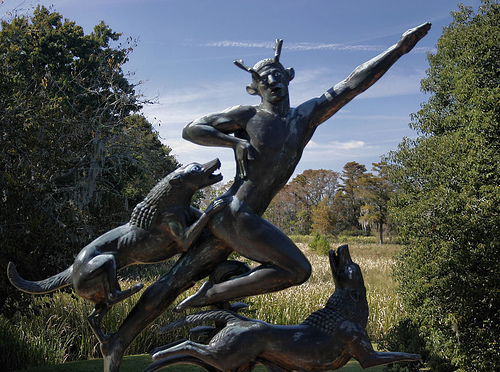
Actaeon: sculpture in Brookgreen Gardens, South Carolina
(Paul Mansh, 1924)
"Actaeon ego sum, dominum cognoscite vestrum!"
verba animo desunt: resonat latratibus aether.
Ovid, Metamorphoses, 3.230-31.
ROMAN and ETRUSCAN ART:
Slide Show: Classical Art from the Metropolitan Museum of Art

French neoclassical painting of a scene from Book I of the Iliad.
Can you identify the characters and dramatic situation?

Grrrrrr!

This controversial statue of George Washington was sculpted by the American artist Horatio Greenough. Washington is shown relinquishing his military command by holding forth his sword. The pose is based on Phidias' famous statue of Zeus at Olympia. The statue is a striking example of the way in which 19th century neoclassical artists embraced Greek models to portray American political leaders. The statue is on display in the Smithsonian.
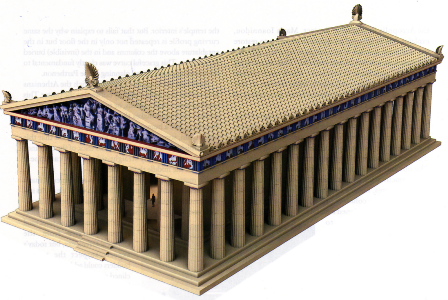
Digital reproduction of the original Parthenon


Parthenon and Erechtheum photos courtesy of Kayla Berman
|
|


