P1 The Earth in the Universe Fact Bank
What do we know about the Earth's structure, and how it changes?
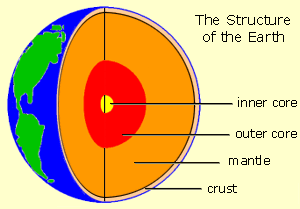
Evidence from rocks tells us about the structure of the Earth. For example, the Earth must be older than its oldest rocks. Scientists use radioactive dating to estimate rocks' ages.
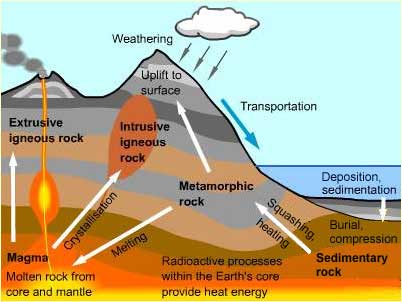
Rock processes we see today explain past changes. For example, mountains are being made all the time - if not, erosion would wear down the continents to sea level.
Wegener's
theory of continental drift (1912)
Wegener's theory states that today's continents were once joined together as
one huge continent. They have been slowly moving for millions of years.
Theory
of seafloor spreading (1960s)
Geologists detected oceanic ridges, which are lines of mountains
under the sea. They notices a symmetrical stripe pattern in rock magnetism on
each side of these ridges. They devised this explanation:
| New ocean floor is made at oceanic ridges, so oceans spread by about 10 cm a year. |
The new ocean floor is made like this:
| Hot mantle rises beneath the ridge. It melts to make magma. Magma erupts at the middle of the ridge. It cools to make new rock. The new rock is magnetized in the direction of the Earth's field at the time. |
The
theory of plate tectonics (1967 onwards)
The outer layers of the Earth is made of about 12 huge pieces of rock, called
tectonic plates. They move slowly all the time. Earthquakes,
volcanoes, and mountain building usually happen where tectonic plates meet.
In some
places at risk from earthquakes, buildings must be built to withstand earthquake
damage. Scientists cannot predict when earthquakes will strike.
What
do we know about our Solar System?
Our Solar System was formed from clouds of gases and dust in
space.
The Sun is a star at the centre of the Solar System. It will probably shine for another 5000 million years. A star is a ball of hot gases, mainly hydrogen. In stars like the Sun, hydrogen nuclei join together (fuse) to make helium nuclei. This is the source of stars' energy. Stars change over time - they have a life cycle.
Eight planets, including Earth, orbit the Sun. Pluto used to be regarded as the ninth planet in out Solar System, but in August 2006 the scientists of the International Astronomical Union voted to reclassify Pluto as a 'dwarf planet'. Some planets have natural satellites (moons) that orbit them. Comets are lumps of rock held together by ice and frozen gases.
Asteroids are lumps of rock that are much smaller than planets. Most asteroids orbit the Sun between Mars and Jupiter, but a few cross the Earth's path. There is a tiny risk that one of these asteroids will collide with Earth. If this happens, many people will die. An asteroid collision may have led to the extinction of dinosaurs 65 million years ago.
| Type of body | Diameter | Age |
| planet | Mercury = 4880 km
(smallest) |
The sSolar System was formed about 5000 million years ago. The Earth is older than its oldest rocks, which are 4000 million years old. |
| moon | Earth's Moon = 3500
km Moons are smaller than planets they orbit. |
|
| asteroid | up to 1000 km; most are much smaller. |
|
| comet | a few km | |
| Sun | 1.4 million km | 5000 million years |
| Universe | many millions of times greater than the diameter of the Solar System | 14 000 million years |
What
do we know about stars, galaxies, and the Universe?
Our Solar System is part of the Milky Way galaxy. Galaxies
contain thousands of millions of stars. The Universe is made
of thousands of millions of galaxies.
Other galaxies are moving away from us, because space is expanding. Hubble discovered that galaxies that are further away from us move faster than those that are closer to us. This is evidence that the Universe started with a 'big bang'.
We do not know what will happen to the Universe; scientists disagree about how to interpret evidence about its final fate. Maybe the Universe will continue to expand. Or perhaps the force of gravity will attract galaxies towards each other again and the Universe will end with a 'big crunch'.
Is
there life elsewhere in the Universe?
Scientists have detected planets around some stars. Life may exist on other
planets in the Universe, but there is so far no evidence for this.
How
do scientists find out about distant stars and galaxies?
Scientists can learn about other stars and galaxies only by studying the radiation
they emit. They measure the distance to stars by looking at their relative brightness
or by parallax. It is difficult to make accurate observations,
so scientists do not know exact distances between objects in space.
Light travels at 300 000 km/s. So when scientists observe distant objects they see what the object looked like when the light left the object - not what it looks like now. Scientists measure distances in space in light-years. One light-year is the distance light travels in one year.
Light pollution near cities makes it difficult to see stars, so scientists set up telescopes in areas of darkness away from cities.
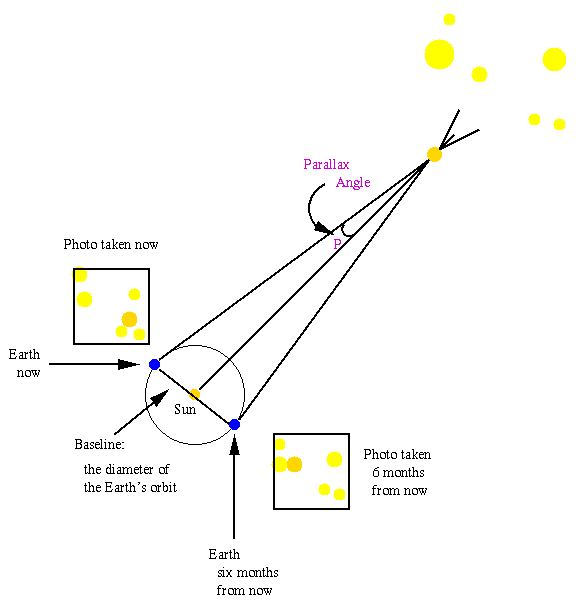
The Earth moves from one side of the Sun to the other. Nearby stars seem to move compared to the background of distant stars. The nearer a star is to Earth, the more it seems to move. This is parallax.