Some resources: http://www.chem1.com/chemed/genchem.shtml
see below
http://www.nongnu.org/fhsst/fhsstchem.pdf
Important
You will be required to review certain skills that will support your learning how to solve the problems using the learned content concepts. You will need to develop a solid mastery not only of problem solving skills but also more importantly critical thinking....
My advice devote at least 20 minutes each night to actually doing problems. This will keep your brain nimble
So let's get to work.
Important check chemistry folder for worksheets
Here is the first set of notes:
What is an electron configuration table?
An electron configuration table is a convenient way of representing how many electrons are in each energy level of an atom and how these electrons are arranged within each energy level. At first it may seem complicated, but once you understand what each part means it becomes much easier to interpret.
What does it all mean?
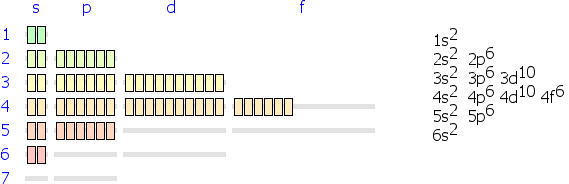
There are two ways of representing the electron configuration, the following two examples are for the element samarium;
The table shows the seven possible energy levels (the rows) that an electron can be in, it also shows the sub-shells that make up each energy level (the columns); p, s, d and f. Notice how not all energy levels have the same available sub-shells. Each coloured rectangle represents one electron (the colours are there to illustrate increasing energy only).
The table on the right is showing the same information just in a slightly different way.
The format of the table is: [energy level][subshell][number of electrons in subshell].
[energy level] From the table we can see that samarium has electrons in six energy levels.
[subshell] The sub-shell where the electrons reside, either; s,p,d or f.
[number of electrons in subshell] The s sub-shell can only hold two electrons, the p sub-shell can hold 6, the d sub-shell can hold 10 and the f sub-shell can hold up to 14. Notice that not all of the sub-shells have to be full before electrons can move to the next available energy level.
Note that either representation of the electron configuration of this atom can also be written as;
2,8,18,24,8,2 (the total number of electrons in each level)
or
1s2 2s2 2p6 3s2 3p6 3d10 4s2 4p6 4d10 4f6 5s2 5p6 6s2
where each part of the electron configuration is written out in sequence, this is usually abbreviated to;
[Xe] 4f6 6s2
This means that the electron configuration is the same as that of xenon but with six extra electrons in the f sub-shell of the 4th energy level (4f6) and 2 extra electrons in the s sub-shell of the 6th energy level (6s2).
IMPORTANT
This may not seem like a chemistry lab but it is. It is a graphing lab, somethng that you will need for AP Chem and College.
LAB 1: GRAPHING
For each research project described below, draw the appropriate graph (line vs. bar), label all axes, create a title, and answer the questions.
1. A study was conducted on the feeding preferences of slugs. Specimens were fed a variety of food sources and data were collected on number of grams of each type of food eaten.
Construct the appropriate type of graph and make a conclusion on food
preference.
Food Source Food Eaten (grams)
lettuce 4.0
mushroom 8.2
dog food 0.0
spinach 6.5
apple 8.6
peach 5.4
orange 1.0
a. What type of graph will you use? _____________________________________________
b. What is the dependent variable? _____________________________________________
c. What is the independent variable? ____________________________________________
d. Which food source was favored by slugs the most, and how do you know that?
____________________________________________________________________
____________________________________________________________________
e. Give your graph a title.
f. Why was this graph drawn as a bar graph? ____________________________________
____________________________________________________________________
___________________________________________________________________________
___________________________________________________________________________
2. Baby chickens require a constant source of food. As chickens grow, more energy is needed for daily activities. The following table gives the grams of food eaten by a chick over a 5-day period. Construct the appropriate type of graph and predict the amount of food that would have been eaten by the chick on the 3rd and 6th day.
Number of Days Food Eaten (grams)
0 0.0
1 1.0
2 3.5
3 ??
4 8.5
5 11.0
6 ??
7 16.5
NOTE: You must use the GRAPH — not any calculations — to determine the missing data.
a. What type of graph will you use? _____________________________________________
b. What is the dependent variable? _____________________________________________
c. What is the independent variable? ____________________________________________
d. Complete the data table above for Day 6 and Day 7.
e. Give your graph a title.
f. Why was this graph drawn as a line graph? ____________________________________
___________________________________________________________________________
___________________________________________________________________________
___________________________________________________________________________
___________________________________________________________________________
Reactions of Lithium
Reactions with water
Lithium metals reacts slowly with water to form a colourless solution of lithium hydroxide (LiOH) and hydrogen gas, H2. The resulting solution is basic because of the dissolved hydroxide. The reaction is exothermic, but the reaction is slower than that of sodium.
2Li(s) + H2O2LiOH(aq) + H2(g)
Reactions with air
When lithium is burned in air, the main product is the white oxide lithium oxide, Li2O. Some lithium peroxide, Li2O2, also white, is also produced.
4Li(s) + O2(g)2Li2O(s)
2Li(s) + O2(g)2Li2O2(s)
Lithium reacts with nitrogen, N2, to form lithium nitride, Li3N. No other Gruop 1 element does anything similar, but the group 2 metal magnesium forms a similar nitride.
6Li(s) + N2(g)2Li3N(s)
Reactions with halogens
Lithium metal reacts vigorously with all the halogens to form lithium halides.
2Li(s) + F2(g)LiF(s)
2Li(s) + Cl2(g)LiCl(s)
2Li(s) + Br2(g)LiBr(s)
2Li(s) + I2(g)LiI(s)
Reactions with acids
Lithium metal dissolves readily in dilute sulphuric acid to form solutions containing the aquated Li(I) ion together with hydrogen gas, H2.
2Li(s) + H2SO4(aq)2Li+(aq) + SO42-(aq) + H2(g)
Reactions with bases
Lithium metals reacts slowly with water to form a colourless solution of basic lithium hydroxide (LiOH) and hydrogen gas (H2). The reaction continues even when the solution becomes basic. The resulting solution is basic because of the dissolved hydroxide. The reaction is exothermic, but the reaction is slower than that of sodium. As the reaction continues, the concentration of the hydroxide increases.
2Li(s) + 2H2O2LiOH(aq) + H2(g)
Reduction Potentials
Balanced half-reaction E0 / V
Li+ + e-Li(s)
Okay here is how you can identify strong acids and based:
Here are some very simple guidelines to classify compounds as strong or weak acids and bases. But they're just that: guidelines. Apply them with caution and as always, common sense and experimental evidence prevails.
There are very few strong acids in aqueous solution. In fact, only the following six are common: hydrochloric acid HCl
hydrobromic acid HBr
hydroiodic acid HI
sulfuric acid H2SO4
nitric acid HNO3
perchloric acid HClO4
If the compound is an acid, and it is not on this list, you are usually safe in assuming it's a weak acid in water. (Your example, CH4, is a covalent compound. It would have negligible acidity in water.)
Strong bases are also very rare. The most common strong bases are the alkali metal hydroxides and the alkaline earth metal hydroxides (except Be(OH)2). If you have a base that is not one of these in water, you can tentatively assume that it's a weak base.
3 in 1
acid n base
Name those chemicals
Some textbook authors describe chemistry as the science of matter and change.
Many students find the changes more interesting than the matter but in order to understand the changes we need to know something about the substances as they are at the "beginning" and as they are at the "end".
Matter is something that occupies space and has mass. That's a basic definition from some elementary science course in your past. Chemists go a little further and subdivide matter into two categories: pure substances and mixtures.
Pure substances may be either elements (all atoms alike) or compounds (different atoms combined in molecules of definite proportions and inseparable by physical means).
Pure or Mix
Mixtures contain at least two pure substances and can--at least in theory--be separated by physical means. Mixtures of the same substances will not necessarily contain the same proportions of those substances.
Elements and compounds have constant properties which can be described as both physical and chemical. Most of the substances we will work with and study during the course are compounds.
Compounds vary a lot. Even compounds containing the same elements like water (H2O) and hydrogen peroxide (H2O2) have very different chemical and physical properties. So it can't be just the kinds of elements present in compounds that determines their properties.
Compounds can be roughly divided into two very large categories based on the way the elements are put together in them.
Ionic compounds are composed of positive and negative ions (atoms with extra or fewer electrons than their neutral counterparts). In such compounds the total charge of the positive and negative ions always adds up to zero. The attractions of the opposite charges holds the compounds together.
Molecular compounds are composed of neutral atoms which are held together by sharing some of their electrons in common. No separate charges are involved.
How can you distinguish one kind of compound from the other?
In general ionic compounds are composed of metals and non-metals. Molecular compounds typically consist of only non-metals. In water solutions ionic compounds are electrolytes. Molecular compounds generally are not.
For example, magnesium chloride, MgCl2, contains one metal (magnesium) and one non-metal (chlorine). It is ionic. Nitrogen dioxide, NO2, contains only non-metals so it is molecular.
You will notice these compounds are named a little differently. The rules of chemical nomenclature begin simply enough but eventually become pretty messy. Our goal here is to keep things simple. The basic "bottom line" rules are:
in ionic compounds metals always come first and numerical prefixes are never used to indicate the number of a type of atom in the formula
in molecular compounds numerical prefixes must be used to indicate the number of a type of atom in the formula
Finally, the nomenclature of acids is more complicated than is worth learning in an introductory course. So rather than struggle with a lot of rules you will never use, learn these five common acids (also listed in your study guide):
hydrochloric acid HCl
nitric acid HNO3
sulfuric acid H2SO4
phosphoric acid H3PO4
acetic acid CH3COOH
|
|

