PHILOSOPHY FINAL EXAM: Scroll down to the bottom of the page and click the Survey link labeled "Philosophy FINAL EXAM." The password is "sophie". Your response is due by the end of the marking period (March 27th.) After you have completed the exam, return your copy of the novel to Mrs. Dorfman.
FOR A BRIEF REVIEW OF THE PHILOSOPHIES COVERED IN THE NOVEL, CLICK HERE: review
Anaximander believed our world was one of many in the boundless. Many modern-day scientists share this belief.
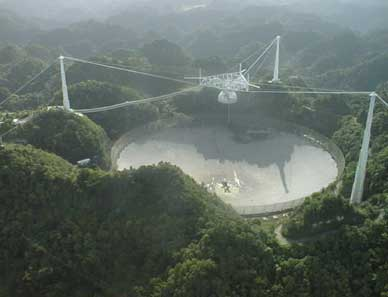
The Search for Extraterrestrial Intelligence, or SETI project, began in 1959, when Cornell physicists Giuseppi Cocconi and Philip Morrison published an article in Nature suggesting the use of microwave radio to communicate between the stars. Since then, the information streaming in from giant radio antennae pointed at the skies has been pored over for evidence of communication from extraterrestrials. This photo shows the world's largest radio telescope, at the Arecibo Observatory in Puerto Rico.
Spacecraft from Earth have been sent into space in hopes of possibly reaching extraterrestrial life.
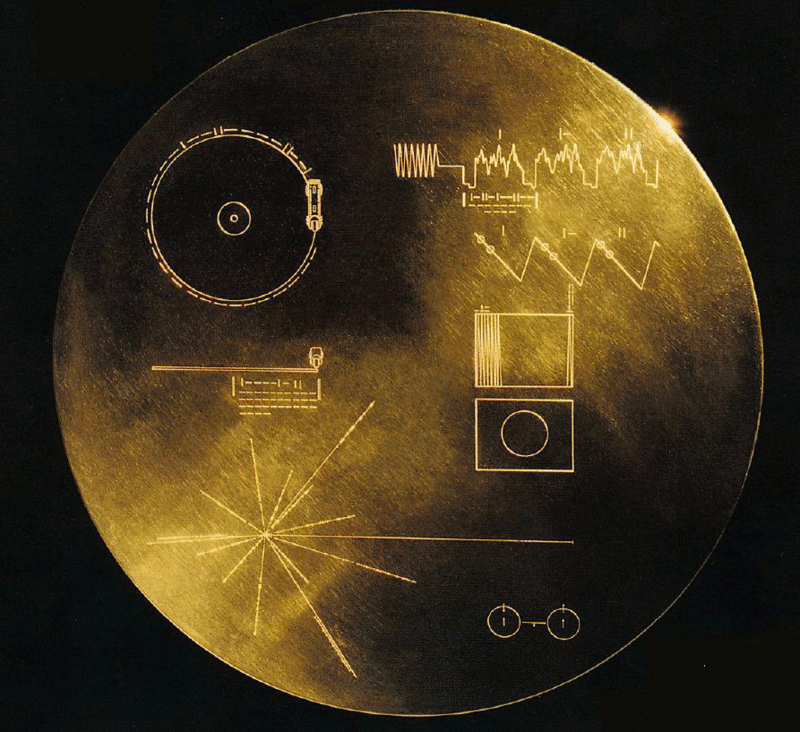
Pioneer 10 was Earth's first emissary into space, carrying a gold plaque that describes what we look like, where we are, and the date when the mission began, 1972. Pioneer 10 will continue to coast silently as a ghost ship into interstellar space, heading generally for the red star Aldebaran, in the constellation Taurus (The Bull). Aldebaran is about 68 light- years away. It will take Pioneer 10 more than two million years to reach it. Its sister ship, Pioneer 11, ended its mission September 30, 1995, when the last transmission from the spacecraft was received.
The Voyager 1 spacecraft was launched in 1977. As of November 28, 2008, Voyager 1 is about 10.06 billion miles from the Sun, and has entered the heliosheath, the region between the solar system and interstellar space, a vast area where the Sun's influence gives way to the other bodies in the galaxy, with the current goal of reaching and studying the heliopause, which is the known boundary of our stellar system. If Voyager 1 is still functioning when it finally completes the passage through the heliopause (effectively becoming the first human-made object to leave our star system), scientists will get their first direct measurements of the conditions in the interstellar medium, which may provide clues relevant to the origin and overall nature of the Universe. At this distance, signals from Voyager 1 take more than fourteen hours to reach its control center at the Jet Propulsion Laboratory, a joint project of NASA and Caltech in La Cañada Flintridge, California. Voyager 1 has achieved escape velocity, meaning that its orbit will not return to the inner solar system.
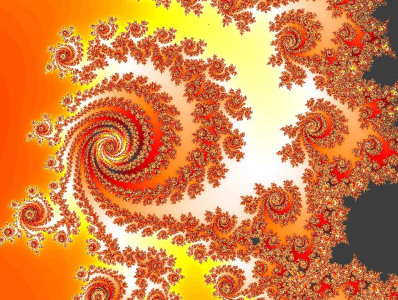
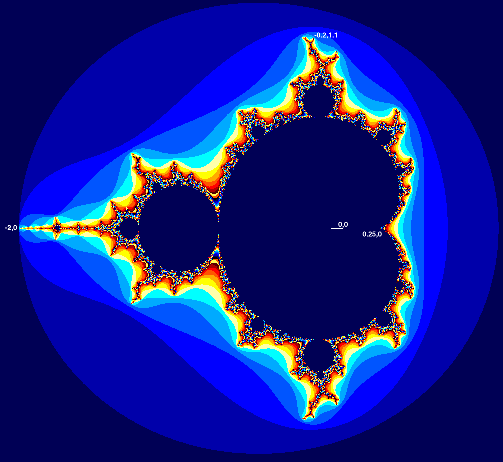
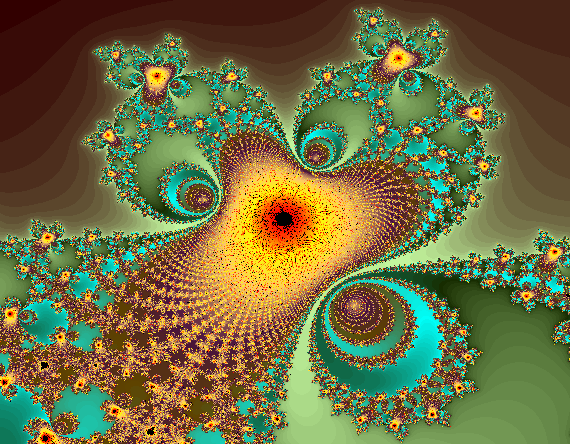
Anaxagoras believed everything was made up of infinitesimal particles but that each particle contained the parts of everything in nature. This made us think of DNA, and also fractals. Approximate fractals are easily found in nature. These objects have self-similar structure. Examples include clouds, snow flakes, crystals, mountain ranges, lightning, river networks, cauliflower or broccoli, and systems of blood vessels and pulmonary vessels. Coastlines may be loosely considered fractal in nature. Trees and ferns are fractal in nature and can be modeled on a computer by using a recursive algorithm. This recursive nature is obvious in these examples—a branch from a tree or a frond from a fern is a miniature replica of the whole: not identical, but similar in nature. The connection between fractals and leaves are currently being used to determine how much carbon is contained in trees. This connection is hoped to help determine and solve the environmental issue of carbon emission and control.
The following pictures are mathematically generated fractal images
CHAPTER FOUR:
The Natural Philsophers
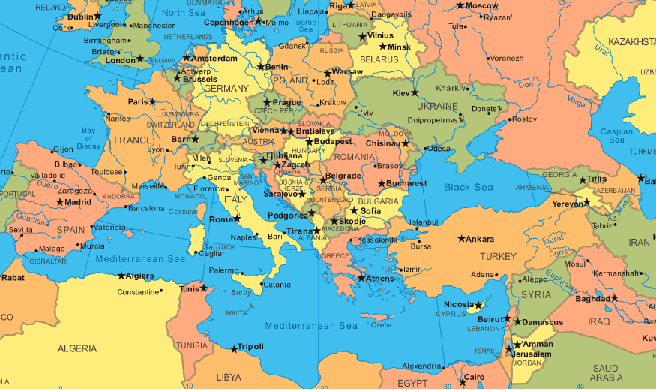
Here is a map of present-day Europe to help you get oriented.
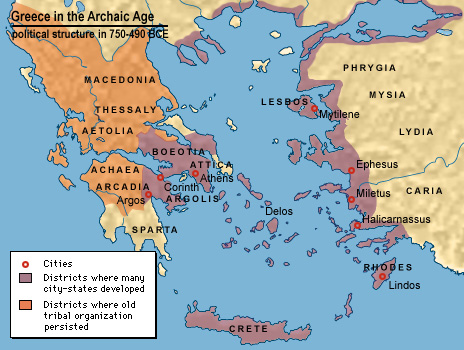
Here is a map of ancient Greece. You will find Miletus on the western coast of what is modern-day Turkey.
Sophie's mysterious philosophy teacher points out that it is important when assessing each philosopher to understand what his project was—what questions he was attempting to answer. The ancient Greeks believed the world was eternal, and so they did not ask about where it came from but rather were interested in what things were made from and how they change. The natural philosophers believed that there was one substance that all things were made of. Three philosophers from Miletus were:
Thales thought everything came from water. He also said, "all things are full of gods."
Anaximander thought that our world was only one of many worlds that evolve and dissolve in the boundless.
Anaximenes thought the source of all things was vapor or air. He thought water was condensed air, and that earth was compressed water.
Another group of philosophers from Elea in Southern Italy were concerned with the project of change. TheEleatics were:
Parmenides believed that nothing actually changed, and he held to his reason despite the evidence of his senses, making him the first rationalist.
Heraclitus believed in his senses and felt that nothing stayed the same. Everything changes. All things are in a state of flow. But there is one thing that does not change--a universal reason or law that guides everything in nature. In place of the term "God" Heraclitus used the word "logos," or reason for this guiding force.
Empedocles suggested that there were four basic substances which he termed natures "roots": fire, earth, air, and water. All changes are the result of intermingling of the four. He also makes a distinction between "substance" and "force", something that scientists still do today. Empedocles called the forces "love" and "strife".
Anaxagoras, from Athens, believed nature was made up of infinitesimal particles but that each one contained part of everything. He called these particles "seeds". He imagined that "order" was a force holding things together. He called this force mind or intelligence. He was the first philosopher in Athens, though he wasn't born there. He got in trouble for his radical ideas, among them that the sun was not a god but instead a hot stone in the sky, and was forced to leave Athens.
Sophie thinks about all of this and concludes that one cannot learn philosophy; one can only learn how to think like a philosopher.
When Tarak McLain’s kindergarten class celebrated their 100th day of school, some kids brought 100 nuts or cotton balls. Tarak brought a list of 100 things he believes. Now a first-grader, Tarak shares his top beliefs about God, life, nature, and war.
Thirty Things I Believe
As heard on NPR's Weekend Edition Sunday, January 18, 2009.
I believe life is good.
I believe God is in everything.
I believe we’re all equal.
I believe we can help people.
I believe everyone is weird in their own way.
I believe hate is a cause for love.
I believe that when I meditate I feel peaceful.
I believe we should be generous.
I believe brothers and sisters should be kind to each other.
I believe kids should respect their parents.
I believe I should not whine.
I believe people should wake up early.
I believe people should go outside more.
I believe in nature.
I believe people should use less trees.
I believe we should help the Arctic and rainforest animals.
I believe people shouldn’t throw litter on the ground.
I believe people should not smoke.
I believe God is in good and bad.
I believe in magic.
I believe people should not give up.
I believe love is everywhere.
I believe that God helps us to have a good time.
I believe we live best in a community.
I believe we can protect people in danger.
I believe we should help the poor.
I believe it's okay to die but not to kill.
I believe war should not have started.
I believe war should stop.
I believe we can make peace.
Seven-year-old Tarak McLain was born in Thailand and lives with his family in Austin, Texas. He collects and hands out food to the homeless, raises money for orphans and impoverished schools, reads about the world's religions, and listens to public radio.
Click the links below to read and hear Tarak's and other people's essays.
 CHAPTER TWO:
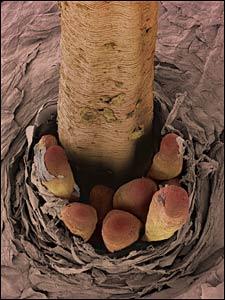
Worlds Within Worlds: What are we to the universe? Infinitesimal. Yet we are a world ourselves: some of our personal inhabitants include eyelash mites (photo by Stephen Gschmeissner). This image shows the rear end of the tiny mites feeding on the dead skin cells of an eyelash hair follicle.
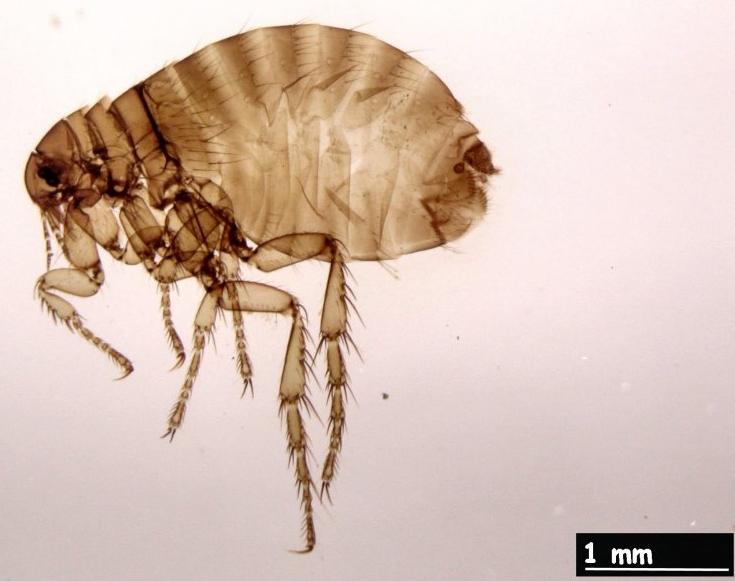
Sometimes we have the misfortune to become home to a flea.
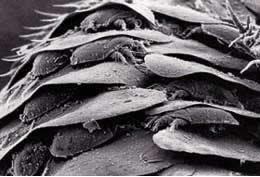
Small as they are, fleas themselves are home to still smaller creatures: here minute insects are tucked under the armoured plates of the flea.
CHAPTER ONE:
In the beginning God created the heaven and the earth.
And the earth was without form, and void; and darkness was upon the face of the deep. And the Spirit of God moved upon the face of the waters.
And God said, Let there be light: and there was light.
--The Bible, King James version
Genesis takes its name from the first Hebrew word in the Bible, which translates as "In the beginning" or "to begin with". It answers the fundamental questions of "where did we come from?", and "why are we here?". It sets the groundwork for answering questions about life and death, sin and redemption, good and evil, and the future.
Genesis 3:1-24 (New International Version)
The Fall of Man
Now the serpent was more crafty than any of the wild animals the Lord God had made. He said to the woman, "Did God really say, 'You must not eat from any tree in the garden'?"
The woman said to the serpent, "We may eat fruit from the trees in the garden, but God did say, 'You must not eat fruit from the tree that is in the middle of the garden, and you must not touch it, or you will die.' "
"You will not surely die," the serpent said to the woman. "For God knows that when you eat of it your eyes will be opened, and you will be like God, knowing good and evil."
When the woman saw that the fruit of the tree was good for food and pleasing to the eye, and also desirable for gaining wisdom, she took some and ate it. She also gave some to her husband, who was with her, and he ate it.
The Garden of Eden is a metaphor for that innocence that is innocent of time, innocent of opposites, and that is the prime center out of which consciousness then becomes aware of the changes.
Campbell, Joseph (with Bill Moyers); 1988. The Power of Myth. New York: Doubleday.
|
|

