The Chocolate Journey
Imagine this scene. A servant brings a cup of a new precious liquid into the room where the Spanish nobles are sitting. One of the noble lifts the cup to his lips. So began the passion fro chocolate that gripped Spain in the 1500s and later spread throughout Europe.
An Early American Favourite
Chocolate had long been a favourite drink in the Americas. Cacao trees originally grew in the river valleys of South America. In the seventh century, the Maya carried the trees and their seeds, cocoa beans, north into Mexico. The beans became so popular, they were used as money.
In 1502, Columbus made his fourth voyage to the Americas. He was the first explorer to take cocoa back to Spain. In 1519, a man who had sailed with the explorer and conqueror of Mexico, Hernán Cortés, tasted chocolate. Cortés’s man saw Montezuma drink chocolate. The drink was served in golden cups, the explorer wrote. When he returned to Europe, Cortés’s man told many people about this wonderful new drink.
The Columbian Exchange
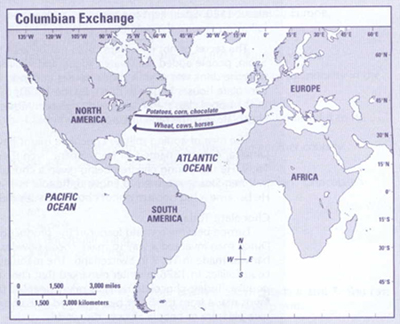
The drink Cortés’s man tried was not the cocoa we know. It had no sugar or milk. Instead, it was made with cocoa, red pepper, vanilla, and water. Even so, cocoa made its way back to Europe. The movement of chocolate is part of the Columbian Exchange, which was named after Columbus. The Columbian Exchange was a network of trade Columbus began that linked the Americas and Europe. It developed as a result of the explorations of Columbus and many other explorers.
From the beginning of his journeys, Columbus took items he found in the Americas back to Europe. He loaded tomatoes, sweet potatoes, and pumpkins onto his ships. He carried squash and beans and tobacco and chocolate. When he returned to the Americas, Columbus brought horses, cows, and pigs from Europe. He also brought wheat barley and sugar cane to the Americas.
The Columbian Exchange changed the world. The foods travelers found on their explorations began to be grown in Europe. The “new” foods spread to West Africa and China. Corn, potatoes and beans became important foods for people all over the world. The discoveries of new food sources probably contributed to the global rise in population that began about then.
Chocolate’s Popularity Grows
Once chocolate arrived in Europe, the people there began trying new things. They added sugar, cinnamon, cloves, and vanilla to the cocoa. The first factories to turn the beans into paste opened in Spain about 1580. Spain kept the secret for years. The drink had a great following among the nobility.
The secret of hot chocolate could not be kept for long. Outside Spain, people added only water, sugar, and vanilla to their cocoa. At first, the drink was sold in coffee houses in London. Then fancy chocolate houses began to open. By the 1600s, the drink was a favourite of the upper class in France and England. Within a few decades, hot chocolate was the rage of Europe.
The idea of adding milk might have come from Jamaica. A doctor named Sir Hans Sloane lived there from 1687 to 1689. He saw young children being given a chocolate drink with milk in it. When Sloane returned to England, he told everyone about the drink. He became a big booster of hot chocolate with milk.
Chocolate Today
Europe became a world leader in the production of chocolate. A Dutch man invented a way to make cocoa powder. The first chocolate bar was made in 1819 in Switzerland. The manufacturer was Francois-Louis Cailler. In 1878, a writer remarked that chocolate was very popular. Today, chocolate remains many people’s favourite. The many foods made from the bitter beans carried to Europe by Columbus still give pleasure to people all over the world.
|
|
