Welcome everyone!
In this class you will learn to talk about past situations by reading some summarised plays of the famous writer William Shakespeare.
As the main learning objective:
You will narrate in written language past situations that happended or were happening at certain
moment in the past.
You will learn how to use the verb conjugation of the verbs into past sentences.
You will learn how to conjugate verbs in the infinitive/present form, past and past participle form.
Why Narrative is important when learning English?
Narrative writing is very important in your day-to-day life. For the rest of your life,you will write texts, e-mails, cover letters, blogs, etc. about your beliefs, your ambitions, information you know, and feelings you have. What could be more important?
Narrative writing in fiction and non-fiction (and even poetry) tells others the stories of our personal experiences and allows us to gain empathy and sympathy about the world around us.
Also because it:
° fosters creativity
Beginning in kindergarten, the State Standards ask students to use a mix of drawing, dictating and writing to tell a story about an event or set of events they experienced and how they felt about it. As students proceed through elementary school, they should begin to use dialogue, descriptive details and other techniques to make their stories more interesting and engaging. Children must learn to use their imaginations to think outside of the box and craft unique and exciting stories.
° improves reading
In elementary school, students read mainly narrative books and texts, whether they're non-fiction accounts of historical events or fictional chapter books. Studying how to write in the narrative style improves a student's ability to read and understand narrative texts, which means he or she will gain improved reading skills.
°develops a better understanding of language
Narrative writing uses language in a completely different way than opinion or informative writing. Language devices, like onomatopo?eias, alliteration and hyperbole, make connecting words and crafting phrases fun and interesting, and they provide new ways to add details or change sentence structure. Plus, they'll prepare students for reading literature and other texts that take liberties with the English language, like Shakespearean plays and poetry.
° appears in other styles
Writing styles are not mutually exclusive. In other words, an informative or opinion piece may have narrative elements within it to make the story more interesting or relatable to readers. For instance, a Pulitzer-prize winning journalist may incorporate an emotionally charged narrative to make his or her news story compelling and interesting. As students move through grade school and begin to focus more on informative and argument writing, they should be able to incorporate some of their story-telling abilities. An informative paper full of a list of facts and statistics is much more engaging when the writer is able to relate that information in a narrative way.
In order to achieve this activity you will have to:
1. watch a video to know the biography of William Shakespeare: http://www.biography.com/people/william-shakespeare-9480323
This video will tell you more about Shakespeare's life so that you can analize some important asoects in his life. For example, among other aspects, his education. It is likely that he began his education at the age of six or seven.
As his father was a bailiff, young William probably attended the local grammar school. Its curriculum emphasised Greek classics and pupils also learned plays in Latin. Religious education was also important, and Shakespeare drew on these sources in his later work with classical and religious allusions. Shakespeare probably attended school until about age 15. There is no record of him going to university.
2. watch a video to see the importance of William Shakespeare as a great influence for the English Language: https://www.youtube.com/watch?v=BrRnOHHth2E
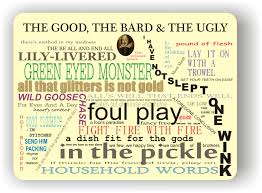
This is important because you will realize that during his 52 years on earth, he enriched the English language in ways so profound it’s almost impossible to fully gauge his impact. Without him, our vocabulary would be just too different. He gave us uniquely vivid ways in which to express hope and despair, sorrow and rage, love and lust. Even if you’ve never read one of his sonnets or seen a play – even if you’ve never so much as watched a movie adaptation – you’re likely to have quoted him unwittingly. It’s almost impossible to avoid.
Some famous phrases are:
If you’ve ever been ‘in a pickle’, waited ‘with bated breath’, or gone on ‘a wild goose chase’, you’ve been quoting from The Tempest, The Merchant of Venice and Romeo and Juliet respectively.
Next time you refer to jealousy as "the green-eyed monster," know that you’re quoting Othello’s arch villain, Iago. (Shakespeare was almost self-quoting here, having first touched on green as the colour of envy in The Merchant of Venice, where Portia alludes to “green-eyed jealousy.”)
3. read the first two summarised acts from the play Hamlet: http://www.sparknotes.com/shakespeare/hamlet/
Hamlet is a great play because "Hamlet" is a classic revenge play. Hamlet believes he must avenge his father's murder at the hands of his uncle.
But Shakespeare took the play in vastly different directions than a typical revenge story, asking profound questions about what it means to be a human being.
"The act of revenge seems to be beside the point," Goeglein said. "His intelligence makes him see every side of a question. He is the quintessential thinking person."
And he's asking the big questions: What is death? Truth? Does it matter? How do we make our way in the world knowing we are going to die?
"He elevated it to a philosophical, sociological, moral examination of humanity that's the foundation of western drama," Fernandez said. "What he touches is God. I think in this amazing burst of creativity, Shakespeare saw God."
The poetry in "Hamlet" is stunning and profound. So true and real that we all quote from it.
"To be or not to be," the opening line of the most famous monologue in literature, is so well known it's become a cliché. But isn't it the ultimate question about existence?}
4. print the two acts and underline the verbs you find. Then, conjugate and rewrite the verbs into the past tense as in previous activities. You can use your verb list of use a dictionary online such as Word Reference.
5. summarise both acts even more. Write between 5 to 8 short sentences narrating acts 1 and 2 but now as past situations.
6. use a presentation in Google Drive to write your sentences in a paragraph. Add some connectors and some illustrations to represent your summary.
7. share your file with your teacher.
8. Answer the three activities for this class and the quiz:
a) the clozeabaout Hamlet acts I and II
b) the challenge board about Hamlet's full summary.
c) the summarythat you have to order about Hamlet's summary
d) the quiz about verb conjugation
References:
TheCatastropherChynna (2011). William Shakespear Biograhy [Video]. Disponible en https://www.youtube.com/watch?v=kOHM7DhqTpE&feature=youtube_gdata_player .Consultado el 25/04/17.
Texas Performing Arts (2014). Shakespeare Inglience on the English Language [Video]. Disponible en https://www.youtube.com/watch?v=BrRnOHHth2E . Consltado el 25/04/17.
VideoSparkNotes (2010). Shakespeare’s Hamlet summary [Video]. Disponible en https://www.youtube.com/watch?v=t0CqUTmwKiM . Consultado el 25/04/17.
Shreman, Aaron. (2015). Digital Storytelling. Recuperado de www.storyboardthat.com . Consultado el 26/04/17.
Sparknotes. (2015). No fear Shakespeare. Recuperado de www.sparknotes.com/romeojuliet/ .Consultado el 26/04/17.
|
|


