QUESTION-ANSWER RELATIONSHIPS
 Question-Answer Relationships (QARs) will help in your ability to answer comprehension questions by giving you a systematic means for analyzing the task of different types of questions.
While you are reading a story or an article or while you answering questions based on a story or an article, it is important to remember that there are four basic ways to answer questions. The four ways are:

- Right There: The answer is in the text, usually easy to find. The words used to make up the question and the words used to answer the question are Right There in the same sentence.

- Think and Search: The answer is in the story, but you need to put together different story parts to find it. Words for the question and words for the answer are not found in the same sentence. They come from different parts of the text.

- Author and You: The answer is not in the story. You need to think about what you already know, what the author tells you in the text, and how it fits together.

- On My Own: The answer is not in the story. You can even answer the question without reading the story. You need to use your own experience.
Learning the Strategy
Raphael (1982, 1984, 1986) developed this strategy and recommends a four tiered approach to teaching and learning the strategy:
- give immediate feedback
- progress from shorter to longer texts
- begin with questions for which the task demand is more straightforward and go on to questions that require the use of multiple sources
- develop independence by beginning with group learning experiences and progressing to individual and independent activities.
Raphael suggests a week of intensive training followed by maintenance activities.
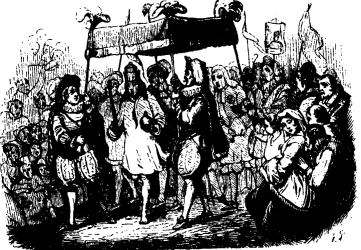 What follows are a series of sample lessons that could be used to teach the Question-Answer Relationships strategy. Lessons One, Two, and Three use Hans Christian Anderson's stories, The Emperor's New Clothes and The Little Match Girl. The fourth lesson uses a selection from the MacMillan/McGraw-Hill basal - Beat the Story Drum. To also demonstrate how technology can assist in this progress, the first lesson will appear on this page; subsequent lessons will appear in the form of quizzes designed in Quia. Attached to some of the lessons are files that you can use as student handouts. The files are in a basic text format so that you can open and edit them in any word processor.
You can download the complete text to both stories:
Lesson One
Teacher's Introduction
There are three stages to the first lesson.
- First Stage: Give students short passages with questions, answers, and the QAR type.
- Second Stage: Give students short passages with questions and answers but have them determine the QAR type.
- Third Stage: Give students short passages with questions but have them determine the answers and QAR type.
This first lesson is intented to introduce students to the task demands of different questions and to provide some initial practice at identifying task demands in conjunction with answering questions. It is recommended that have students work in cooperative groups for this activity.
Student Lesson
There are multiple ways to access the student materials for this first lesson.
- You can download the Student's Lesson One.
- You can use the activities created with Quia:
Lesson Two
Teacher's Introdution
The purpose of the second lesson is to provide students with longer passages, review, and guided practice. It is recommended that the teacher begin with a longer practice with 5 - 6 questions; use this passage as a review. Then provide some guided pratice with similar length and similar number of questions.
Student Lesson
There are multiple ways to access the student materials for this second lesson.
- You can download the
Student's Lesson Two
- You can use the activities created with Quia:
Lesson 3
Teacher's Introduction
In the third lesson, students should apply the strategy to complete passages or short stories. It is suggested that the passage should be divided into at least four sections with two questions of each type. The first section should be done in conjunction with a review of the strategy.
Student Lesson
There are multiple ways to access the student materials for this second lesson.
- You can download the Student's Lesson Three
- You can use the activities created with Quia:
Lesson 4
Teacher's Introduction
At this point the teacher should turn to material that is found in the student's normal reading series (basal or literature). In addition, the strategy should be used with social studies and science content as well.
Maintaining QARs
To maintain the use of QARs, it is recommended that a weekly review lesson should be designed to reinforce the strategy.
|
