| A | B |
|---|
| What is the definition of a biological community? | All the different species of organisms that live and interact in a certain area. |
| A symbiotic relationship between two species in which one benefits at the expense of the other is called ____. | parasitism |
| A symbiotic relationship between two species in which one benefits while the other neither benefits nor is harmed is called ____. | commensalism |
| A symbiotic relationship between two species in which both benefit is called ___. | mutualism |
| Mutualism, parasitism and commensalism are all types of ____ relationships. | symbiotic |
| ______ occurs when different species compete for a particular resource that is in short supply. | interspecific competition (competition between members of the same species would be called intraspecific competition) |
| The sum total of a species' use of the biotic and abiotic resources in its environment is called the species' _____. | ecological niche |
| "Habitat" is to "address" as "niche" is to ____. | profession |
| Two species cannot coexist in a community if their ____ are identical. | niches |
| _____ is an interspecific interaction in which one species kills and eats the other species. | Predation |
The tree frog in the picture below is demonstrating ______ coloration (a.k.a. camouflage), 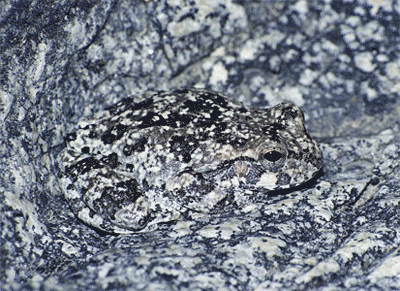 | cryptic coloration, |
Animals that are poisonous (like this frog) often display bright warning colors known as ______ coloration.,  | aposematic coloration, |
| In ______ mimicry, a tasty harmless organism evolves to look like an unpalatable (yucky), poisonous, or dangerous organism. | Batesian mimicry (like the hawkmouth larva that has evolved to look like a snake which gives it an evolutionary advantage for survival), 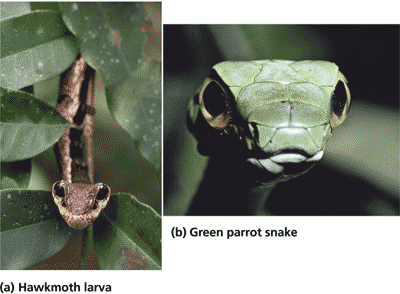 |
| In _____ mimicry, two harmful species evolve to look more like each other, ensuring a greater survival rate as it becomes easier for predators to remember to avoid them. | Mullerian mimicry (like the bee and the yellow jacket in the picture below), 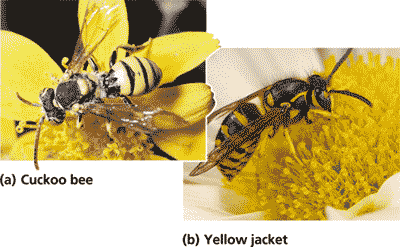 |
| The type of predation in which an animal eats an autotroph is called _____. | herbivory |
| The organism from which a parasite derives its nourishment is called the ____. | host |
| A disease-causing agent is called a(n) ____. | pathogen |
| An evolutionary change in one species which then acts as a selective force on another species, whose adaptations in turn act as a selective force on the first species, is an example of _____. | coevolution (Think of prey that adapt to fast predators by becoming faster. In turn, only the fastest predators can catch enough prey to survive and reproduce, so the predators become faster, necessitating the evolution of even faster prey, and so on, back and forth) |
The picture below represents a(n) ____.,  | food chain,  |
The picture below represents a(n) ____.,  | food web, |
| The first (or bottom) level of a food chain is made up of the ____. | primary producers,  |
| The second level of a food chain is made up of the ____. | primary consumers, |
| The primary consumers in a terrestrial ecosystem are called ____. | herbivores, |
| The primary consumers in an aquatic ecosystem are usually ____. | zooplankton, |
| The primary producers in an aquatic ecosystem is mostly made up of ____. | phytoplankton (in shallow waters, there may also be some attached plants and algae. Plankton, by definition, are free-floating), |
| Most food chains consist of no more than ____ trophic levels. | five |
| A _____ species is a species whose removal would cause a large effect on community structure. | keystone species (keystone species are usually low in abundance but play a pivotal ecological role in the community) |
| _____ species are species, generally introduced into a community by humans, that often times out compete native species because they lack their own native predators and diseases in their new habitat. | Invasive species |
| The total mass of a population is called the population's _____. | biomass (total dry mass = normal mass minus water mass) |
| What has the greatest impact on biological communities worldwide? | Humans |
| The orderly and predictable appearance and replacement of species as a community grows back after a disturbance is called _______. | ecological succession,  |
The type of succession taking place in the picture below is _______.,  | primary succession (You are starting from scratch in this type of succession because you don't even have organic soil for life to colonize. Another example where primary succession would have to occur would be after a glacier retreats, leaving just rubble), |
The type of succession taking place in the picture below is _______.,  | secondary succession (After a forest fire, there is still very rich organic soil and probably some trees and seeds that survived. Another example where secondary succession occurs is on abandoned farmland), |
| The elaborate, interconnected feeding relationships in an ecosystem. | food web |
| The number AND relative abundance of species in a biological community. | species diversity |
| A type of ecological succession that occurs in a virtually lifeless area, where there were originally no organisms and where soil has not yet formed. | primary succession |



