| A | B |
|---|
| The movement of water molecules across a cell membrane is called ___. | osmosis |
| In a salt water solution, the salt is known as the ___. | solute |
| If a cell membrane allows glucose to pass through it, then the cell membrane is said to be ____ to glucose. | permeable, 
|
| In a salt water solution, the water is known as the ____. | solvent |
| The movement of particles across a cell membrane from areas of high concentration to areas of low concentration is known as ____. | diffusion,  |
| The cell membrane is said to be _______ permeable to substances because it lets some pass through but not others. | selectively |
| The type of substances that can most easily diffuse across a cell membrane are ____ substances. | small non-polar substances |
| The composition of nearly all cell membranes is a double-layered sheet called a __________ | lipid bilayer |
| Larger molecules and charged particles usually pass through _____ to get into cells. | protein channels |
| Cells will shrink if placed into a _____ solution. | hypertonic |
| When energy is needed to force molecules across a cell membrane, _______ is taking place. | active transport,  |
| Cells will grow bigger if placed in a ____ solution. | hypotonic |
| When osmotic pressure increases in plant cells, why don't the cells usually burst?,
| Plant cells have a tough cell wall that keeps the cell from expanding enough to burst. |
| If a solution is 6% solutes, it will be ____ % water. | 94 |
| If a solution is 90% water, it will have ___ % solutes. | 10 |
| A solution that has the same concentration of solutes as the interior of a cell is known to be ____. | isotonic |
| Active transport requires _____. | energy |
| If a substance is diffusing across a cell membrane, it is going from an area of ____ concentration to an area of ___ concentration. | high, low |
| When osmotic pressure decreases in a plant, the ______ shrinks and the plant ____.,
| central vacuole, wilts |
| When osmotic pressure increases in plants, the ______ gets bigger and the plant ___. | central vacuole, gets turgid (stiff) |
| The type of cell membrane protein that allows larger molecules and ions to pass through by facilitated diffusion is called a ____. | channel protein |
The process pictured below is called ____., 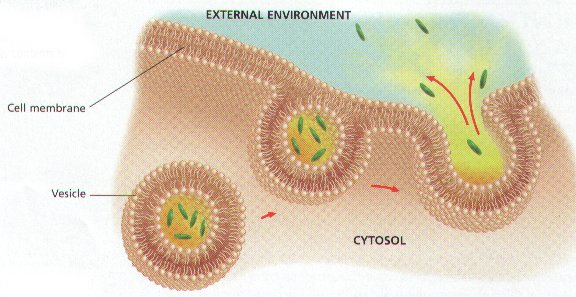 | exocytosis, ,
|
The process pictured below is called ____., 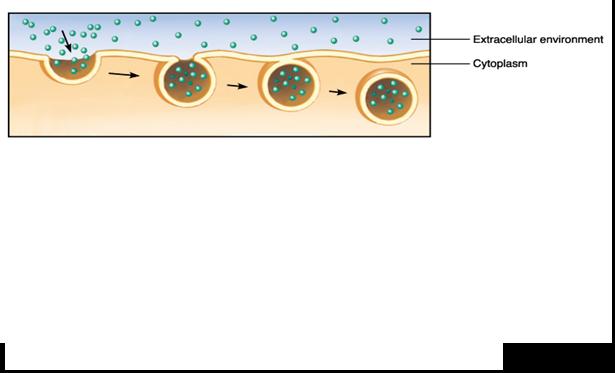 | endocytosis, ,
|
| The type of endocytosis that takes in solid particles (usually food) is called ____. | phagocytosis |
| The type of endocytosis that takes in liquids is called ___. | pinocytosis |
| _______ transport involves the diffusion of a substance across a biological membrane. | Passive transport |
| A molecule that binds specifically to a receptor site of another molecule is called a(n) _____. | ligand |
| A property of biological membranes that allows some substances to cross more easily than others is called _____. | selective permeability |
| In comparing two solutions, the one with the lower solute concentration is called the _____ solution. | hypotonic |
| The currently accepted model of cell membrane structure, which envisions the membrane as a collage of individually inserted protein molecules drifting laterally in a fluid bilayer of phospholipids is called _____. | the fluid mosaic model, 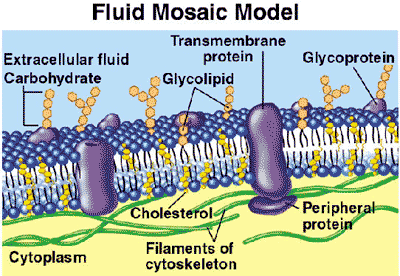 |
| A(n) ______ is a protein structure that involves active transport by using ATP to force hydrogen ions out of a cell, generating a membrane potential in the process. | proton pump (remember, a hydrogen ion is a proton), 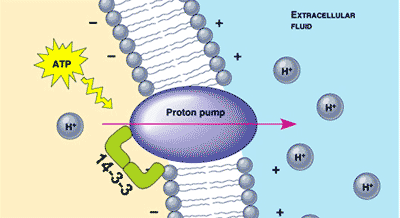 |
| A protein covalently attached to a carbohydrate is called _____. | a glycoprotein, 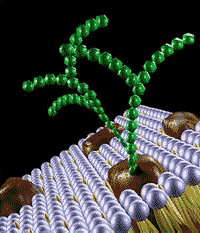 |
| Cells will have to use active transport if they are trying to transport substances against the ________ of that substance. | concentration gradient |
| ______ occurs in walled cells when the cytoplasm shrivels and the plasma membrane pulls away from the cell wall (due to the cell losing water to a hypertonic environment). | plasmolysis, 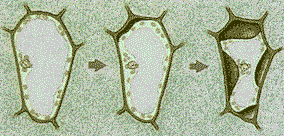 |
| A measure of the ability of a solution to cause a cell within it to gain or lose water is called _____. | tonicity |
| _______ diffusion is the spontaneous passage of molecules and ions, bound to specific carrier proteins, across a biological membrane down their concentration gradients. | Facilitated diffusion,  |
?,  | Jeff Spicoli, |



