| A | B |
|---|
| ______ produce their organic molecules from carbon dioxide and other organic raw materials obtained from the environment. | Autotrophs |
| _______ are autotrophs that use light as a source of energy to synthesize organic substances. | Photoautotrophs |
| Photosynthesis converts _____ energy to the ______ energy of food. | light, chemical |
| _____ are the major sites of photosynthesis in most plants. | Leaves |
What is "B" referring to?, 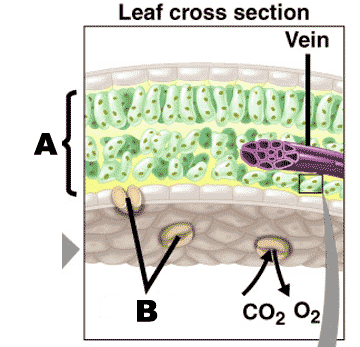 | stomata, |
What is #1 pointing to?,  | a thylakoid, |
| What is #2 pointing to?, | A granum (a stack of thylakoids), |
| What is #3 pointing to?, | The stroma inside a chloroplast., |
| What is the net chemical equation for photosynthesis? | The equation below shows the net usage and production of molecules in photosynthesis. In reality, 12 water molecules are used as reactants and 6 water molecules are produced.,  |
| Energy from the sun is used to produce the high energy molecules NADPH and ATP during the ______ reaction of photosynthesis. | light,  |
| Energy from the sun is used to produce the high energy molecules ______ and ______ during the light reaction of photosynthesis. | NADPH and ATP, |
| Electrons are stripped from water, producing hydrogen ions and oxygen molecules during the ______ reaction of photosynthesis. | light, |
| Electrons are stripped from _____, producing hydrogen ions and oxygen molecules during the light reaction of photosynthesis. | water |
| _______ are stripped from water, producing hydrogen ions and oxygen molecules during the light reaction of photosynthesis. | electrons, |
| Electrons are stripped from water, producing _________ and ________ molecules during the light reaction of photosynthesis. | hydrogen ions and oxygen molecules, |
| The _____ reaction of photosynthesis takes place on the thylakoid membrane. | light, |
| The light reaction of photosynthesis takes place on the _________. | thylakoid, |
| The _______ cycle takes place in the stroma of the chloroplast. | Calvin |
| The Calvin Cycle takes place in the ______ of the chloroplast. | stroma |
Which molecule belongs in the "A" spot?,  | water, 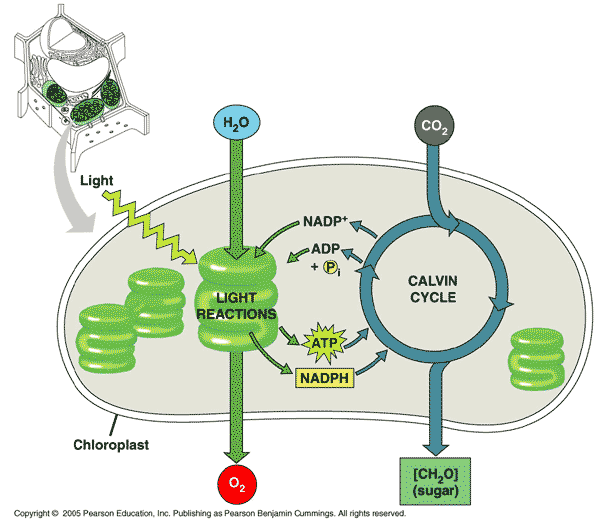 |
| Which molecule belongs in the "B" spot?, | oxygen, |
| Which molecule belongs in the "C" spot?, | carbon dioxide, |
| Which molecule belongs in the "D" spot?, | [CH2O] This is the generic formula for a carbohydrate. The actual carb that exits the Calvin cycle is a triose sugar called Glyceraldehyde-3-phosphate (G3P). This molecule can be linked to form glucose, sucrose, or starch. Or it can be used as raw material to make amino acids and lipids., |
| Which molecules belongs in the "E" spot?, | NADP+ and ADP and P, |
| Which molecule belongs in the "F" spot?, | NADPH and ATP, |
What is "A" pointing to?,  | photosystem I (a.k.a. P700), |
| What is "C" pointing to?, | NADP+ (NADPH), |
| What is the final electron receptor in the light reaction of photosynthesis? | NADP+ |
| What supplies electrons to the electron transport chain of photosynthesis? | Water (when it is split) |
| Where do hydrogen ions end up when they are moved by active transport during the light reaction of photosynthesis? | inside the thylakoid space |
| In which direction do protons (aka - hydrogen ions) flow through ATP synthase in the light reaction of photosynthesis? | From the thylokoid space out to the stroma of the chloroplast. |
| What is "D" pointing to?, | Photosystem II (a.k.a. P680),  |
| What is "E" pointing to?, | Electron transport chain of photosynthesis, |
| What is "F" pointing to?, | thylakoid space, |
| What is "G" pointing to?, | thylakoid membrane, |
| What is "H" pointing to?, | ATP synthase, |
| What is "I" pointing to?, | stroma of the chloroplast, |
| How is water split during photosynthesis? | With a Chuck Norris roundhouse kick |
What is this graph showing?, 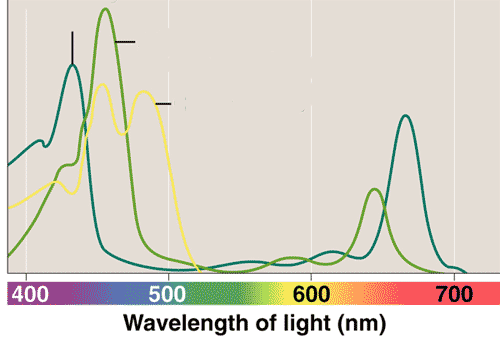 | The absorption spectra of chlorophyl a and b plus carotenoids, |
| Where do the ATP and NADPH that are produced during the light reaction head next? | the Calvin Cycle |
| What are two other names for the Calvin Cycle? | Dark reactions, light independent reactions |
| The light reaction converts light energy to the chemical energy of ____ and _____. | ATP and NADPH |
| The Calvin Cycle uses _____ and _____ to convert ______ to sugar. | ATP, NADPH, carbon dioxide |
| Which enzyme helps fix carbon dioxide from the atmosphere in the Calvin cycle? | Rubisco |
| What is the name of the 5-carbon starting molecule of the Calvin cycle? | Ribulose Biphosphate (RuBP),  |
| What is the name of the molecule that exits the Calvin cycle and is used as raw material to build other organic molecules? | glyceraldehyde-3-phosphate (G3P), |
| When the ________ are open to take in carbon dioxide during the day, the plant becomes vulnerable to water loss through ____________ | stomata, transpiration |
| When oxygen concentrations inside a plant leaf increase, the enzyme ______ may bind oxygen instead of carbon dioxide in an inefficient process called _____. | rubisco, photorespiration |
| Which alternate method of carbon fixation reduces photorespiration by separating carbon fixation from the Calvin cycle spatially? | C4 (Carbon fixation takes place in the outer mesophyll cells and is then funnelled into the inner bundle of sheath cells where the Calvin Cycle takes place. This keeps the carbon dioxide concentrations high for rubisco), 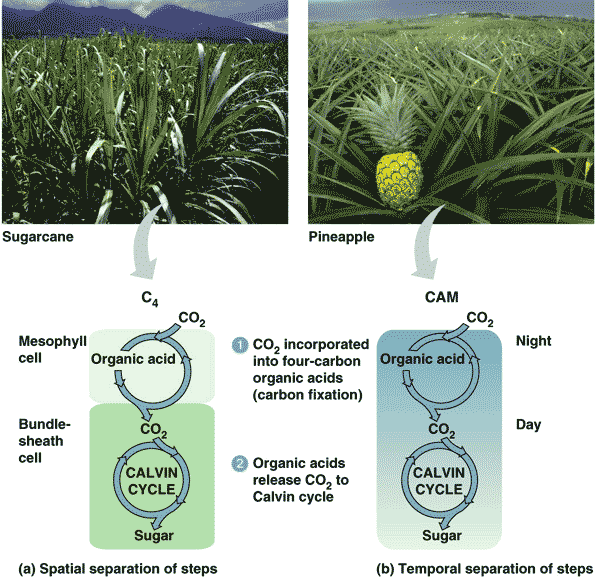 |
| Which alternate method of carbon fixation reduces photorespiration by separating carbon fixation from the Calvin cycle temporally? | CAM (CAM plants fix carbon dioxide at night and store the carbon in organic acids until daytime when the carbon is funnelled into the Calvin Cycle), |
| Most plants, including rice, wheat, and soybeans are ____ plants (named for their mode of carbon fixation). | C3 (They are called C3 plants because the first product after carbon fixation is the 3 carbon molecule 3-phosphoglycerate) |
| Many plants that evolved in ____, ____ climates have evolved alternate modes of carbon fixation such as C4 and CAM to reduce photorespiration. | hot, arid (arid means dry) |



