| A | B |
|---|
| Critical thinking | Critical thinking is the systematic evaluation or formulation of statements by rational standards |
| Systematic | it involves distinct procedures and methods |
| Evaluation or formulation | it is used to both assess existing beliefs and devise new ones |
| Rational standards | beliefs are judged by now well they are supported by reasons |
| The importance of critical thinking | increases the quality of life because who we are is defined by what we do and what we do is defined by what we thinking; When we just adopt the beliefs of your parents, we need to evaluate the adopted beliefs of others |
| Explanation | statements, but look like premises, they do not make up an arguments; EXPLAINS WHY or HOW |
| Argument | A group of statements in which some of them are inteneded to support another of them |
| Deductive Argument: | inteneded tp provided logically conclusive support for its conclusion. (The only way the conclusion can happen is if the premises are true) |
| Inductive Argument: | Inteneded to provide prpbable- not conclusive- support for its conlcusion |
| What is a "good" deductive argument? | Valid/ invalid; Valid: A deductive argument that succeeds in providing such decisive logical support |
| What is a "good" inductive argument? | Strong/ Weak; Strong: An inductive agrument that succeeds in providing probable, but not conclusive, logical support for its conclusion |
| Tree diagrams | 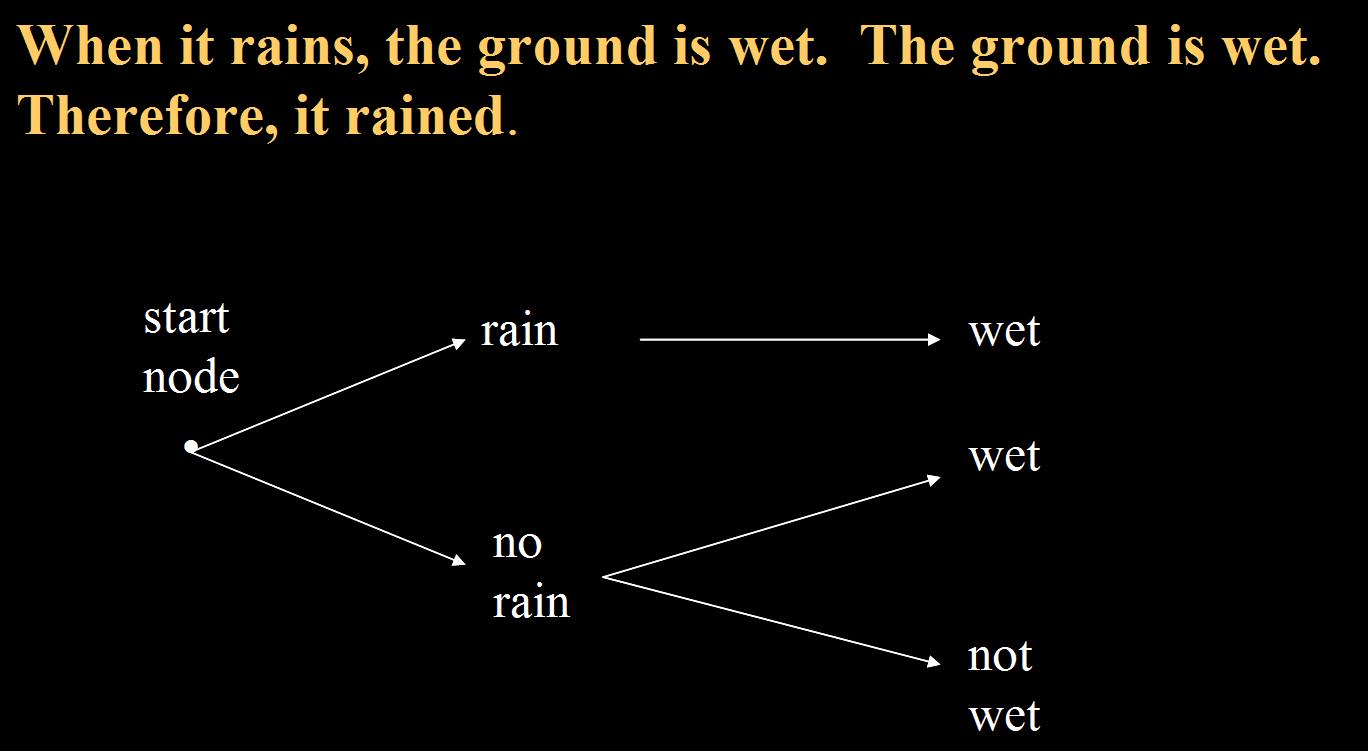 |
| Diagram arguments using arrows | 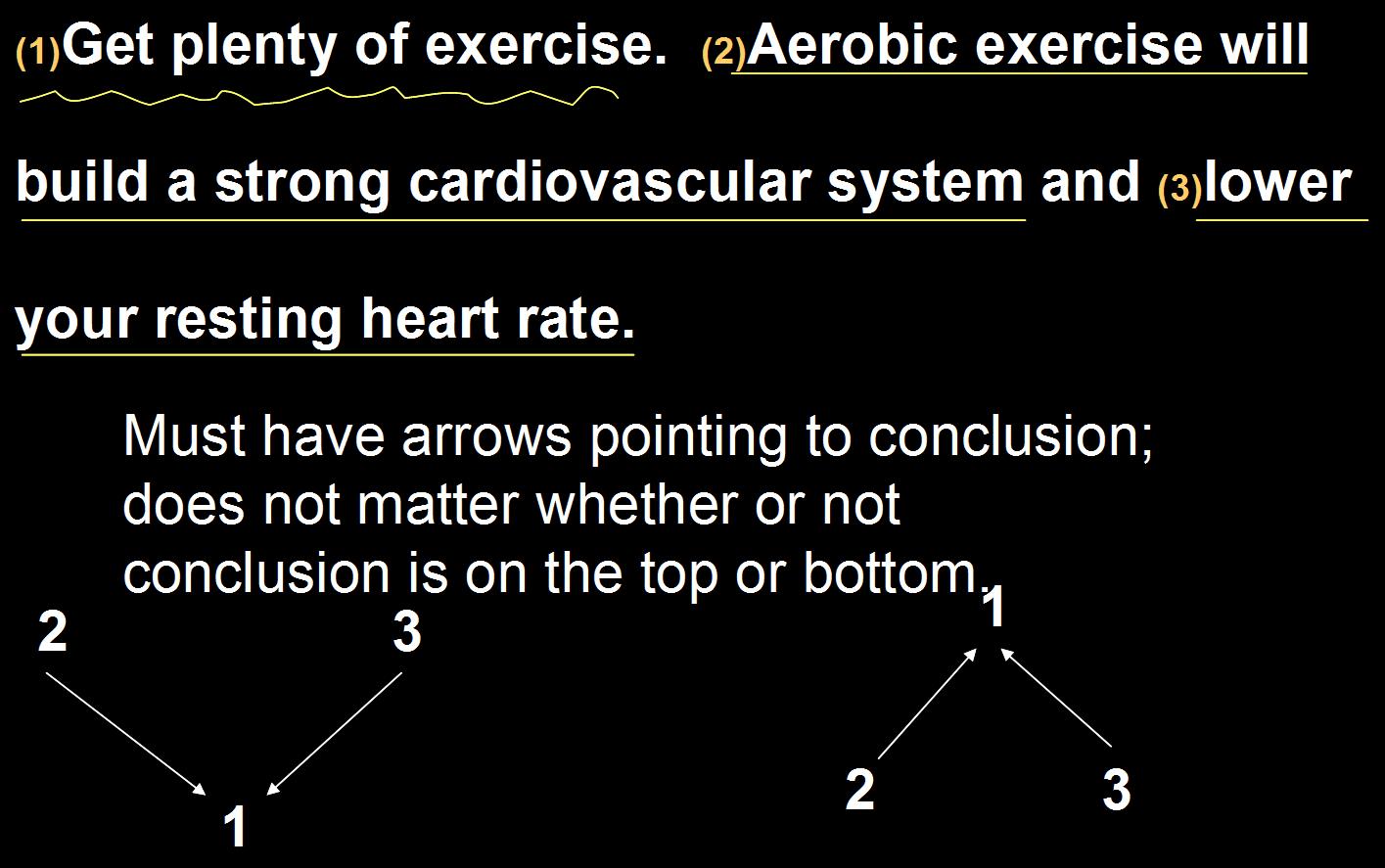 |
| Middle Term | Not in the conclusion (M) |
| Minor Term | The subject of the conclusion (S) |
| Major Term | The predicate term in the conclusion (P) |
| Major Premise | [Middle term] [Major term] |
| Minor Premise | [Minor term] [Middle term] |
| Conclusion | Therefore, [Minor term] [Major term] |
| Using Venn diagrams | 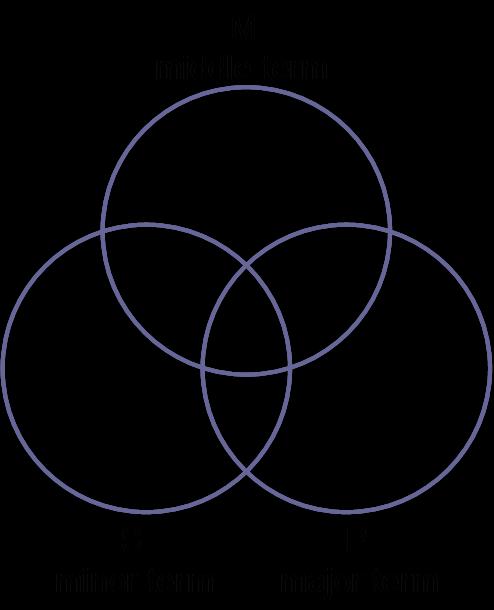 |
| Argument by analogy | The use of analogy to argue inductively |
| What Argument By analogy contains | Thing A has properties P1, P2, P3 plus the property P4. Thing B has properties P1, P2, and P3. Therefore, thing B probably has property P4. Example: A rose is radiant, soft/silky, delicate and fragrant. Your face is radiant, soft/silky, and delicate. Your face is like a rose and probably is fragrant, as well. |
| Measure Arugment by analogy | The greater the degree of similarity, the more likely the conclusion is to be true. |
| Method of agreement | if two or more occurrences of a phenomenon have only one relevant factor in common, that factor must be the cause… in other words, look for the common denominator. |
| Method of difference | The relevant factor present when a phenomenon occurs, and absent when the phenomenon does not occur, must be the cause…in other words, look for differences |
| Method of agreement and difference | Find relevant factors common to occurrences of the phenomenon AND throw away any of these that are present even when there are no occurrences…in other words, find the common denominator(s) when the event happens and subtract the factors present when the event does not happen. |
| Necessary conditions | A condition where without it, the event cannot occur. Example: You need water to live. (must have water to live), but you need food and other things as well |
| Sufficient conditions | A condition where it is guaranteed that the will event occur. Example: Chopping off the head of the king put an end to him (there are other ways to kill him) |
| Necessary & Sufficient conditions | A conditition where without it, the event cannot occur, and with it the event is guaranteed. EXAMPLE: There must be oxygen and enough heat present in order for paper to burn. |
| Moral argument | An argument in which we are trying to convince someone something is good or bad, right or wrong. Not illegal or legal. Inductive argument |
| Contained in a Moral Argument | A moral statement, a non-moral statement, and a moral conclusion |
| Moral vs. non-moral statements | Moral: "should, wrong, immoral…" Non-moral: "did, did not, was, think…" |
| Implicit premise to complete a moral argument | Make sure there is at least one moral agument and one non moral argument for the conclusion, think of counter examples and treat as deductive arguments to make the conclusion valid |
| How to evaluate moral premises | Think of counter examples, look at non-moral premises, weak premises make a weak conclusion |
| Worldview | A philospohy of life; a set of fundamental ideas that helps us make sense of a wide rage of important issues in life. A worldview defines for us what exists, what should be, and what we can know. |
| Problem | A gap or barrier between where you are and where you want to be |
| Parts of a problem | Start: initial state; Final: goal state; Problem space – all possible solutions; and givens: information and rules to solve the problem |
| Stages of problem solving | Preparation or familiarization: time spent understanding the problem and the goal; Production stage: come up with solution paths that make up the problem space (brain storm stage); Judgment or evaluation: evaluate the various solutions in order to choose the best one; Incubation stage: (may or may not occur) |
| Ways to increase problem space | Stating the goal in several different ways can widen the problem space and increase the changes of generating a good solution. And change your perspective |
| Best problem-solving strategy for a given problem | Means-ends analysis, Working Backwards, Random Search and Trial & Error, Rules, Hint, Split-Half Method, Brainstorming, Analogies and Metaphors |
| Means-ends analysis | Choose the most appropriate sub-goal; Reduce distance between where you are and where you want to be |
| Working Backwards | Work backward from the goal to your present state |
| Random search and Trial and Error | Search possible solutions at random – no particular order; works best on well-defined problems with only a few solutions |
| Rules | To find rules, look for patterns in the “givens” or subgoals |
| Hints | Additional information helpful in solving a problem; good problem solvers seek as much information (hints) as they can |
| Split-half method | Good search strategy to use when there is no reason to start your search in a particular place |
| Brainstorming | Generate lots of ideas |
| Analogies and Metaphors | Use the solution of a similar problem to help solve the current problem |
| Functional fixedness | Getting stuck on the usual function of items (wrench & string or affix candle to wall problem) |
| Mental set | Refers to a state of mind – inability to think of a new solution (the dot problem) |
| Hasty generalization | Making some kind of generalization base on a limited view or fac |
| Appeal to tradition | This is the way its always been done |
| Appeal to popularity | Because everyone is doing it |
| Begging the question (circular) | The premises and the conclusion are the same, a restatement. |
| Straw Man | Rewording the argument to make it easier to attack |
| Ad Hominem | Rejecting the claim for outside reasons |
| False Analogy | Taking two situations that don’t have much, if anything, in common |
| Red Herring | Use something that does not have anything to do with the point. (distract a person with random issues). Conclusion does not follow premises. |
| Division | What is true for the whole is true for the parts |
| Composition | What ever is true of individual parts must be true for the whole |
| False Dichotomy / Dilemma | Only giving something two options, even though there may be more than two |
| Appeal to ignorance | Accepting a claim with no support, using a lack of evidence as prove or support as evidence |
| Genetic | We don’t accept an argument because of where it came from |
| Equivocation | change the meaning of a word within the same argument |
| Slippery Slope | If we let one thing happen then all these other things are going to happen. |
| Appeal to emotion | Play with emotion rather than actual facts |
| No Fallacy | No lie in the conclusion or premise |
| Abusive Ad Hominem / Personal Attack | Attacking the person |
| Ad Hominem: Tu quoque | You did it too |
| Ad Hominem: Circumstances | because of someone's circumstances we should/shouldn't believe them |
| Ad Hominem: Poisoning the well | labeling someone or giving bad information about them so that whatever they say will be discredited (don't listen to him because he's stupid). So, whatever argument they are about to give is not to be believed because of the label we've given them or the |
| Ad Hominem: inconsistency | said one thing before and now you're saying something different |


