| A | B |
|---|
| An aberration in chromosome structure resulting from reattachment in a reverse orientation of a chromosome fragment to the chromosome from which the fragment originated. | inversion |
| _____ is a human genetic disease caused by a recessive sex-linked allele; characterized by excessive bleeding following injury. | hemophilia |
| An ordered list of genetic loci (genes or other genetic markers) along a chromosome. | genetic map |
| _______ is a human genetic disease caused by the presence of an extra chromosome 21; characterized by mental retardation and heart and respiratory defects. | Down syndrome |
| _______ is a human genetic disease caused by a sex-linked recessive allele; characterized by progressive weakening and loss of muscle tissue. | Duchenne muscular dystrophy |
| _______ are genes located close enough together on a chromosome to be usually inherited together. | Linked genes |
| A(n) _____ is a dense object lying along the inside of the nuclear envelope in female mammalian cells, representing an inactivated X chromosome. | Barr body |
| ______ is an error in meiosis or mitosis,in which both members of a pair of homologous chromosomes, or both sister chromatids, fail to move apart properly. | Nondisjunction |
| ______ is a deficiency in a chromosome resulting from the loss of a fragment through breakage OR a mutational loss of one or more nucleotide pairs from a gene. | A deletion |
| A gene located on a sex chromosome is called a(n) _____. | sex-linked gene |
| A basic principle in biology stating that genes are located on chromosomes and that the behavior of chromosomes during meiosis accounts for inheritance patterns. | chromosome theory of inheritance |
| A(n) ______ is an aberration in chromosome structure due to fusion with a fragment from a homologous chromosome, such that a portion of a chromosome is repeated. | duplication |
| ______ is a chromosomal alteration in which the organism possesses more than two complete chromosome sets. | Polyploidy |
| _____ is an abberation in chromosome structure resulting from the attachment of a chromosomal fragment to a nonhomologous chromosome. | Translocation |
| The reciprocal exchange of genetic material between nonsister chromatids during prophase I of meiosis is called _____. | crossing over |
| Four types of chromosomal mutations are ___. | Deletions, duplications, inversions, and translocations |
The type of mutation shown below is a(n) _____.,  | chromosomal deletion, |
The type of mutation shown below is a(n) _____.,  | chromosomal duplication, |
The type of mutation shown below is a(n) _____.,  | chromosomal inversion, |
The type of mutation shown below is a(n) _____.,  | chromosomal translocation, |
What would be the sex of the person who owns these chromosomes?,  | male (notice the X and the Y chromosome at the last pair), |
| What type of genetic disorder does the owner of these chromosomes have?, | Down syndrome (notice the extra chromosome at the 21st pair), |
| In humans, colorblindness is a sex-linked recessive allele. What are the expected phenotypes of the offspring if both parents have normal vision but the mother is heterozygous? | 100% normal vision girls and 50% of the boys are expected to be colorblind., 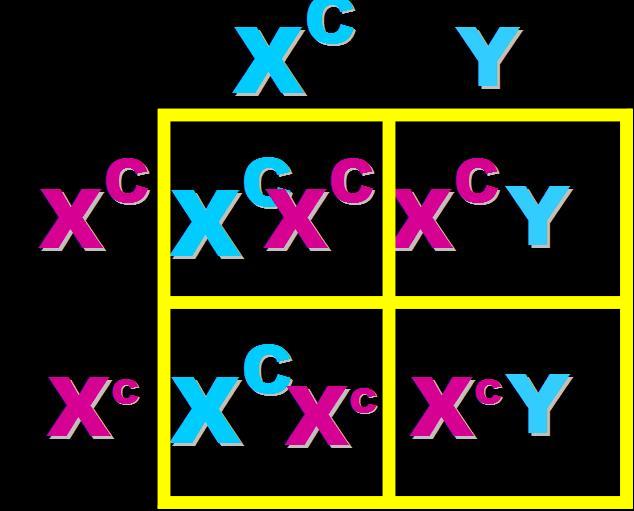 |



