| A | B |
|---|
| The stalk of a flower's carpel, with the ovary at the base and the stigma at the top is called the ______. | style |
| ______ is the mutual evolutionary influence between two different species interacting with each other and reciprocally influencing each other's adaptations. | coevolution (an example is the adaptations that flowers have made to attract pollinators and pollinators have made to extract pollen) |
| A mechanism of fertilization in angiosperms, in which two sperm cells unite with two cells in the embryo sac to form the zygote and endosperm. | double fertilization |
| Fertilization in angiosperms, involves two sperm cells uniting with two cells in the embryo sac to form the zygote and _________. | endosperm (which becomes the nutrients within the seed for the developing embryo) |
| Any of the largest subgroup of traditionally dicot angiosperms, including roses, peas, buttercups, sunflowers, oaks, and maples | Eudicots (pronounced U-dicot) |
| Embryonic seed leaves are called ______. | cotyledons (the two leaves are the cotyledons in the picture of the dicot below), 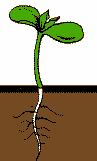 |
What is "A" in the picture below?, 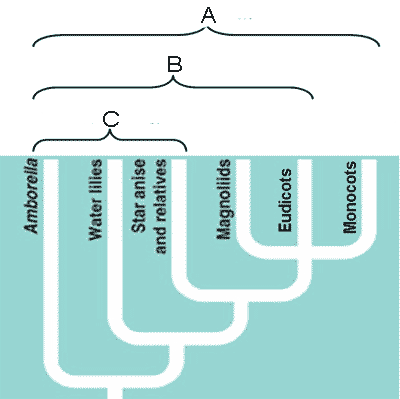 | Angiosperms, |
| What is "B" in the picture below?, | Dicots, |
| What is "C" in the picture below?, | Basal Angiosperms, |
The flower below is typical of (monocots or dicots), 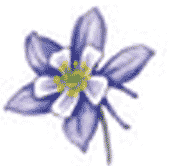 | dicots (floweral organs are usually in multiples of four or five in dicots), |
| What type of angiosperm seedling is shown below (monocot or dicot)?, | dicot (notice the two cotyledons "embryonic seed leaves" of this seedling), |
The angiosperm leaf below is typical of (monocots or dicots), 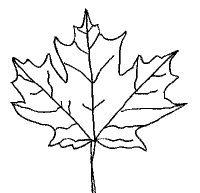 | Dicot (the veins in dicot leaves are usually net-like), |
The angiosperm pollen grain below is typical of (monocots or dicots),  | Dicot (dicot pollen grains typically have 3 openings), |
The angiosperm root below is typical of (monocots or dicots), 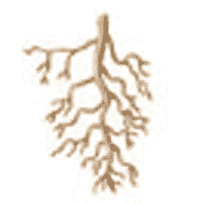 | dicot (dicots typically have a main taproot), |
This cross section of an angiosperm stem is typical of (monocots or dicots).,  | dicots (vascular bundles of xylem and phloem are typically arranged in an orderly fashion around the periphery of the stem), |
Roman numeral I refers to the ______., 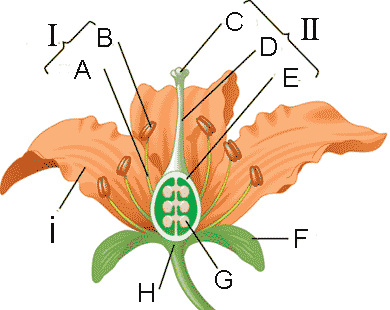 | stamen (male reproductive structure),  |
| Roman numeral II refers to the ______., | Carpel (female reproductive structure), |
| The letter "B" refers to the _____., | Anther (where the microsporangium which produces pollen is located), |
| The letter "A" refers to the _____., | filament, |
| The letter "C" refers to the _____., | stigma, |
| The letter "D" refers to the _____., | style, |
| The letter "E" refers to the _____., | ovary, |
| The letter "F" refers to the _____., | sepal, |
| The letter "G" refers to the _____., | ovule, |
| The letter "H" refers to the _____., | receptacle, |
| The letter "i" refers to the _____., | petal, |
The flower below is typical of (monocots or dicots), 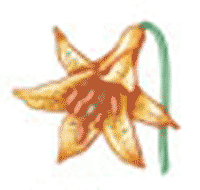 | Monocot (monocot floral organs are usually found in multiples of 3), |
What type of angiosperm seedling is shown below (monocot or dicot)?, 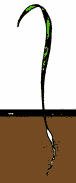 | monocot (notice the single cotyledon, |
The angiosperm leaf below is typical of (monocots or dicots), 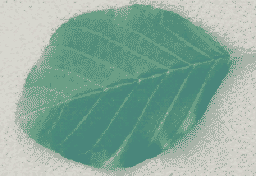 | Monocot (monocots typically have parallel vein structure), |
The angiosperm pollen grain below is typical of (monocots or dicots), 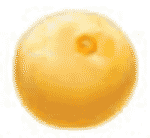 | Monocot (monocot pollen grains typically have only one opening), |
The angiosperm root below is typical of (monocots or dicots), 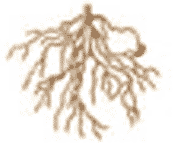 | Monocot (monocot root systems typically lack a central taproot), |
This cross section of an angiosperm stem is typical of (monocots or dicots)., 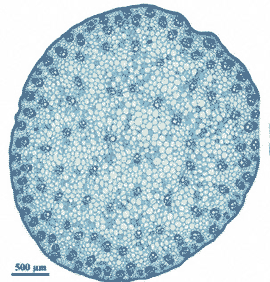 | Monocot (The vascular bundles of xylem and phloem are typically scattered and unorganized in monocots), |
What should go in the number 1 space below?, 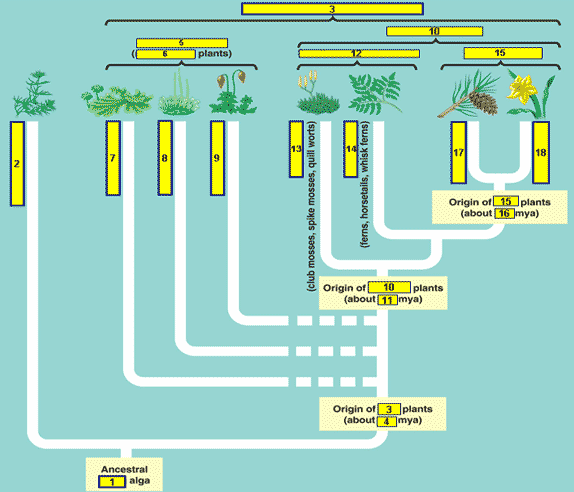 | green, |
| What should go in the number 2 space below?, | charophyceans, |
| What should go in the number 3 space below?, | Land plants (a.k.a. Embryophytes), |
| What should go in the number 4 space below?, | 475 MYA, |
| What should go in the number 5 space below?, | Bryophytes, |
| What should go in the number 6 space below?, | Non-vascular, |
| What should go in the number 7 space below?, | Liverworts, |
| What should go in the number 8 space below?, | Hornworts, |
| What should go in the number 9 space below?, | Mosses, |
| What should go in the number 10 space below?, | Vascular plants, |
| What should go in the number 11 space below?, | 420 MYA, |
| What should go in the number 12 space below?, | seedless vascular plants, |
| What should go in the number 13 space below?, | Lycophytes, |
| What should go in the number 14 space below?, | Pterophytes, |
| What should go in the number 15 space below?, | seed plants, |
| What should go in the number 16 space below?, | 360 MYA, |
| What should go in the number 17 space below?, | Gymnosperms, |
| What should go in the number 18 space below?, | Angiosperms, |
What type of plant is shown below?, 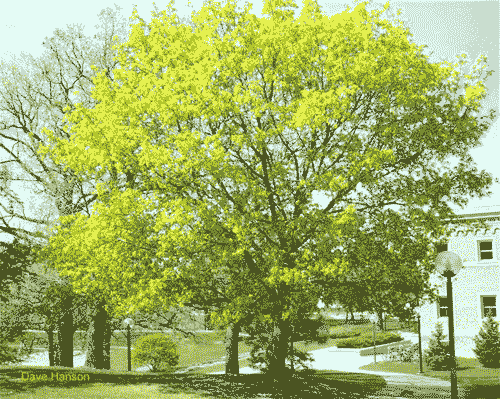 | Angiosperm (Flowering Plant) - Most trees other than conifers are flowering plants. Notice the maple flowers in the picture below., 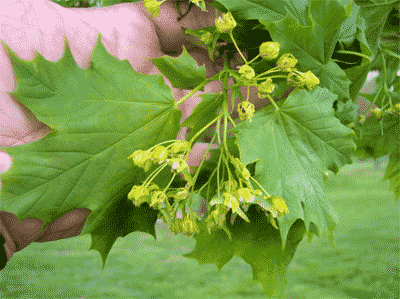 |
| The layer of sporophyte tissue that contributes to the structure of an ovule of a seed plant is called the __________. | integument, 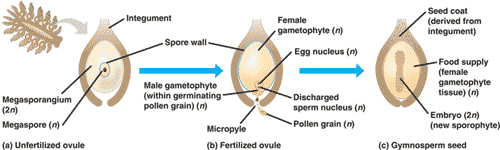 |
| A pore in the integument of an ovule is called a(n) _____. | micropyle, |
| The stalk of a stamen is called a(n) ______. | filament, |
| The pollen-producing male reproductive organ of a flower, consisting of an anther and filament is called a(n) _____. | stamen, |
| The sticky part of a flower's carpel, which traps pollen grains, is called a(n) _____. | stigma, |
| The transfer of pollen from one plant to ovule of a different plant is called ____. | cross-pollination |
| In flowers, the _____ is the portion of a carpel in which the egg-containing ovules develop. | ovary, |
| The structure that develops within the ovary of a seed plant and contains the female gametophyte is called the _____. | ovule, |
| The nutrient-rich tissue formed by the union of a sperm cell with two polar nuclei during double fertilization in an angiosperm. | endosperm,  |
| The _____ is the female reproductive organ of a flower consisting of the stigma, style, and ovary. | carpel |
| The thickened wall of a fruit is called the ______. | pericarp |
| An adaptation for terrestrial plants consisting of an embryo packaged along with a store of food within a resistant coat is called a(n) ______. | seed |
| The structure that contains the male gametophyte of a seed plant. | pollen grains |
| The female gametophyte of angiosperms formed from the growth and division of the megaspore into a multicellular structure with eight haploid nuclei. | embryo sac |
| A(n) _____ is the mature ovary of a flower that protects dormant seeds and aids in their dispersal. | fruit |
| A(n) is a modified leaf in angiosperms that helps enclose and protect a flower bud before it opens. | sepal, |
| The clade consisting of flowering plants that have one embryonic seed leaf, or cotyledon. | monocots |
| The process by which two or more species in a close ecological relationship affect each others adaptations over time. | Coevolution |



