| A | B |
|---|
| True or False: Individual organisms evolve. | False: Although natural selection acts upon individuals, only populations evolve as organisms can't acquire new adaptations after they start to develop. |
| _____________ is change in the genetic makeup of a population from generation to generation. | Microevolution |
| The modern synthesis integrates _________ with the ________. | Mendellian genetics, Darwinian evolution by natural selection |
| The ________ integrates Mendelian genetics with the Darwinian theory of evolution by natural selection. | modern synthesis |
| A __________ is a localized group of individuals that are capable of interbreeding and producing ______ offspring | population, fertile |
| The _________ is the total aggregate of genes in a population at any one time | gene pool |
| The Hardy-Weinberg theorem describes a population that is _________. | not evolving |
| What is the Hardy-Weinberg equation? | ., 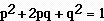 |
| In the Hardy-Weinberg equation, p + q =____ | 1 (remember, p and q represent the frequencies of the two alleles being considered. Their frequencies have to add up to 1, or 100%) |
| In the Hardy-Weinberg equation, p squared and q squared equal the frequencies of the ________ genotypes. | homozygous |
| In the Hardy-Weinberg equation, 2pq equals the frequencies of the ________ genotype. | heterozygous |
| If the percentage of blue eye alleles in a population is 60%, what percentage of the population is expected to have blue eyes? | 36% (Blue is recessive, so q = .6. Therefore, q squared = .36) |
| If the percentage of blue eye alleles in a population is 70%, what percentage of the population is expected to have brown eyes? | 51% (Blue eyes are recessive, so q = .7. Therefore, the frequency of blue eyed people in the population = q squared = .49. The rest are browned eyed, so their frequency = 1.0 - .49 = .51, or 51%) |
| If 64% of the population has blue eyes, what is the frequency of the blue allele in the gene pool? | 80% (Since blue is recessive, and q squared is the frequency of the recessive trait in the population, q squared = .64. Therefore, q, the frequency of the blue allele = the square root of q squared = the square root of .64 = .8 = 80%) |
| If 16% of the population has blue eyes, what percentage of the population is heterozygous for brown eyes? | 48% (Since blue is recessive, and the frequency of blue eyes in a population = q squared = .16, the frequency of the blue allele is the square root of q squared = the square root of .16 = .4. Therefore, p, the frequency of the brown allele is 1.0 - .4 = .6. The frequency of the heterozygous population is 2pq = 2 X .4 X .6 = .48 = 48%) |
| If 9% of the population has blue eyes, what percentage of the population is homozygous for brown eyes? | 49% (Since blue is recessive, and the frequency of blue eyes in a population = q squared = .09, the frequency of the blue allele is the square root of q squared = the square root of .09 = .3. Therefore, p, the frequency of the brown allele is 1.0 - .3 = .7. The frequency of the homozygous brown eyed population is p squared = .7 squared = .49 = 49%) |
| If the frequency of the blue eyed allele in a population is 25%, what is the frequency of the brown eyed allele? | 75% (There are only 2 alleles for human eye color, so if 25% of them are blue, the rest are brown) |
| What are the five conditions that must be met in order to maintain Hardy-Weinberg equilibrium? | 1) Large population size. 2) No gene flow. 3) No mutations. 4) No natural selection. 5) Random mating. |
| What two factors are responsible for the variation that make evolution possible? | Mutations and genetic recombination |
| _______ are changes in the nucleotide sequences of DNA. | Mutations |
| A _____ mutation is a change in one base in a gene. | point mutation |
| Sickle-cell anemia is caused by which type of mutation? | A point mutation. |
What type of mutation is shown in the picture below?,  | Chromosomal deletion, |
What type of mutation is shown in the picture below?,  | Chromosomal duplication, |
What type of mutation is shown in the picture below?,  | Chromosomal inversion, |
What type of mutation is shown in the picture below?,  | Chromosomal translocation, |
| _______ is the main cause of differential success in reproduction. | Natural selection |
| _______ is defined as random deviation from the expected allele frequencies over time | Genetic drift |
| ______ populations are the most susceptible to the effects of genetic drift. | Small |
| A sudden change in the environment that causes a drastic reduction in the size of population, causing the remaining gene pool to be significantly different from the original gene pool. | The bottleneck effect |
| The ______ is caused by a few individuals becoming separated from the larger population, often leading to a different genetic makeup in subsequent generations compared to the gene pool of the original population. | The founder effect |
| _________ results from the migration of fertile individuals or gametes between populations. | Gene flow |
| Gene flow tends to _______ differences between populations over time. | reduce |
| _______ is the primary mechanism of adaptive evolution. | Natural selection |
| ______ causes the accumulation and maintenance of favorable genotypes in a population. | Natural selection |
| In genetic variation, ______ characters can be classified on an either-or basis. | Discrete characters (example: Brown or blue eyes) |
| In genetic variation, ______ characters vary along a continuum in a population. | Quantitative characters (example: human skin color) |
| _______ polymorphism describes a population in which two or more distinct morphs for a character are each represented in high enough frequencies to be readily noticeable. | Phenotypic |
| _______ polymorphisms are the heritable components of characters that occur along a continuum in a population. | Genetic |
| Differences between gene pools of separate populations or population subgroups are referred to as ______ variation. | geographic |
| A(n) _____ is a graded change in a trait along a geographic axis. | cline (for example, a species may be found to be larger with more subcutaneous fat in order to deal with colder temperatures as you move from the southern edge of its territory to its northern edge. This gradual change would be referred to as a cline) |
| _______ is the contribution an individual makes to the gene pool of the next generation, relative to the contributions of other individuals. | Fitness |
| _______ is the contribution of a genotype to the next generation as compared to the contributions of alternative genotypes for the same locus. | Relative fitness |
Which type of selection effect does the graph below show?,  | Directional, |
Which type of selection effect does the graph below show?,  | Disruptive, |
Which type of selection effect does the graph below show?,  | Stabilizing, |
| Diploidy maintains genetic variation in the form of hidden _______ alleles | recessive |
| _________ selection occurs when natural selection maintains stable frequencies of two or more phenotypic forms in a population. | Balancing |
| Balancing selection leads to a state called ________ when the frequency of two or more forms stays stable over time. | balanced polymorphism |
| _______ describes situations in which individuals who are heterozygous at a particular locus have greater fitness than homozygotes. | Heterozygous advantage |
| The sickle-cell allele causes mutations in hemoglobin but also confers resistance to _______. | malaria |
| The sickle-cell allele causes mutations in ______ but also confers resistance to malaria. | hemoglobin |
| A classic example of heterozygous advantage is the _____. | sickle-cell allele |
| In _______ selection, the fitness of any morph declines if it becomes too common in the population. This usually involves a predator that learns to prey on the most common morph of a prey species. | frequency-dependent selection |
| _______ variation is genetic variation that appears to confer no selective advantage (for example, human eye color) | Neutral variation |
| Genetic variation in the untranslated parts of the genome is an example of _____ variation because it appears to confer no selective advantage. | neutral variation |
| Selection due to the sexual preferences of males or females within a species is called __________. | sexual selection |
| Marked differences between the sexes in secondary sexual characteristics is called ______. | sexual dimorphism (for example, humans are sexually dimorphic whereas most fish are not) |
| __________ selection is a direct competition among individuals of one sex for mates of the opposite sex. | Intrasexual selection |
| __________ selection occurs when individuals of one sex (usually females) are choosy in selecting their mates from individuals of the other sex. | Intersexual selection |



