| A | B |
|---|
What does the word polygon mean?, 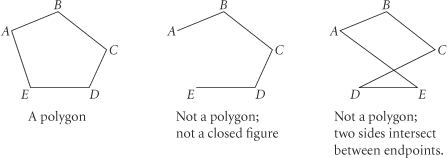 | Many angles. Each polygon is formed by segments (sides) such that each segment intersects exactly two other segments, one at each endpoint and no two segments with a common endpoint are collinear (on the same line). |
By looking at this picture, what is the difference between a convex and a concave polygon?,  | A convex polygon does not have a side of the polygon with a point in the interior of the polygon. A concave polygon does. |
What do we call a 3-sided figure?,  | triangle |
What do we call a four-sided figure?,  | quadrilateral |
What do we call a five-sided figure?,  | pentagon |
What do we call a six-sided figure?,  | hexagon |
What do we call a seven-sided figure?,  | heptagon |
What do we call an eight-sided figure?,  | octagon |
What do we call a ten-sided figure?,  | decagon |
What do we call the line of dashes that join two nonconsecutive vertices.,  | diagonal |
Use theorem 3.13 which states that the sum of the measures of a convex polygon with n sides is (n-2)180 to find the missing angle measurement., 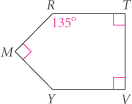 | The sum of the angles of a pentagon is 540. The measurement of the missing angle is 135 degrees. |
These are example of Theorem 3.14. Based on the pictures, what is Theorem 3.14?,  | The sum of the measures of the exterior angles of any convex polygon, one angle at each vertex, is 360 degrees. |
What do we call a polygon that is both equiangular and equilateral?,  | Regular polygon |
Use deductive thinking to provide the missing angle measurement.(An accepted theorem), 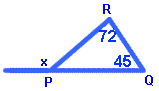 | Missing angle measurement is 117 degrees. My conclusion is based on Theorem 3.12 (the exterior angle is equal to the sum of the two remote angles) |
Can you use inductive reasoning (patterns) to fill in the next rows of Pascal's triangle?, 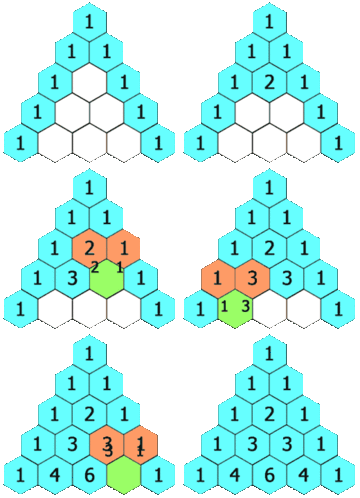 | 1--5---10--10--5---1, 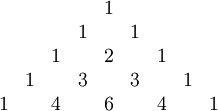 |



