| A | B |
|---|
| a point | an udefined term in geometry, a location only--with no width, length or depth(thickness) |
| this has no dimensions, no size in any direction | a point |
| a line | an undefined term in geometry, it has no width or depth(thickness) but extends indefinitely |
| this has 1 dimension, length only, and cannot be seen because it has no width or depth(thickness) | a line |
| a plane | an undefined term in geometry, it has no depth(thickness) but extends infinitely in all directions |
| this has 2 dimensions, length and width, but no depth(thickness) | a plane |
| the intersection of 2 intersecting lines | a point |
| the intersection of 2 intersecting planes | a line |
| the intersection of 2 parallel lines | no intersection, parallel lines are always the same distance apart and so can't inersect |
| skew lines | lines that are not coplanar and will never intersect |
| intersection of 2 skew lines | no intersection, skew lines are not coplanar and so can't intersect |
| notation to name a line | a double arrow symbol over any 2 points on the line, in either order |
| notation to name a line segment | the segment symbol over the 2 endpoints, in either order |
| notation to name a ray | the single arrow ray symbol over 2 points on the ray, the left one is the endpoint and the right one is any other point on the ray |
| notation to name a plane | the word plane, followed by any 3 NONcollinear points in the plane or 1 letter if the plane has a label |
| notation to name an angle | the angle symbol followed by 3 points on the angle: the middle point is the vertex and the other 2 points are one from each ray |
| Use Always, Sometimes, Never: 2 points are ________ collinear | always |
| Use Always, Sometimes, Never: 3 points are ________ collinear | sometimes |
| Use Always, Sometimes, Never: 2 points are ________ coplanar | always |
| Use Always, Sometimes, Never: 3 points are ________ coplanar | always |
| Use Always, Sometimes, Never: 4 points are ________ coplanar | sometimes |
| Use Always, Sometimes, Never: a line and a point not on the line are ________ coplanar | always |
| Use 0,1,2,infinite: 2 intersecting planes meet in ________ points | infinite |
| Use Always, Sometimes, Never: 2 intersecting planes ________ meet in 1 point | never |
| collinear points | points that lie on the same line (whether or not the line has been drawn) |
| coplanar points | points that lie on the same plane (whether or not the plane has been drawn) |
| perpendicular lines | intersect to form a right angle |
| point B is BETWEEN point A and point C | A,B,and C are collinear, and AB + BC = AC |
| formula to find the distance between points A and B on the number line | the absolute value of: A minus B or B minus A |
| formula to find the midpoint between points A and B on the number line | the average of A and B: (A+B)/2 |
| You are solving a problem in which Bev is 6km south of the bridge and Tyrell is 12 km north. If Tyrell's position is represented by 12, what number represents Bev's position? | -6 |
| If M is the midpoint of segment PQ and PM is 5, how can you find PQ | because M is the midpoint, PM is 1/2 of PQ. So 2 times PM, or 10, is PQ |
| If M is between P and Q and PM is 5, how can you find PQ? | There isn't enough information. M is somewhere between P and Q, not necessarily the midpoint. |
| the Segment Addition Postulate | If B is between A and C, then AB + BC = AC |
| Suppose D is between E and F, and EF = 36. Also, ED=5y+8 and DF=4y+10. Describe the steps to find ED. | According to the Segment Addition Postulate, ED+DF=EF so set 5y+8 + 4y+10 equal to 36. Solve for y by combining like terms, subtracting 18 from both sides, and dividing both sides by 9. y = 2, so ED = 5(2)+8, or 18 |
| vertex | the point at which 2 sides of a polygon meet or 2 rays meet to form an angle |
| When can an angle be named by a single point? | When the point is the vertex of only 1 angle |
| an angle measuring 180 degrees | a straight angle |
| an angle measuring between 90 and 180 degreees | an obtuse angle |
| an angle measuring 90 degrees | a right angle |
| an angle measuring between 0 and 90 degrees | an acute angle |
| supplementary angles | 2 angles whose measures add up to 180 degrees |
| complementary angles | 2 angles whose measures add up to 90 degrees |
| Use Always, Sometimes, Never: An acute angle ________ has a complement | always |
| Use Always,Sometimes,Never: an obtuse angle ________has a complement | never |
| Use Always, Sometimes, Never, a right angle _______ has a complement | never |
| Use Always, Sometimes, Never: An obtuse angle ________ has a supplement | always |
| Use Always,Sometimes, Never: a straignt angle ________ has a supplement | never |
| adjacent angles | 2 angles which share a vertex and one side, but no interior points |
| linear pair of angles | 2 adjacent, supplementary angles |
| vertical angles | the 2 pairs of nonadjacent angles formed by the intersection of 2 lines |
| an angle divides a plane into these 3 areas | points in the interior of the angle, points in the exterior of the angle, points on the angle |
| Use Always,Sometimes,Never: vertical angles are ________ congruent | always |
| Use Always,Sometimes,Never: vertical angles are _______ supplementary | sometimes (if the lines forming them are perpendicular) |
| the Angle Addition Postulate | If D is in the interior of angle ABC, then the sum of the measures of angle ABD and angle DBC equals the measure of angle ABC |
angles 1&5, 2&6, 3&7 or 4&8, 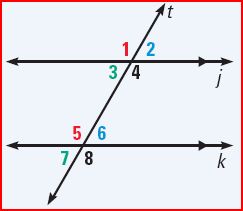 | corresponding angles |
| angles 1&8 or 2&7, | alternate exterior angles |
| angles 3&5 or 4&6, | consecutive interior angles |
| angles 3&6 or 4&5, | alternate interior angles |
| If 2 different lines are each shown to be parallel to a third, then | they are parallel to each other |
| If 2 different lines are each shown to be perpendicular to a third, then | they are parallel to each other |
| points on the perpendicular bisector of a line segment | are equidistant from each endpoint of the line segment |
| the relationship between a line and the shortest path to that line from a point | perpendicular to each other |
| a way to show that 1 ray is perpendicular to a 2nd ray | show that the angle(s) formed by the rays are complementary |


