| A | B |
|---|
| Matter | occupies space and has mass |
| Mass | amount of matter in an object |
| Weight | gravitational force acting upon an object of given mass |
| Element | the simplest type of matter with unique chemical properties |
| atom | the smallest particle of an element |
| The atomic # of an element | equal to the number of protons, 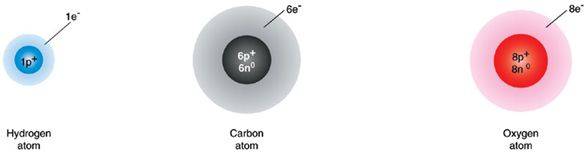 |
| Protons | a component of all atomic nuclei |
| carries a positive charge equal to that of the electron's negative charge | A proton |
| Neutrons | a neutral elementary particle |
| has a zero electrical charge & a mass equal to a proton | a neutron |
| Atomic # of Hydrogen | has 1 proton, so it has an atomic number of 1, 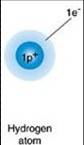 |
| The mass # of an element | the # of protons + the # of neutrons in each element, 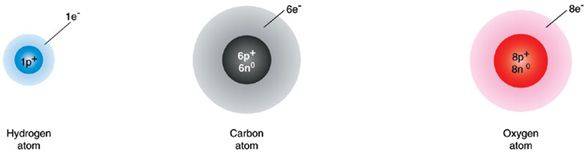 |
| eight | The atomic # of an oxygen atom, |
| sixteen | The mass # of an oxygen atom, |
| Mass # of Carbon | has 6 protons & 6 neutrons, so it has a mass # of 12, 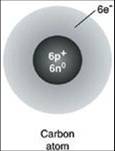 |
| Subatomic Particles | Neutrons, Protons, & Electrons |
| no charge | Neutrons |
| positive charge | Protons |
| negative charge | Electrons |
| nucleus | Protons and neutrons clumped in the center of the atom, 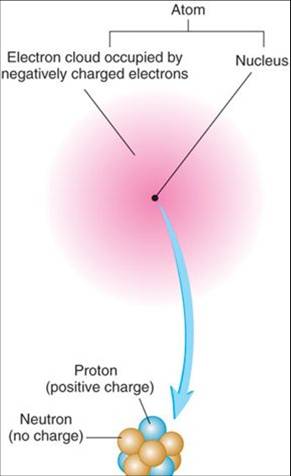 |


