| A | B |
|---|
| In order for organisms to be considered the same species, they must be able to | mate with each other and produce fertile offspring naturally. |
| The main way that new species start to form is | a group becomes physically isolated (separated). |
| Features that have the same structure and were inherited from a common ancestor are called | homologous structures., 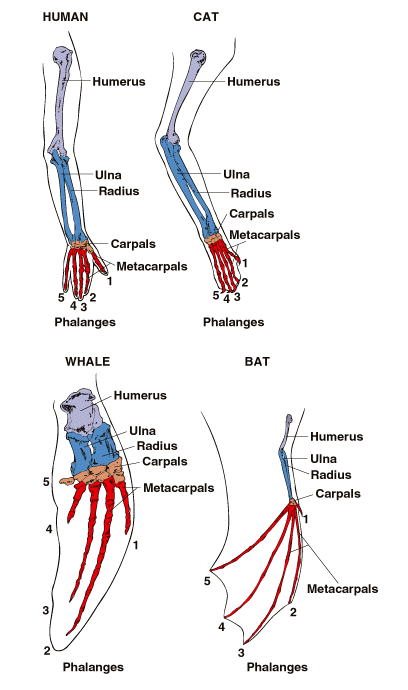 |
Which animal is the Tyrannosaurus most closely related to?, 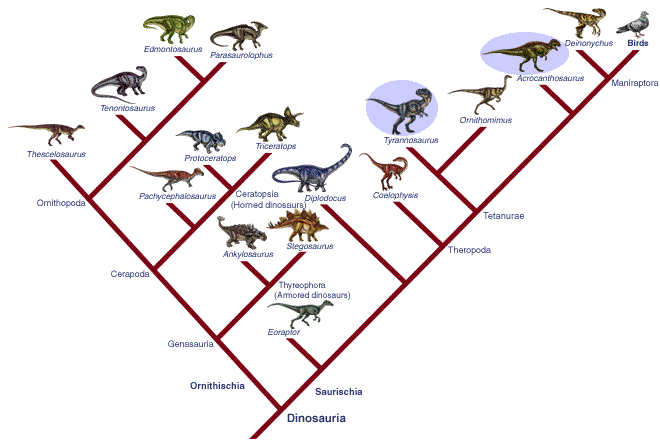 | Ornitmimus |
| Organisms are grouped into different domains or kingdoms based on | the makeup of their cells. |
| Both Archaea and Bacteria are | prokaryotes. |
| Related species have similar body features because | they have inherited many of the same genes from a common ancestor. |
| The earliest form of life on Earth is | bacteria. |
What does the picture show?, 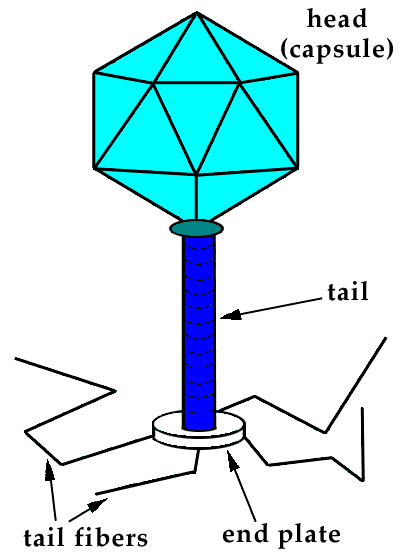 | A virus |
What does the picture show?, 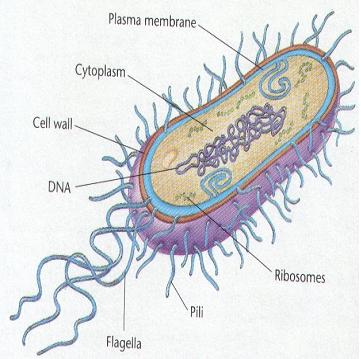 | A bacterium (single of bacteria) |
| Unlike bacteria, protists are | eukaryotes. |
| T/F: Protists can be autotrophs or heterotrophs. | True |
| Protists can move using | cilia or flagella. |
| Fungi reproduce using | spores. |
| Chloroplasts are special organelles that do | photosynthesis. |
What type of structure does this protist use to move?, 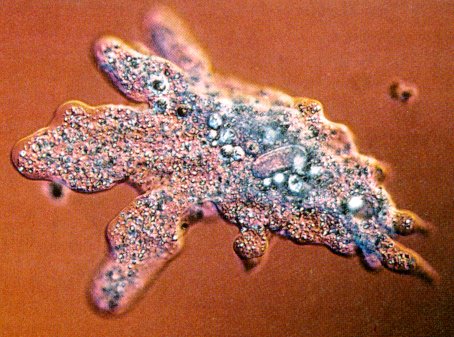 | Pseudopod |
| All mollusks have a | mantle and muscular foot. |
| Tapeworms are part of the phylum | nematoda (flatworms). |
| To move, echinoderms use | a water vascular system. |
| Like segmented worms, roundworms have a complete digestive system, but no | circulatory system. |
| Sponges have _______ symmetry. | No symmetry |
| Cnidarians use _____ _____ to capture prey. | Stinging Cells |
| Lungs are used by | adult amphibians, reptiles, birds, and mammals. |
| T/F: Amphibians have dry, scaly skin. | False (their skin is moist). |
| T/F: In some mammals, the offspring doesn't develop within the mother. | True (marsupials develop in pouches & monotremes develop in eggs). |
| Most physical digestion takes place in the | stomach. |
| Humans have a digestive system similar to that of | segmented worms. |
| Plants that have special tubes to carry food and water are called | vascular. |
| Angiosperms have protected seeds, but ________ have "naked" seeds. | Gymnosperms |
| The original source of ALL energy for EVERY ecosystem is the | sun. |
| Fruits come from flowers and contain | seeds. |
| Invasive species are problems for ecosystems because | they crowd out and harm the native species; plus, they spread very quickly. |
| The level of study that includes organisms of different species is called | community. |
| The level of study that contains all the same species is called | population. |
Which organism in the web gets the least amount of energy?, 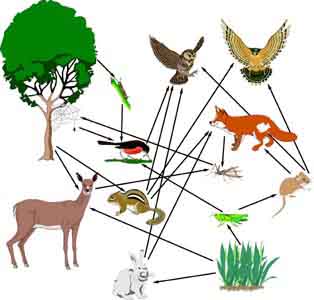 | The owl (top levels) |
| Which organism in the food web has the largest population?, | The grass (producers) |
| Primary consumers eat producers; those that eat primary consumers are called | secondary (or second-level) consumers. |



