| A | B |
|---|
| Enzyme | Any of several complex proteins that are produced by cells and act as catalysts in specific biochemical reactions, 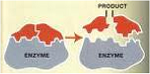 |
| Fatty Acid | Any of the group of a long chain of hydrocarbon derived from the breakdown of fats (through a process called hydrolysis). It has a single carboxylic group and aliphatic tail., 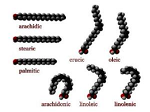 |
| Heterotroph | Are the consumers in the food chain, particularly the herbivores, carnivores and omnivores. All animals, some fungi and most bacteria are heterotrophs. They are not capable of producing their own food, 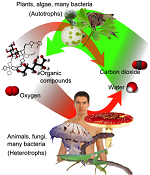 |
| Autotroph | Are the producers in a food chain, such as plants on land or algae in water. Autotrophs may be photoautotrophs or chemoautotrophs., 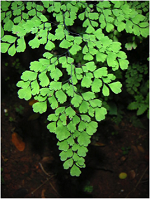 |
| Catabolism | Breakdown in living organisms of more complex substances into simpler ones together with release of energy, 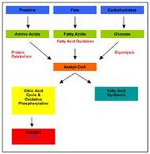 |
| Amino Acid | Molecules containing an amine group, a carboxylic acid group and a side chain that varies between different amino acids., 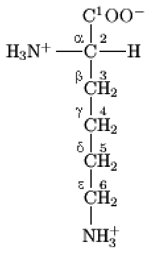 |
| Protein | Organic compounds made of amino acids arranged in a linear chain and folded into a globular form, 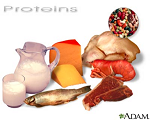 |
| Denaturation | Process in which proteins or nucleic acids lose their tertiary structure and secondary structure by application of some external stress or compound, such as a strong acid or base, a concentrated inorganic salt, an organic solvent or heat., 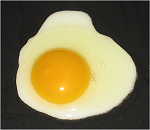 |
| DNA Replication | The process of duplicating the DNA to make two identical copies, one of which will be passed along to each daughter cell when the cell divides., 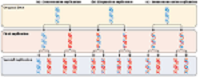 |
| Metabolism | The set of chemical reactions that happen in living organisms to maintain life., 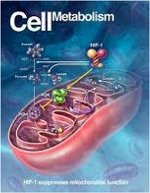 |
| Anabolism | The synthesis in living organisms of more complex substances (e.g., living tissue) from simpler ones together with the storage of energy, 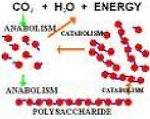 |
| Cloning | The use of dna manipulation procedures to produce multiple copies of a single gene or segment of dna, 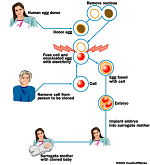 |


