 |
Java Games: Flashcards, matching, concentration, and word search. |
 |
|
Computer Basics 2
Vocabulary for computer terms that you will be using in this class or at home.
|
| A | B |
|---|
Keyboard, 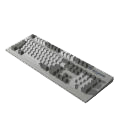 | A typewriter-like layer of keys used to enter text information into a computer. |
Central Processing Unit (CPU), 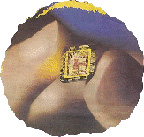 | The part of the computer hardware that controls all functions. |
Byte, 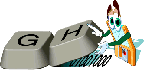 | The amount of storage required to hold one character. A set of 8 bits that means something to the computer, like a letter, number, or punctuation mark. For example, the byte 01001000 means a capital "H". |
| Megabyte | Equals 1,048,576 bytes, or 1024 kilobytes. The text of a six hundred page paperback book would require about one megabyte of ASCII storage. |
bit, 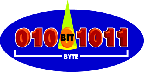 | A single number, either a 1 or 0, used for counting in the binary number system. A single bit can’t tell you much, so bits are usually gathered into groups of 8 to make a byte. For instance, 8 bits can tell your computer you mean a certain letter, number, or symbol like M, 9, o |
Hardware,  | The visible part of the computer system. |
| Gigabyte | is 1,073,741,824 bytes; The number of books it would take to fill the bed of a pickup; symphony in high-fidelity sound; broadcast quality movie. |
| Terabyte | is 1,099,511,627,776. Equal to 50,000 trees made into paper and printed. Equal to all books in the UT library. |
RAM, 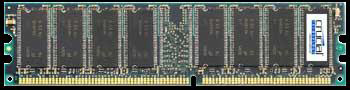 | stands for random-access memory. RAM contains bytes of information, and the microprocessor can read or write to those bytes depending on whether the RD or WR line is signaled. One problem with today's RAM chips is that they forget everything once the power goes off. That is why the computer needs ROM. |
Operating System, 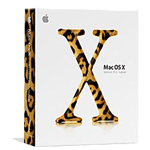 | The operating system defines our computing experience. It's the first software we see when we turn on the computer, and the last software we see when the computer is turned off. It's the software that enables all the programs we use. The operating system organizes and controls the hardware on our desks and in our hands. |
Monitor, 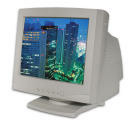 | Computer visual display device. |
Printer, 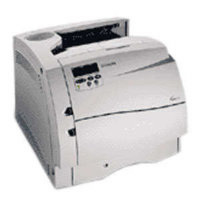 | An output device that produces print on paper. |
Mouse, 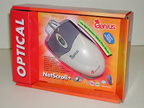 | A palm-size pointing input device used to control the cursor on a computer screen. |
CD-ROM,  | Disk that can hold 650 megabytes of text, graphics, movies, sound, and computer data. Read by an optical laser. |
Hard drive, 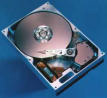 | a hardware device that permits the storage of data |
Cursor, 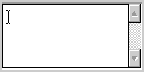 | An indicator on a monitor, frequently a blinking rectangle or line, that indicates the point of insertion on a screen. |
Software,  | Electronic instructions that tell your computer what to do. Without software, a computer is like an airplane without a pilot. There are two types of software: operating system software and application software. |
|
|
|
|
|
|
| |

