| A | B |
|---|
| measured in coulomb | charge (Q) |
| measured in amps | current (I) |
| measured in volts | voltage (V) |
| means the same as voltage | potential difference |
| formula for power | P = VI |
| V= IR | Ohm's Law |
| definition of resistance | R = V/I |
| Energy delivered formula | E = VIt |
| P = E/t | connection between power and energy |
| resistors in series | Rt = R1 + R2 + R3 |
| resistors in parallel | 1/Rt = 1/R1 + 1/R2 + 1/R3 |
| ohmic | resistance is constant |
| non-ohmic | resistance is not constant |
| voltage divider formula | V(out) = R2/(R1 + R2) x V(in) |
| symbol for diode |  |
| symbol for LED |  |
| symbol for LDR | 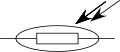 |
| thermistor | 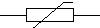 |
| V(RMS) | = V(p)/2^0.5 |
| V(p-p) | = 2 x V(p) |
| frequency (f) | = 1/T |
| units of frequency | Hertz (Hz) |
| dc value of mixed AC-DC signal | average of signal |
| signal | voltage against time (input or output) |
| capacitors | block DC signals |
| photons | 'packets' of light energy |
| photodiode symbol | diode in circle + light coming in |
| forward biased diode (any kind) | diode + battery pushing current with the arrow |
| reverse (or negative) biased diode (any kind) | 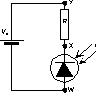 |
| unbiased diode (any kind) | 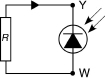 |
| LDR behaviour | resistance falls with increased light levels |
| thermistor behaviour | resistance changes with temperature |
| behaviour of reverse-biased photodiodes | current proportional to light intensity |
| transistor symbol | 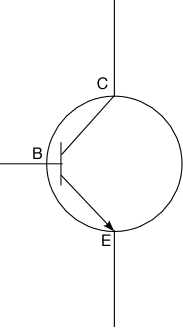 |
| quiescent point | (correct) bias point |
| another name for quiescent point | operating point |
| bias in a transistor amplifier | voltage applied to base |
| current gain | Ic/Ib |
| voltage gain | V(out, AC)/V(in, AC) |
| transfer graph | graph of V(out, DC) vs V(in, DC) |
| another name for transfer graph | characteristics graph |
| clipping distortion | 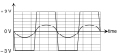 |
| linear amplifier | v(out) same shape as v(in) |
| inverting amplifier | AC output upside down (out of phase) |
| cut-off | transistor switched off |
| cause of cutoff | base voltage too low |
| saturation | transistor near zero resistance |
| cause of saturation | base voltage too high |
| phototransistor | transistor with light sensitive base |
| phototransistor behaviour | Ic proportional to light intensity on base |
| intensity modulation | changing amplitude of AC signal |
| incandescent lights | hot wire lights |
| carrier wave | wave that carries 'information' |
| demodulation | analysis of changing amplitude (to get 'information') |
| CRO | cathode ray oscilloscope (draws graph of V vs t) |
| energy transfer in photoelectronic devices | some to electrons; some to heat |
| effect of greater RC in npn amplifier | larger gain |
| Ic is equal to: | Ib + Ie |
| base current is: | much smaller than Ic or Ie |
| Ic is nearly equal to: | Ie |
| output (AC) voltage of npn amplifier is equal to: | AC voltage across collector resistor |
| V(Rc) + V (Re) + V(transistor) = | V (supply) |
| supply voltage to amplifier | battery voltage |
| typical Vbe | 0.7 V |
| V(Re) + V be = | voltage at base of transistor |
| purpose of voltage divider R1 and R2 | to set the base voltage |
| fastest photosensitive device of LDR, PT and PD? | PD |
| slowest photosensitive device of LDR, PT and PD? | LDR |


