| A | B |
|---|
| The movement of organisms into a given area from another area is called ____. | immigration p. 1172 |
| When organisms leave a certain area, the movement is called ___. | emigration p. 1172 |
| For a population to grow, the ____ must be bigger than the ____ | birthrate must be larger than the deathrate (assuming no immigration or emigration) p. 1176 |
| The number of individuals per unit area or volume is a population’s ____. | density p. 1171 |
| Under ideal conditions with unlimited resources, a population will grow _____. | exponentially p. 1176 |
Which type of population growth does this graph show?, 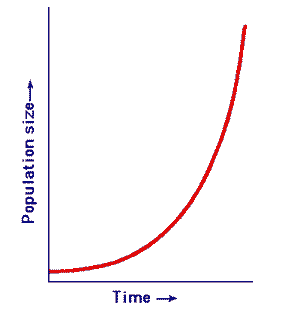 | Exponential growth (Can only happens under ideal conditions with unlimited space, food and no predators) p. 1176, |
Which type of population growth does this graph show?, 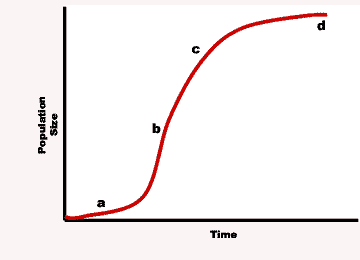 | Logistic growth p. 1178, |
| At which point in the graph below is the population growth rate accelerating?, | Point A (The graph line should be more curved in an upward direction. It looks a little too linear, but I had a hard time drawing it that way) p. 1178, |
| At which point in the graph below is the population growth rate the highest?, | The population growth "rate" is the highest at point B. (You can determine the growth rate by finding the slope of the line tangent to the curve. Remember, slope = rise divided by run. In this case, the rise is the current population. The run is time. Dividing population by time gives you the population growth "rate.") p. 1178, |
| At which point in the graph below is the population growth rate starting to slow down?, | Point C p. 1178, |
| At which point in the graph below is the population the highest?, | The population is the highest at point D (look along the y-axis) p. 1178, |
| At which point on the graph below is the population growth rate the lowest?, | The population growth rate is lowest at point D (notice that the population, even though it is at its highest, has stopped growing) p. 1178, |
| At which point in the graph below is the population at the carrying capacity?, | The population has reached the carrying capacity at point D. Remember, the carrying capacity is the maximum number of individuals that the environment can support. p. 1178, |
Which of these two age structure diagrams shows the typical human age structure of a typical third-world country?,  | A p. 1189, |
| Which of these two age structure diagrams shows the typical human age structure of a first world modernized country?, | B p. 1189, |
| The age structure diagram on the left shows a ____ birth rate and a ____ death rate., | high birth rate and high death rate. p. 1189, |
| The age structure diagram on the right shows a ____ birth rate and a ____ death rate., | low birth rate and low death rate. p. 1189, |
The graph below shows population fluctuation typical of a(n) _____ relationship., 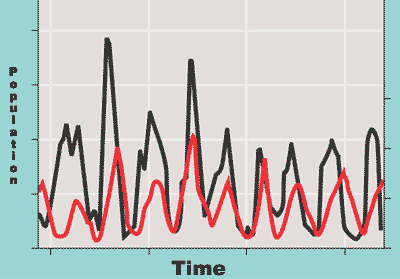 | predator-prey p. 1185, |
Which country below is likely to experience a decline in population due to its age structure?,  | Italy. Notice the small percentage of young people in the population. As they reach child-baring age, the country's birth rate is likely to fall. Conversely, Afghanistan has a large proportion of its population in child-baring or soon to be child-baring age categories and will likely see rapid population growth unless war and famine cause the death rate to match the birth rate. p. 1189, |
Which survivorship curve would represent the human species? Which would represent a typical fish species?, 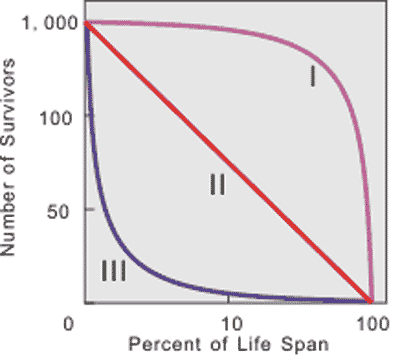 | Humans would be type I due to their fairly high infant survival rate. Fish would be type III because most lay many eggs and generally don't guard them or protect the juveniles, so most fish are eaten when they are small, if they even manage to make it out of their egg. p. 1174, |
| Selection that favors life history traits that maximize reproduction in uncrowded environments are called ____ selection or density-____. | r-selection or density-independent selection p. 1181 |
| Selection that favors life-history traits that allow for survival under crowded competitive conditions is known as ____ selection or density-____. | K-selection or density-dependent selection p. 1181 |
| The maximum population size that can be supported by the available resources, symbolized as K. | carrying capacity p. 1177 |
| The study of populations in relation to the environment, including environmental influences on population density and distribution, age structure, and variations in population size. | population ecology p. 1170 |
| Referring to any characteristic that varies according to an increase in population density. | density-dependent p. 1182 |
| A behavior in which an animal defends a bounded physical space against encroachment by other individuals, usually of its own species. | territoriality p. 1172 |
| Referring to any characteristic that is not affected by population density. | density-independent p. 1182 |
| Disease is a density-_____ factor that limits population growth. | density-dependent p. 1182 |
| Harsh winters would be considered as density-______ factors that limit population growth. | density-independent p. 1182 |
| A(n) _______ is a group of individuals of a single species living in the same general area. | population p. 1170 |
| What is the current human population of the planet (to the nearest billion)? | 7 billion (The book says 6.8 billion, but since this book was published, it has gone over 7 billion. This is pretty scary considering that when Mr. McGee was your age, there were only about 4.5 billion people on the planet) p. 1187 |



