| A | B |
|---|
| A group of populations of different species living close enough to interact is called a biological ________. | community p. 1194 |
| Interaction between different species is called a(n) ____. | interspecific interaction (interactions between members of the same species would be called intraspecific interactions) p. 1194 |
| What are the five possible types of interactions that different species can have with each other? | competition, predation, symbiosis, herbivory, and facilitation p. 1194 |
| A symbiotic relationship between two species in which one benefits at the expense of the other is called ____. | parasitism p. 1198 |
| A symbiotic relationship between two species in which one benefits while the other neither benefits nor is harmed is called ____. | commensalism p. 1199 |
| A symbiotic relationship between two species in which both benefit is called ___. | mutualism p. 1199 |
| Mutualism, parasitism and commensalism are all types of ____ relationships. | symbiotic p. 1198 |
| ______ occurs when different species compete for a particular resource that is in short supply. | interspecific competition (competition between members of the same species would be called intraspecific competition) p. 1195 |
| Strong interspecific competition can lead to the extinction of one of the two competing species in a process called ____. | competitive exclusion p. 1195 |
| The sum total of a species' use of the biotic and abiotic resources in its environment is called the species' _____. | ecological niche p. 1195 |
| "Habitat" is to "address" as "niche" is to ____. | profession p. 1195 |
| Two species cannot coexist in a community if their ____ are identical. | niches p. 1195 |
| What is the difference between a species "fundamental niche" and its "realized niche"? | The fundamental niche is the niche that a species could occupy if it wasn't in competition for any parts of that niche. The realized niche is the niche that it is limited to due to interspecific competition. For example, using the profession analogy, Mr. McGee's fundamental niche could include professional football player if everyone else was slow, weak, and small. p. 1195 |
The diagram below shows the difference between brown barnacle's _____ niche (shown on the left) and its _____ niche (shown on the right),  | realized niche (left) vs. fundamental niche (right) p. 1195,  |
| The differentiation of niches that enables similar species to coexist in a community is called _____. | resource partitioning p. 1195 |
| Closely related species that share parts of the same geographic range are called _____ populations. | sympatric (think sym = same and patric = homeland; patriotic is to be proud of your homeland) p. 1196 |
| Closely related species that DO NOT share parts of the same geographic range are called _____ populations. | allopatric p. 1196 |
| The tendency for characteristics (such as beak size) to be more divergent (different) in sympatric populations (populations that occupy the same area) of two species than in allopatric (geographically separated) populations of the same two species is called _____. | character displacement p. 1196 |
| _____ is an interspecific interaction in which one species kills and eats the other species. | Predation p. 1197 |
The picture below demonstrates the concept of _____ which allows several different species (in this case, Anole lizards) to live in the same general area.,  | resource partitioning (notice how their niches differ primarily because of the different microhabitats that they occupy) p. 1195, |
| Another term for camouflage is ____. | cryptic coloration p. 1197, 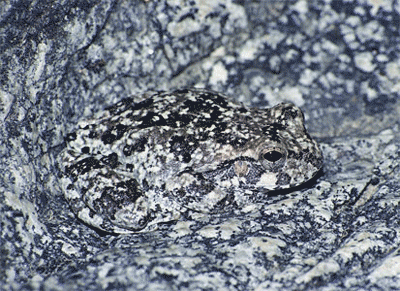 |
| The tree frog in the picture below is demonstrating ______ coloration, | cryptic coloration p. 1197, |
| Another term for cryptic coloration is ____. | camouflage p. 1197, |
Animals that are poisonous (like this frog) often display bright warning colors known as ______ coloration.,  | aposematic coloration p. 1197, |
| In ______ mimicry, a tasty harmless organism evolves to look like an unpalatable (yucky), poisonous, or dangerous organism. | Batesian mimicry (like the hawkmouth larva that has evolved to look like a snake which gives it an evolutionary advantage for survival) p. 1197, 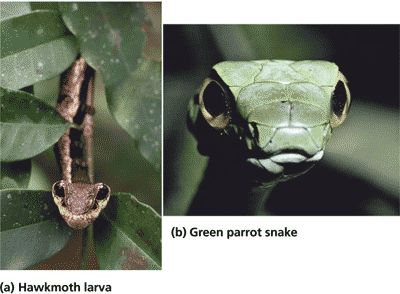 |
| In _____ mimicry, two harmful species evolve to look more like each other, ensuring a greater survival rate as it becomes easier for predators to remember to avoid them. | Mullerian mimicry (like the bee and the yellow jacket in the picture below) p. 1197, 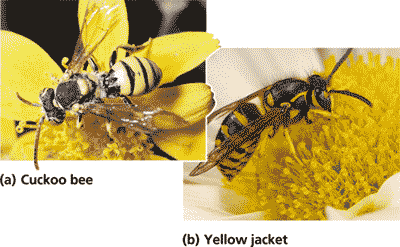 |
| _____ mimicry is designed to confuse predators, giving the prey a better chance of escaping. | Self-mimicry (The eyes on the moth and the spot near the tail of the four-eyed butterfly fish are meant to confuse the predator as to which direction the organism will move when it reacts to the predator. It is called self-mimicry because one body part mimics another body part. No, this isn't in the book, but it is important and I expect you to know it), 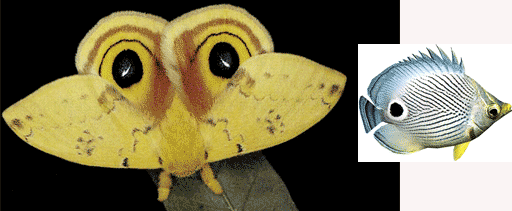 |
| What are the two main types of defensive adaptations that plants use against herbivores? | Thorns and chemical toxins |
| The type of predation in which an animal eats an autotroph is called _____. | herbivory p. 1198 |
| The organism from which a parasite derives its nourishment is called the ____. | host p. 1198 |
| Parasites that live inside the body of their host are called ____. | endoparasites (example - tapeworm) p. 1198 |
| Parasites that live on the surface of their host are called ____. | ectoparasites (example - a tick) p. 1198 |
| Parasitism in which the parasite (usually a wasp) lays eggs on or in the body of a living host so that the larva can feed upon and eventually kill the host is called ____. | parasitoidism (In the picture below, a cicada killer wasp is paralyzing a cicada with a sting. The wasp will then lay eggs inside the abdomen of the still living cicada. When the larva hatch, they will eat their way out of the cicada. And you thought you had it rough.) p. 1198, 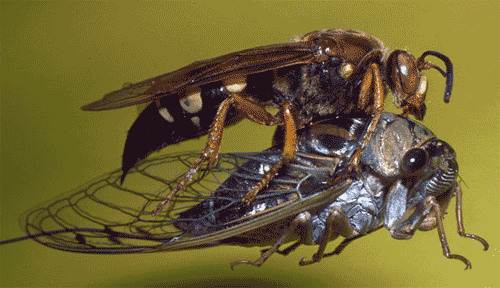 |
| What is a pathogen? | A pathogen is anything that causes disease. p. 1213 |
| A disease-causing agent is called a(n) ____. | pathogen p. 1213 |
| An evolutionary change in one species which then acts as a selective force on another species, whose adaptations in turn act as a selective force on the first species, is an example of _____. | coevolution (Think of prey that adapt to fast predators by becoming faster. In turn, only the fastest predators can catch enough prey to survive and reproduce, so the predators become faster, necessitating the evolution of even faster prey, and so on, back and forth) p. 1199 |
| What are the two components of species diversity? | species richness and relative abundance p. 1200 |
Which forest below demonstrates the greatest diversity?,  | Forest A (Although both forests have the same species richness, the relative abundance in forest A is more balanced, giving it an overall higher rate of diversity) p. 1201, |
| Which forest below demonstrates the greatest species richness?, | They are both equal because both forests have 4 different species of plants p. 1200, |
| The structure of the feeding relationships between organisms in a community is called the ____ structure of the community. | trophic p. 1202 |
The picture below represents a(n) ____.,  | food chain p. 1202, |
The picture below represents a(n) ____.,  | food web p. 1202, |
| The first (or bottom) level of a food chain is made up of the ____. | primary producers p. 1202,  |
| The second level of a food chain is made up of the ____. | primary consumers p. 1202, |
| The primary consumers in a terrestrial ecosystem are called ____. | herbivores p. 1202, |
| The primary consumers in an aquatic ecosystem are usually ____. | zooplankton p. 1202, |
| The primary producers in an aquatic ecosystem is mostly made up of ____. | phytoplankton (in shallow waters, there may also be some attached plants and algae. Plankton, by definition, are free-floating) p. 1202, |
| The ______ hypothesis says that food chains are short because most of the energy at each trophic level is lost as heat instead of being passed onto the next trophic level, so eventually, there isn't enough energy to sustain much more than four or five trophic levels. | energetic hypothesis (most evidence supports this hypothesis over the dynamic stability hypothesis) p. 1203 |
| The _______ hypothesis says that food chains are short because natural fluctuations of populations at lower levels have a magnified effect at higher levels, potentially causing the extinction of top level predators during a bad year. | dynamic stability hypothesis (most evidence favors the energetic hypothesis over this hypothesis) p. 1203 |
| Most food chains consist of no more than ____ trophic levels. | five p. 1203 |
| _____ species are those species in a community that are the most abundant (or have the most biomass). | Dominant species p. 1204 |
| A _____ species is a species whose removal would cause a large effect on community structure. | keystone species (keystone species are usually low in abundance but play a pivotal ecological role in the community) p. 1204 |
| _____ species are species, generally introduced into a community by humans, that often times out-compete native species because they lack their own native predators and diseases in their new habitat. | Invasive species p. 1202 |
The graph below suggests that the seastar Pisaster ochraceous is a _____ species in tidepool communities., 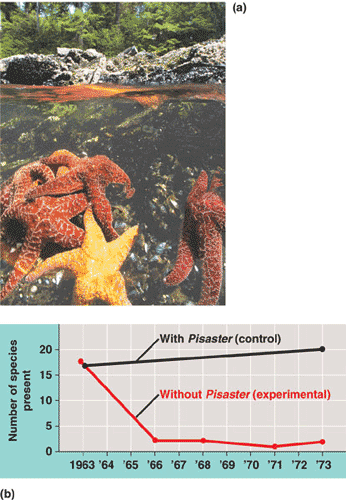 | keystone species (The seastar Pisaster is a predator of a mussel called Mytilus californianus which is a dominant species. As long as the Mytilus mussel population is kept in check by the seastar, other species can live in the area. But left unchecked, the Mytilus mussel will outcompete most other species for space in the intertidal zone, lowering the biodiversity of the community as the graph shows) p. 1205, |
| The total mass of a population is called the population's _____. | biomass (total dry mass = normal mass minus water mass) p. 1203 |
Organisms that strongly influence community structure by physically altering the environment, such as the beaver below, are called _____ or _____., 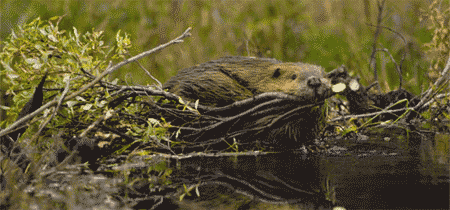 | ecosystem engineers or foundation species p. 1205, |
| By altering the structure or dynamics of the environment, foundation species act as ______ that have a positive effect on the survival and reproduction of some other species., | facilitators, |
| The _____ model of community organization postulates a unidirectional influence from lower to higher trophic levels. In this model, if you want to change the structure of this type of community, you would start by changing something about the primary producers, the effect of which would ripple up through the food chain. | bottom-up model p. 1206 |
| The _____ model of community organization postulates a unidirectional influence from higher to lower trophic levels. In this model, if you want to change the structure of this type of community, you would start by changing the abundance of a top predator, the effect of which would ripple down through the food chain. | top-down model or trophic cascade model p. 1206 |
| A biologist was hired to slow down the eutrophication of a lake. Residents didn't want to change anything that they were doing, like fertilizing their lawns, so the biologist removed many of the fish from the lake. Sure enough, the single-celled algae that had been causing the greenish water started to disappear and the water became clearer. What tactic was the biologist using? Why did the biologist's tactics work and what does this suggest about the community organization of the lake? | The tactic being used in this case is biomanipulation. Zooplankton are the primary predators of phytoplankton (the single-celled algae that make the water look scummy). Fish eat zooplankton. By removing the fish, the zooplankton population increased which caused a decrease in the phytoplankton population. The fact that the biologist was successful by manipulating the top of the food chain indicates that the lake has a top-down model of community organization p. 1206 |
| The ________ hypothesis (widely supported by studies) suggests that moderate levels of disturbances (such small scale fires) foster greater species diversity than low levels (which allows dominant species to become established, driving out other species) or high levels of disturbance (that can wipe out many species completely). | intermediate disturbance hypothesis p. 1207 |
| The orderly and predictable appearance and replacement of species as a community grows back after a disturbance is called _______. | ecological succession p. 1208,  |
The type of succession taking place in the picture below is _______.,  | primary succession (You are starting from scratch in this type of succession because you don't even have organic soil for life to colonize. Another example where primary succession would have to occur would be after a glacier retreats, leaving just rubble) p. 1208, |
The type of succession taking place in the picture below is _______.,  | secondary succession (After a forest fire, there is still very rich organic soil and probably some trees and seeds that survived. Another example where secondary succession occurs is on abandoned farmland) p. 1208, |
| By altering the soil properties, _______ species permit new plants to grow, and the new plants in turn alter the environment (by providing shade for instance) that allow still more plant species (like shade tolerant trees) to come in and replace the original plant species in a process called ______. | pioneer plant species, ecological succession p. 1208 & 1210 |
| The species richness of an area correlates positively with increasing ______ and decreasing ______. | increasing evapotranspiration and decreasing latitude (regions closest to the equator with plenty of available water have the highest species diversity in the world) p. 1211 |
| The dry weight of organic matter comprising a group of organisms in a particular habitat. | biomass p. 1203 |
| The idea that long food chains are less stable than short chains. | Dynamic stability hypothesis p. 1203 |
| Differences in the abundance of different species within a community. | relative abundance |
| The concept that the length of a food chain is limited by the inefficiency of energy transfer along the chain. | energetic hypothesis p. 1203 |
| The evaporation of water from soil plus the transpiration of water from plants. | evapotranspiration p. 1211 |
| A type of succession that occurs where an existing community has been cleared by some disturbance that leaves the soil intact. | secondary succession p. 1208 |
| A mutual mimicry by two unpalatable species. | Mullerian mimicry p. 1197 |
| The bright coloration of animals with effective physical or chemical defenses that acts as a warning to predators. | aposematic coloration p. 1197 |
| The number of species in a biological community. | species richness p. 1200 |
| A model of community organization in which mineral nutrients control community organization because nutrients control plant numbers, which in turn control herbivore numbers, which in turn control predator numbers. | bottom-up model p. 1206 |
| The model of communities that emphasizes that they are not stable in time but are constantly changing after being buffeted by disturbances. | non-equilibrium model p. 1206 |
| The division of environmental resources by coexisting species such that the niche of each species differs by one or more significant factors from the niches of the other coexising species. | Resource partitioning p. 1195 |
| In general, the larger the geographic area of a community, the greater the _____. | number of species (species richness) p. 1211 |
| The concept that when populations of two similar species compete for the same limited resources, one population will use the resources more efficiently and have a reproductive advantage that will eventually lead to the elimination of the other population. | competitive exclusion p. 1195 |
| The elaborate, interconnected feeding relationships in an ecosystem. | food web p. 1202 |
| The number AND relative abundance of species in a biological community. | species diversity p. 1200 |
| A type of ecological succession that occurs in a virtually lifeless area, where there were originally no organisms and where soil has not yet formed. | primary succession p. 1208 |
| A model of community organization in which predation controls community organization because predators control herbivores, which in turn control plants, which in turn control soil nutrient levels. | top-down model (or trophic cascade model) p. 1206 |
| A species that is not necessarily abundant in a community yet exerts strong control on community structure by the nature of its ecological role or niche. | keystone species p. 1204 |
| Species that are active at night are said to be ______. | nocturnal p. 1196 |
| Species that are active during the day are said to be ______. | diurnal p. 1196 |
| Species that are active around sunrise or sunset (twilight hours) are said to be ______. | crepuscular (This is not in the book, but since they mention nocturnal and diurnal in this chapter, I want you to know crepuscular too. Many fish are crepuscular) |
| A relationship in which two or more different species live in direct and intimate contact with each other is called _____. | symbiosis p. 1198 |
| A type of mutualism in which at least one of the species involved has lost the ability to survive on its own. | obligate mutualism p. 1199 |
| A type of mutualism in which both of the species involved could survive on their own. | facultative mutualism p. 1199 |
| _______ is an interaction between two species that has a positive effect on at least one of them, but is not classified as a type of symbiosis because the two species are NOT living in direct and intimate contact with one another. | Facilitation (An example is a plant called black rush which makes the soil more hospitable for other plants. In studies in which this species was removed, 50% fewer plant species could grow nearby) p. 1200 |
| The Shannon Diversity index is an equation for quantitatively determining the _____ of an area. | species diversity {H = -(pAl*ln pA + pB*ln pB + pC*ln pC + . . .)} where p = the % of each species found in the area. p. 1200 |
| Which type of community is more likely to resist the establishment of an invasive species; one with a high species diversity or one with a low species diversity? | high p. 1202 |
| Another word for an ecosystem engineer is a(n) _____. | foundation species (these are species that effect other species by dramatically altering the environment) p. 1205 |
| Another word for a foundation species is a(n) _____. | ecosystem engineer (these are species that effect other species by dramatically altering the environment) p. 1205 |
| Another name for the top-down model, in which predation controls community organization, is the _____ model. | trophic cascade model p. 1206 |
| Another name for the trophic cascade model, in which predation controls community organization, is the _____ model. | top-down model p. 1206 |
| The use of adding or removing one type of species to control the population of another species is called ______. | biomanipulation p. 1206 |
| According to the island equilibrium model, the species richness correlates strongly with the ______ and to a lesser extent, the ______. | size of the island, how close the island is to the mainland p. 1213 |
| What is a zoonotic pathogen? | A pathogen that has been transferred to humans from other animals (an example is avian flu) p. 1214 |
| The root word "ecto-" means ____. | outer |
| The root word "endo-" means ____. | inner |
| The root word "inter-" means ____. | between (For example, interspecific competition is competition between species, while intraspecific competition is competition within a population of the same species. "Intra-" means within) |
| The root word "intra-" means ____. | within (For example, intraspecific competition is competition between members of the same species, while interspecific competition is competition between different species. "Inter-" means between) |



