| A | B |
|---|
| ______ produce their organic molecules from carbon dioxide and other organic raw materials obtained from the environment. | Autotrophs p184 |
| _______ are autotrophs that use light as a source of energy to synthesize organic substances. | Photoautotrophs p184 |
| What are three types of organisms that are photoautotrophs? | All plants, some Protists and some Prokaryotes p184 |
| Photosynthesis converts _____ energy to the ______ energy of food. | light, chemical p184 |
| _____ are the major sites of photosynthesis in most plants. | Leaves p186 |
What is "B" referring to?, 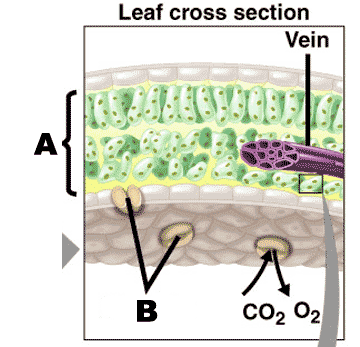 | stomata p186, |
What is #1 pointing to?,  | a thylakoid p186, |
| What is #2 pointing to?, | A granum (a stack of thylakoids) p186, |
| What is #3 pointing to?, | The stroma p186, |
| What is the net chemical equation for photosynthesis? | The equation below shows the net usage and production of molecules in photosynthesis. In reality, 12 water molecules are used as reactants and 6 water molecules are produced. p187,  |
| Energy from the sun is used to produce the high energy molecules NADPH and ATP during the ______ reactions of photosynthesis. | light p188,  |
| Energy from the sun is used to produce the high energy molecules ______ and ______ during the light reaction of photosynthesis. | NADPH and ATP p188, |
| Electrons are stripped from water, producing hydrogen ions and oxygen molecules during the ______ reaction of photosynthesis. | light p188, |
| Electrons are stripped from _____, producing hydrogen ions and oxygen molecules during the light reaction of photosynthesis. | water p188 |
| _______ are stripped from water, producing hydrogen ions and oxygen molecules during the light reaction of photosynthesis. | electrons p188, |
| Electrons are stripped from water, producing _________ and ________ molecules during the light reaction of photosynthesis. | hydrogen ions and oxygen molecules p188, |
| The _____ reaction of photosynthesis takes place on the thylakoid membrane. | light p189, |
| The light reaction of photosynthesis takes place on the _________. | thylakoid p189, |
| The _______ cycle takes place in the stroma of the chloroplast. | Calvin p189 |
| The Calvin Cycle takes place in the ______ of the chloroplast. | stroma p189 |
Which molecule belongs in the "A" spot?,  | water p188, 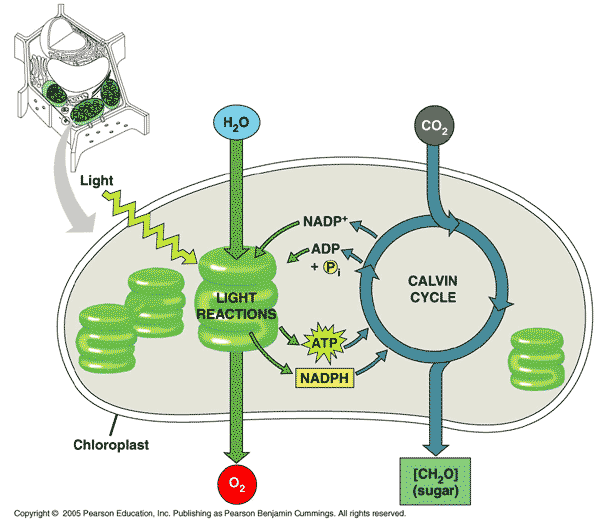 |
| Which molecule belongs in the "B" spot?, | oxygen p188, |
| Which molecule belongs in the "C" spot?, | carbon dioxide p188, |
| Which molecule belongs in the "D" spot?, | [CH2O] This is the generic formula for a carbohydrate. The actual carb that exits the Calvin cycle is a triose sugar called Glyceraldehyde-3-phosphate (G3P). This molecule can be linked to form glucose, sucrose, or starch. Or it can be used as raw material to make amino acids and lipids. p188, |
| Which molecules belongs in the "E" spot?, | NADP+ and ADP and P p188, |
| Which molecules belong in the "F" spot?, | NADPH and ATP p188, |
What is "A" pointing to?,  | photosystem I (a.k.a. P700) p197, |
| What is "C" pointing to?, | NADP+ (NADPH) p197, |
| What is the final electron receptor in the light reaction of photosynthesis? | NADP+ (In cellular respiration, it is oxygen. However, whereas the electrons at the end of the electron transport chain of cellular respiration contain very little potential energy, the electrons that end up in NADP+ to form NADPH still contain a significant amount of potential energy, so NADPH, unlike water, is an energy carrier and will be used in the next phase, the Calvin Cycle, to drive endergonic reactions that build up carbohydrates) p195 |
| What supplies electrons to the electron transport chain of photosynthesis? | Water (when it is split) p194 |
| Where do hydrogen ions end up when they are moved by active transport during the light reaction of photosynthesis? | inside the thylakoid space p196, |
| In which direction do protons (aka - hydrogen ions) flow through ATP synthase in the light reaction of photosynthesis? | From the thylakoid space out to the stroma of the chloroplast. p196, |
| What is "D" pointing to?, | Photosystem II (a.k.a. P680) p197,  |
| What is "E" pointing to?, | Electron transport chain of photosynthesis p197, |
| What is "G" pointing to?, | thylakoid membrane p197, |
| What is "H" pointing to?, | ATP synthase p197, |
| What is "I" pointing to?, | stroma of the chloroplast p197, |
What type of electromagnetic radiation is in the "D" spot?,  | visible light p189,  |
| Violet light has ____ energy, _____ wavelength and ______ frequency compared to red light., | violet light has greater energy, shorter wavelength and higher frequency compared to red light p189, |
| The frequency of electromagnetic radiation is inversely proportional to ______ but directly proportional to _____. | frequency is inversely proportional to wavelength but directly proportional to the energy of the ray. p189 |
| Where do the ATP and NADPH that are produced during the light reaction head next? | the Calvin Cycle pp198&199 |
| The light reactions convert light energy to the chemical energy of ____ and _____. | ATP and NADPH p188 |
| When electromagnetic energy hits matter, it can either be _____, _____, or _____ depending on the wavelength of energy and type of matter. | absorbed, reflected, or transmitted p190 |
| When electromagnetic energy hits matter, it can either be absorbed, reflected, or transmitted depending on the _______ and _____. | wavelength of energy and the type of matter p190 |
The red arrow signifies ______., 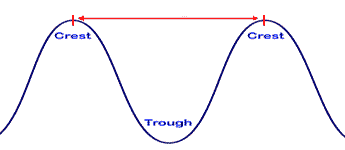 | The wavelength of this wave p189, |
| The Calvin Cycle uses _____ and _____ to convert ______ to sugar. | ATP, NADPH, carbon dioxide p198 |
| The Calvin cycle for most plants occurs during the ____. | day p189 |
| Which enzyme helps fix carbon dioxide from the atmosphere in the Calvin cycle? | Rubisco pp.198&199 |
| When the ________ are open to take in carbon dioxide during the day, the plant becomes vulnerable to water loss through _________. | stomata, transpiration p199 |
| Which alternate method of carbon fixation reduces photorespiration by separating carbon fixation from the Calvin cycle spatially? | C4 (Carbon fixation takes place in the outer mesophyll cells and is then funneled into the inner bundle-sheath cells where the Calvin Cycle takes place. This keeps the carbon dioxide concentrations high for rubisco) p200, 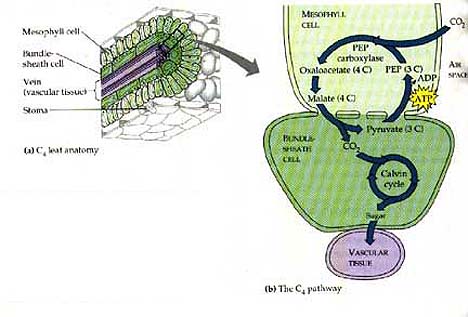 |
| Which alternate method of carbon fixation reduces photorespiration by separating carbon fixation from the Calvin cycle temporally? | CAM (CAM plants fix carbon dioxide at night and store the carbon in organic acids until daytime when the carbon is funneled into the Calvin Cycle. Separating something temporally means separating something by time, in this case, day versus night ) pp201&202, 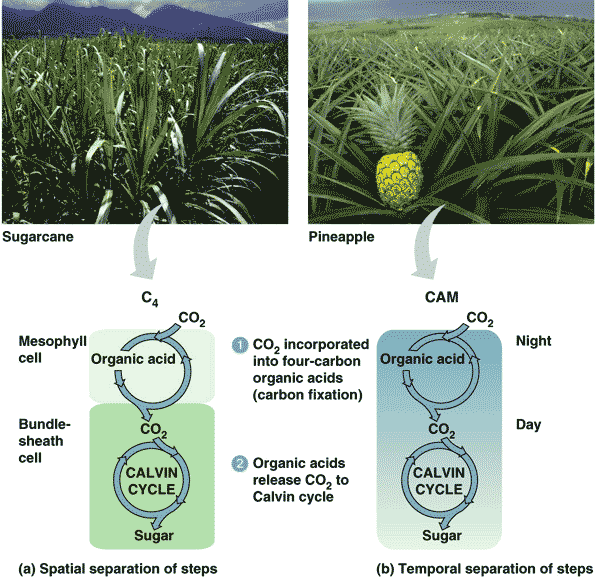 |
| Pineapples and most cacti are _____ plants (named for their mode of carbon fixation) | CAM p201, |
| Most plants, including rice, wheat, and soybeans are ____ plants (named for their mode of carbon fixation). | C3 (They are called C3 plants because the first product after carbon fixation is the 3 carbon molecule 3-phosphoglycerate) p200 |
| Which method of carbon fixation keeps stomata closed during the hot daytime hours and opens them up at night to fix carbon dioxide into organic molecules that will be broken down during the day to provide carbon dioxide to the Calvin Cycle? | CAM pp201&202, |



