| A | B |
|---|
| The number of chromosomes in a gamete is represented by the letter ___. | n p251 |
| A carrot has a diploid number of 18. What is it's haploid number? | 9 p251 |
| Gametes are normally produced by the process of ___. | meiosis pp251&252, 
|
| Another word for sex or reproductive cell is ___. | gamete p249 |
| What are the two main types of gametes? | sperm and egg p249 |
| During which stage of meiosis do chromosomes undergo synapsis to pair up and connect with each other? | prophase I (Below is a pair of homologous chromosomes, loosely attached to each other. Each chromosome is duplicated as a pair of sister chromatids. This formation is often times called a tetrad) p254, 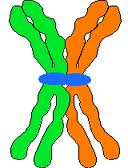 |
| During which stage of meiosis do homologous chromosomes line up in the middle of the cell? | metaphase I p254 |
| During which stage of meiosis do sister chromatids separate from each other? | anaphase II p255 |
| What happens between meiosis I and meiosis II that reduces the number of chromosomes? | DNA replication does not occur but cytokinesis does. pp253-255 |
| When does DNA replication occur during meiosis? | Interphase I only (remember, there is no interphase II) p253 |
| What is the diploid number of chromosomes in humans? | 46 (also written as 2n=46) p251 |
| What is the haploid number for humans? | 23 (also written as n=23) p251 |
| The gametes of fruit flies have 4 chromosomes each. What is the diploid number of chromosomes for fruit flies? | 8 (remember the diploid number is always twice the haploid number) p251 |
| _________ chromosomes are chromosomes that have the same types of genes, but are not identical. | Homologous (They are not identical because one came from the mother and the other from the father) p250,
|
| _________ are chromosomes that have the same types of genes, and are identical. | Sister chromatids p253 |
| A(n) _____ is a segment of DNA that has the instructions for making one protein. | gene p249 |
| An organism's gametes have ___ the number of chromosomes as are found in the organism's body cells. | half p251 |
| During which stage of meiosis might crossing over occur? | prophase I pp254&258 |
| When homologous chromosomes are lined up next to each other during meiosis, they might swap pieces of DNA. This phenomenon is called ___. | crossing over pp254&258 |
| Crossing over during meiosis is important because it increases ___. | genetic variation (= the number of different chromosomes, and therefore different combinations of traits, that offspring can inherit) p258 |
Which diagram is mitosis and which is meiosis?,  | Mitosis is on the left and meiosis is on the right. p256, |
Which process from meiosis is shown below and during which stage would it occur?, 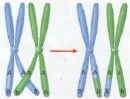 | The picture shows "crossing over" and it usually happens during prophase I. pp258&259, |
| The transmission of traits from one generation to the next is called _______ or ________. | inheritance or heredity p248 |
| The scientific study of heredity is called ______. | genetics p248 |
| The fusion of sperm and egg is called _____. | fertilization pp248&251 |
| Segments of DNA that act as hereditary units are called ____. | genes p249 |
| Reproductive cells are called _____. | gametes (they are also called sex cells or reproductive cells and include the egg and sperm) p249 |
| The DNA of eukaryotes is subdivided into _____ within the nucleus of the cell. | chromosomes p249 |
| Most human cells have ____ chromosomes. | 46 p249 |
| How many DNA molecules make up a chromosome? | 1 p.249 |
| One chromosome includes several hundred to a few thousand _____, each of which is a specific sequence of nucleotides within the DNA molecule. | genes p249 |
| Single-celled eukaryotic organisms can reproduce asexually by _____ cell division. | mitotic p249 |
| In ______ reproduction, a single individual is the sole parent and passes identical copies of all its genes to its offspring. | asexual p249 |
| A(n) _____ cell is any cell other than a gamete. | somatic p249 |
| A picture of all the chromosomes in the nucleus of a cell, arranged side-by-side in homologous pairs is called a(n) _____. | karyotype p250,  |
| The X and Y chromosomes are referred to as the _______. | sex chromosomes p250 |
| When considering a homologous pair of chromosomes, one came from the ____ and the other came from the ____. | father, mother p250 |
| Diploid cells are cells that have ____________. | both pairs of homologous chromosomes p251 |
| Haploid cells are cells that have _____________. | a single chromosome set (not both pairs of a homologous set) p251 |
| A fertilized egg is called a(n) _____. | zygote p251 |
| The type of cell division that reduces the number of chromosomes in half is called _____. | meiosis p252,
|
| During _______ of meiosis, homologous chromosomes separate. | Anaphase I p254,  |
| During ____ of meiosis, sister chromatids line up in a straight line. | Metaphase II p255,  |
| The picture below is called a(n) ______ ., | karyotype (These are the chromosomes of a male. You can tell because there is one X and one Y chromosome) p250, |
| In humans, what type of sex chromosomes do males have? | an X and a Y p250 |
| In humans, what type of sex chromosomes do females have? | two X chromosomes p250 |
Which stage of meiosis is shown below?,  | prophase I p254, |
Which stage of meiosis is shown below?, 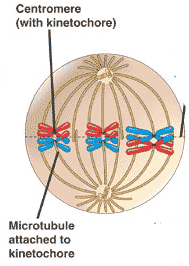 | metaphase I (Homologous chromosomes are lining up to get separated. In metaphase II, sister chromatids are lining up to get separated) p254, |
| Which stage of meiosis is shown below?, | anaphase I (Notice that homologous chromosomes are separating, but not the attached sister chromatids) p.254, |
Which stage of meiosis is shown below?, 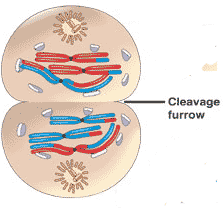 | telophase I p254, |
Which stage of meiosis is shown below?, 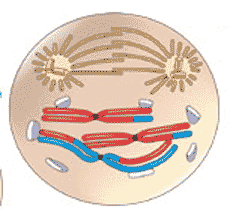 | prophase II p255, |
| Which stage of meiosis is shown below?, | metaphase II (If it was metaphase I, you would see homologous pairs of duplicated chromosomes, a.k.a., tetrads, lined up) p255, |
Which stage of meiosis is shown below?,  | anaphase II (If it was anaphase I, you would see homologous chromosomes pulling apart with sister chromatids still stuck together) p255, |
Which stage of meiosis is shown below?, 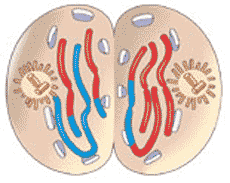 | telophase II (If it was telophase I, you would still see sister chromatids stuck together) p255, |
| Meiosis results in ___ non-identical daughter cells (looking for a number here) | four p256 |



