| A | B |
|---|
| The process of making proteins inside cells is called ______. | protein synthesis (For some reason, this book has all but stopped using the term "protein synthesis" although it is mentioned on page 325. Instead, they describe what is commonly referred to as protein synthesis as "Getting from DNA to protein") p328 |
| In which organelle is DNA located in? | nucleus (in prokaryotic organisms, DNA is located in the nucleoid region of the cytoplasm since they don't have a nucleus) p328 |
Which type of nucleic acid can't leave the nucleus?, 
| DNA p328 |
| On which organelle are proteins made? | ribosomes p328,
|
| Where are ribosomes located? | out in the cytoplasm p328,
|
| The process of making a strand of RNA in the nucleus is called _____. | transcription p328 |
| Which nucleotide do you find in RNA but not DNA?,
| uracil p328 |
| Uracil bonds to across from ______. | adenine p328 |
| The process of using the code on m-RNA to make a long chain of amino acids in the correct order to form a protein is called _____. | translation p328 |
| Which type of molecule brings amino acids to the site of protein synthesis? | transfer RNA (t-RNA) p337 |
| Which molecule attaches to a ribosome and serves as a code for putting amino acids together? | messenger RNA (m-RNA) p328 and section 17.4 |
| How many nucleotides are needed to code for 1 amino acid?,
| 3 p329 |
| How many different types of amino acids are used to make proteins? | 20 pp326&330 |
| Each set of 3 nucleotides on a strand of m-RNA are called a _____.,
| codon p330 |
| How many nucleotides are found at the bottom of a molecule of t-RNA and are involved with bonding to m-RNA? | 3 p329 |
| How many amino acids are found attached to a molecule of t-RNA? | 1 p337 |
| A change in the sequence of nucleotides in a molecule of DNA will cause a ____.,
| mutation p344 |
| Mutations that are harmful are usually weeded out by ______. | natural selection p259 |
| Mutations in a gene that are helpful usually become part of the gene pool as a new ____. | allele (An allele is a different form of a gene) p259 |
Which amino acid would the codon sequence AGU call for?,  | Serine p330, |
| Which enzyme is required for transcription? | RNA Polymerase (remember, you are making RNA during transcription) p331 |
| What are the three types of RNA that have major roles in protein synthesis? | m-RNA (messenger RNA), t-RNA (transfer RNA) and r-RNA (ribosomal RNA) p339 |
| Where does transcription occur in eukaryotic cells? | In the nucleus p329 |
| Where does translation occur? | Out in the cytoplasm on ribosomes p328 |
| Proteins are made out of ____. | amino acids pp326-328 |
| Which type of molecule is a codon found on? | m-RNA (the term codon is also sometimes used for the DNA base triplet along the non-template strand. These codons are complementary to the template strand and thus identical to the m-RNA codon other than the substitution of uracil for thymine in the m-RNA) p330 |
| If a recently manufactured protein has a primary structure that is 1000 amino acids long, how many nucleotides long was the coding part of the mRNA molecule used as the instructions for that protein? | 3000 (remember, it takes 3 nucleotides to code for each amino acid) p330 |
| A mutation involving the addition of one or more nucleotide pairs to a gene is called a(n) _______. | insertion p345 |
| A noncoding, intervening sequence within a eukaryotic gene is called a(n) ______. | intron (the part of the mRNA that is transcribed from DNA introns, but is cut out before the mRNA exits the nucleus, is also called an intron) p335 |
Which amino acid is represented by the shape with the question mark in the picture below? Use the chart to find the answer.,  | Serine p330,  |
| The removal of the noncoding portions (introns) of the RNA molecule after initial synthesis and the subsequent attachment of the remaining coding portions (exons) to each other is called ______. | RNA splicing p334 |
| A(n) _____ mutation occurs when the number of nucleotides inserted or deleted is NOT a multiple of three, resulting in the improper grouping of the following nucleotides into codons. | frameshift p346 |
| Which type of mutations can lead to frameshift mutations? | insertions or deletions that are not in multiples of three pp345&346 |
| The DNA strand that temporarily binds RNA nucleotides during transcription is called the _________. | template strand p329 |
| Where are ribosomes constructed and what are they composed of? | nucleolus, r-RNA and protein (the large and small subunits of the ribosome are constructed in the nucleolus but never come together until they start the process of transcription in the cytoplasm, after which, they come apart again) p339,  |
| A chemical or physical agent that interacts with DNA and causes a mutation is called a(n) ______. | mutagen p346 |
| A specific nucleotide sequence in DNA that binds RNA polymerase and indicates where to start transcribing RNA is called the _____. | promoter p332,  |
| The enzyme that links together the growing chain of ribonucleotides during transcription is called _____. | RNA polymerase pp331-333, 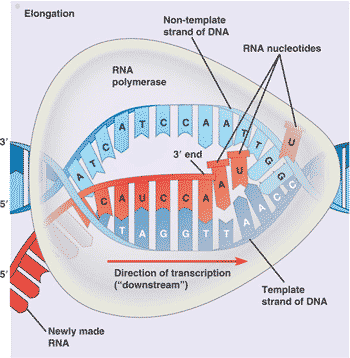 |
| A point mutation in which one or more nucleotides pairs are lost from a gene is called a(n) ______. | deletion (deletions can also happen at the chromosomal level in which case they are called chromosomal deletions) p345 |
| Modification of RNA before it leaves the nucleus in eukaryotes is called _____. | RNA processing p334, 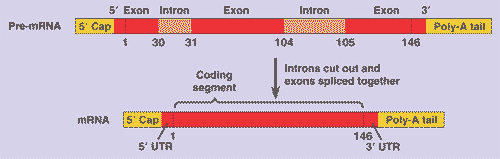 |
| A change in a gene at a single nucleotide pair. | point mutation p344 |
| The coding region of a eukaryotic gene; when transcribed into mRNA, it is the coding part of mRNA that leaves the nucleus. | exon p335, |
Which process belongs in the darker red box in the picture below?,  | transcription p329,  |
| Which process belongs in the pink box in the picture below?, | RNA processing p329, |
| Which process belongs in the light blue box in the picture below?, | translation p329, |
What is "A" pointing to in the picture below?, 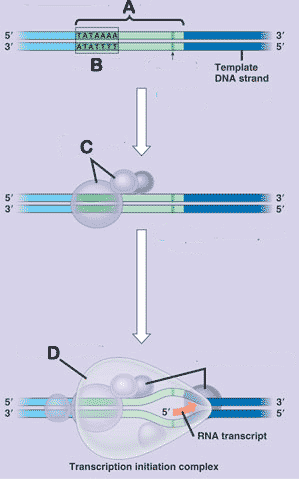 | Promoter p333, |
| What is "D" pointing to in the picture below?, | RNA polymerase p333, |
What is "B" pointing to in the picture below?, 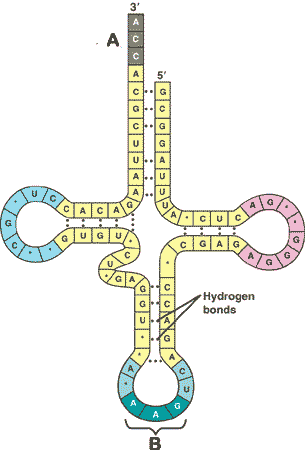 | anticodon of tRNA p338, |
| The concept that genetic information flows from _____ to _____ to _______ was dubbed the "central dogma" by Francis Crick in 1956. | DNA --> RNA --> Protein p328 |



