| A | B |
|---|
acute angle, 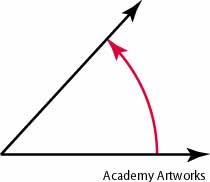 | angle with measure less than 90 degrees |
adjacent angles, 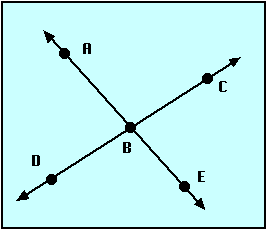 | Angles that are next to each other, have a common vertex and common side, but no other overlap. |
axis, 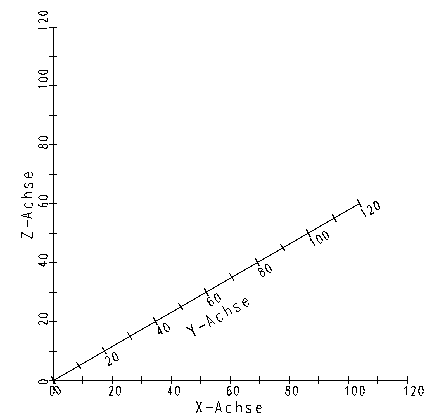 | Either of the two number lines that intersect to form a coordinate grid. |
| bisect | to divide a segment, angle or figure into 2 equal parts |
| compass and straightedge construction | drawing of a geometric figure using only a compass and a straightedge |
| concentric circles | Circles that have the same center but radii of different lengths. |
congruent, 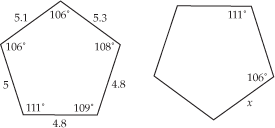 | figures having the same size and shape |
consecutive angle, 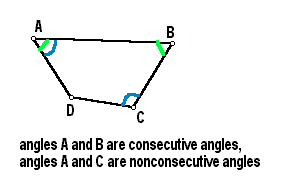 | 2 angles in a polygon with a common side |
| coordinate | A number used to locate a point on a number line. |
| corresponding | Having the same relative position in similar or congruent figures. |
| image | The reflection of an object that you see when you look in a mirror. |
| isometry transformation | A transformation such as a translation (slide), reflections (flip), or rotation (turn) that changes the position or orientation or a figure but does not change its size or shape |
| line of reflection | A line halfway between a figure (preimage) and its reflected image |
midpoint, 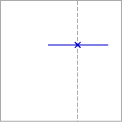 | A point halfway between two other points. |
obtuse angle, 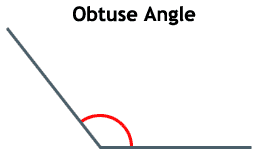 | angle that measures between 90 and 180 degrees |
| ordered number pair | Two numbers that are used to locate a point on a rectangular coordinate grid. |
| origin | The 0 point on a number line. The point where the two axes of a coordinate grid meet. |
parallel lines, 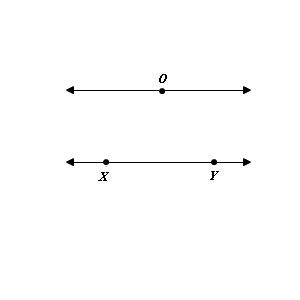 | line segment or rays in the same place are parallel if they never cross or meet, no matter how far they are extended. |
perpendicular, 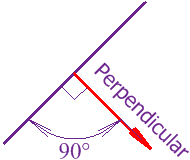 | Crossing or meeting of right angles. Lines, rays, line segments, or plances that cross or meet at right angles are perpendicular. |
| preimage | A geometric figure that is changed by reflection, rotation, or translation, |
| rectangular coordinate grid | A device for locating points in a plane using ordered number pairs, or coordinates. |
| reflection | The “flipping” of a figure over a line (the line of reflection) so that its image is the mirror image of the original figure. |
| reflex angle | an angle with a measure of 180-360 degrees |
right angle, 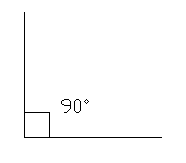 | an angle with a measure of 90 degrees |
| rotation | A movement of a figure around a fixed point, axis; a turn. |
| sector | A region bounded by an arc and two radii of a circle. |
| skew lines | Lines in space that do not like in the same plane |
straight angle, 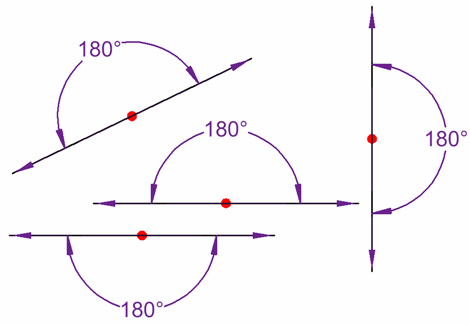 | a 180 degree angle |
| supplementary angles | Two angles whose measures total 180°. |
| transformation | Something done to a geometric figure that produces a new figure. Most common are translations (slides), reflections (flips), and rotations (turns). |
| translation | A movement of a figure along a straight line; a slide. |
| transversal | A line that crosses two or more other lines. |
| vertex | The point where the sides of an angle, the sides of a polygon, or the edges of a polyhedron meet. |
| vertical | Upright; perpendicular to the horizon. |



