| A | B |
|---|
| troposphere | most dense layer of the atmosphere |
| exosphere | outermost layer of the atmosphere |
| mesosphere | coldest layer of the atmosphere |
| auroras | these are formed in polar regions when ions radiate energy as shimmering lights |
| ions | electrically charges particles |
| ozone | this layer protects life on Earth by absorbing harmful UV radiation |
| atmosphere | a mixture of gases that surrounds a planet or moon |
| nitrogen | the most common atmospheric gas |
| radiation | the transfer of energy by electromagnetic waves |
| cirrus | clouds that are made up of ice crystals |
| cumulonimbus | clouds that indicate an approaching thunderstorm |
| stratus | clouds that form in layers or smooth even sheets in the sky |
| wind | the movement of air caused by differences in air pressure |
| jet stream | a narrow belt of strong winds in the upper troposphere |
| doldrums | means “dull” or “sluggish” |
| polar easterlies | prevailing winds that blow from east to west between 60° and 90° |
| cold front | 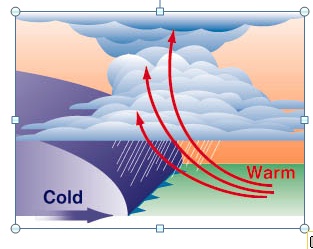 |
| sea breeze | 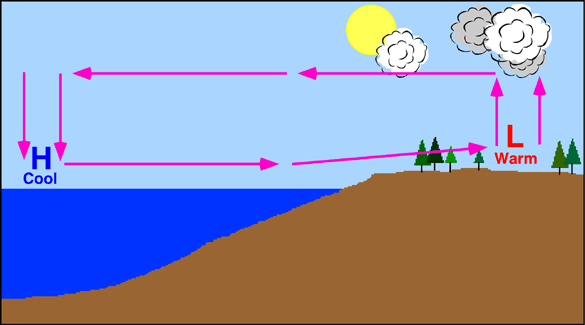 |
| land breeze | 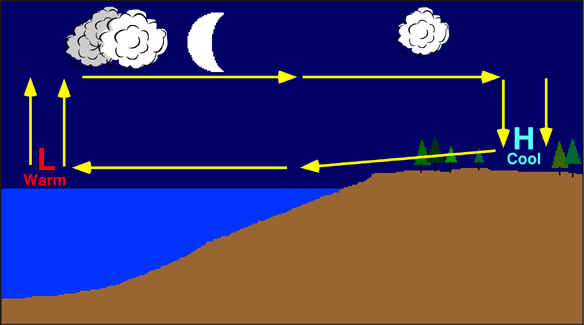 |
| humidity | the amount of water vapor in the air |
| relative humidity | the amount of water vapor in the air compared with the amount of water vapor that the air can hold at a certain temperature |
| dewpoint | the temperature at which a gas condenses into a liquid |



