| A | B |
|---|
| The scientific study of the interactions between organisms and the environment is called _____. | ecology p. 1144 |
| The windward side of a mountain range is usually ______ than the leeward side which is usually ____ due to the _____ effect | moister, drier, rainshadow effect p. 1148,  |
| The upper part of an aquatic biome, where enough light penetrates for photosynthesis to occur, is called the ____. | photic zone p. 1157,  |
| The lower layer of an aquatic ecosystem, which doesn't receive enough light to support photosynthesis, is called the _____ . | aphotic zone p. 1157, |
The bottom substrate of all aquatic ecosystems is called the ____ zone and the organisms that live there are called the ____., 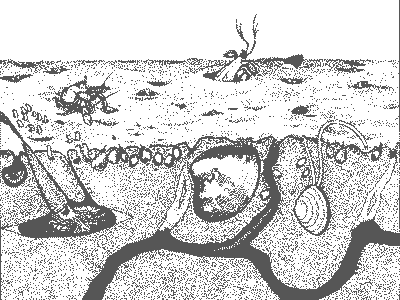 | benthic zone, benthos pp. 1157 and 1162, |
| The zone of open water that includes both the photic and aphotic zone is called the _____ zone. | pelagic p. 1157, |
The pond in the picture below is classified as being ______ because of its murky (turbid) nutrient ____ water that supports a lot of life (especially algae).,  | eutrophic, nutrient-rich p. 1159, |
The lake in the picture below is classified as being ____ because of its clear nutrient ____ waters that support little photosynthetic life., 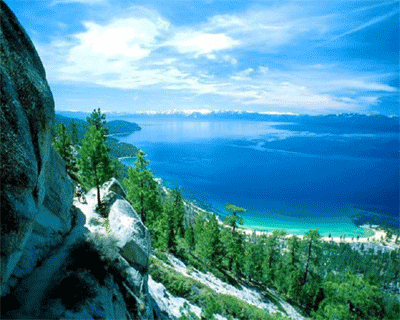 | oligotrophic, nutrient-poor p. 1159, |
Which biome is shown in the picture below?,  | coral reef p. 1162, |
| _____ largely determines the distribution and structure of terrestrial biomes. | Climate (mostly temperature and precipitation) pp. 1150-1151 |
Which biome is pictured below?,  | Tropical forest (The map shows the distribution of tropical forests. The picture is a tropical rainforest in Borneo) p. 1153, |
Which biome is pictured below?,  | Chaparral p. 1154, |
Which biome is pictured below?,  | Northern coniferous forest p. 1155, 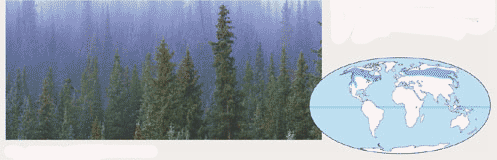 |
Which biome is pictured below?,  | Desert p. 1153, |
Which biome is pictured below?, 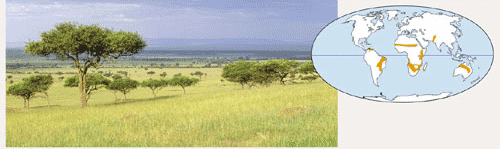 | Savanna p. 1154, |
Which biome is pictured below?, 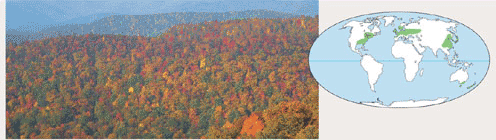 | Temperate broadleaf forest (a.k.a. Temperate Deciduous Forests) p. 1156, |
Which biome is pictured below?,  | Temperate grasslands p. 1155, |
Which biome is pictured below?,  | tundra p. 1156, |
| Which terrestrial biome has the greatest biodiversity? | Tropical forests (biodiversity refers to the number of different species that can be found in an area) p. 1153 |
| Which biome is very warm with a dry season that can last eight or nine months? | savanna p. 1154,  |
| Which biome is usually found close to the coast and has mild rainy winters and long dry summers? | chaparral p. 1154, |
| Which biome is characterized by short drought resistant trees and shrubs? | chaparral p. 1154, |
| Which biome is characterized by cold dry winters and hot humid summers? | temperate grasslands p. 1155, |
| Deciduous trees are trees that ______. | drop their leaves in the fall p. 1156,  |
| Which biome is characterized by a layer of permafrost just below the surface soils? | Tundra p. 1156,  |
| The tundra is characterized by a permanently frozen layer of soil just below the surface called _____. | permafrost p. 1156, |
| A biome located throughout midlatitude regions where there is sufficient moisture to support the growth of large, broadleaf deciduous trees. | temperate broadleaf forest p. 1156, |
| Which biome is characterized by sparsely scattered individual trees and large herds of herbivores, large carnivores, and occasional fires and droughts? | savanna p. 1154, 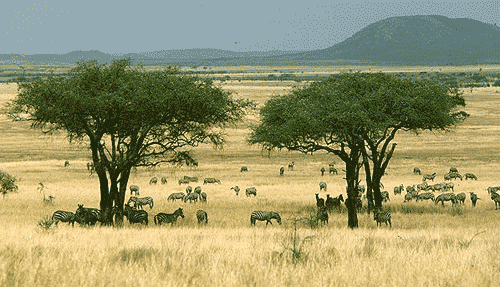 |
| A warm-water, tropical ecosystem dominated by the hard skeletal structures secreted primarily by the resident cnidarians. | Coral reef (The cnidarians they are talking about are hard corals like the brain coral pictured below. Notice the white patch of calcium carbonate skeleton that is exposed where the coral polyps have died) p. 1162, 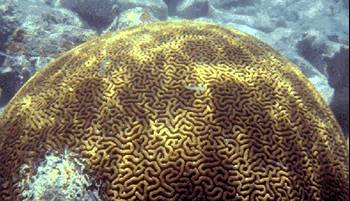 |
| A scrubland biome of dense, spiny evergreen shrubs found at midlatitudes along coasts where cold ocean currents circulate offshore; characterized by mild, rainy winters and long hot dry summers. | chaparral p. 1154, |
| The most significant influence on the distribution of organisms is _____. | climate p.1144 |
| ______ is the long-term prevailing weather conditions in a given area. | Climate p. 1144 |
| The _____ is the global ecosystem - the sum of all the planet's ecosystems and landscapes. | biosphere p. 1145 |
| A(n) ______ is the community of organisms in an area and the physical factors with which those organisms interact. | ecosystem p. 1145 |
| A(n) ____ is a group of populations of different species in an area. | community p. 1145 |
| A(n) ____ is a group of individuals of the same species living in an area. | population p. 1145 |
| The living factors in an environment are called ____ factors. | biotic p. 1149 |
| The non-living factors in an environment are called ____ factors. | abiotic p. 1149 |
| _______ are major life zones characterized by vegetation type (in terrestrial ones) or physical environments (in aquatic ones). | Biomes p. 1150 |
| ______ biomes are aquatic biomes with salt concentrations somewhere around 3% while _____ biomes have salt concentrations near or below 0.1%. | Marine, freshwater p. 1157 |
| Any organism that is not strong enough to swim against the current (and therefore basically floats and drifts) is referred to as ______. If they are photosynthetic, they are called _____. If they are heterotrophs, they are referred to as ____. | plankton, phytoplankton, zooplankton (1159-1161),  |
| A(n) ________ is an action carried out by muscles under control of the nervous system in response to a stimulus. | behavior p.1118 |
| Questions about "_____" a behavior occurs or is modified are questions about proximate causation. | how p.1119 |
| Questions about "_____" a behavior occurs or is modified are questions about ultimate causation. | why p.1119 |
| An instinctual behavior that is automatically initiated by an external cue called a sign stimulus is called a(n) _______. | fixed action pattern (For example, the male stickleback fish that automatically attack anything if they see the color red on it) p. 1119 |
| A fixed action pattern is an automatic response to an external cue called a(n) ______. | sign stimulus p.1119 |
| _______ is a regular long-distance change in location, like birds that fly south every winter. | Migration p.1119 |
| A(n) ______ rhythm is a daily cycle of rest and activity. | circadian p.1120 |
| A(n) ______ is a stimulus transmitted from one animal to another as a means of communication | signal p.1120 |
| ______ are chemicals released by an animal and detected by another animal as a means of communication. | Pheromones p.1122 |
| Behaviors that are instinctual (you're born with them already programmed into you) are _____ behaviors | innate p.1123 |
| The modification of behavior based on specific experiences is called _____. | learning p.1123 |
| A type of learned behavior with innate components, often associated with birds, in which learning must occur at a specific time in the life history of the individual (the _______ period) is called imprinting. | sensitive period (a.k.a. critical period) p.1123 |
| A type of learned behavior with innate components, often associated with birds, in which learning must occur at a specific time in the life history of the individual (the sensitive, or critical period) is called _____. | imprinting p.1123 |
| Operant conditioning is sometimes informally called " ____ learning." | trial and error learning p.1125 |
| Training an animal using a system that gives mild rewards for the desired behavior and mild punishments for undesirable behavior would be an example of ______ conditioning. | operant p.1125 |
| _____ mating systems involve strong long-lasting pair bonds in which a male and a female mate with each other exclusively. | Monogamous (This type of mating system is favored by natural selection when the offspring require a lot of parental care to ensure the offspring survives long enough to have its own offspring. The amount of care required is more than the mother alone can provide) p.1129 |
| __________ mating systems involve the member of one sex mating with several members of the opposite sex. | Polygamous (This type of mating strategy is favored when the amount of parental care needed to ensure the offspring survives long enough to reproduce its own young is not more than the amount the caregiver can provide on its own. In this case, it is an evolutionary advantage that the caregiver mates with the most fit individual of the opposite sex, even if that individual is mating with several other members of that species at the same time) p.1129 |
| Monogamous mating systems are favored when the amount of parental care required to successfully raise an offspring until it is old enough to mate on its own is ____. | high . p.1130 |
| Polygamous mating systems are favored when the amount of parental care required to successfully raise an offspring until it is old enough to mate on its own is ____. | low (It's usually the male that mates with several female and gives little care or protection to the family afterwards. The male has an evolutionary advantage for passing on its genes by producing more offspring. However, if the number of "surviving" offspring is not as great because the male doesn't help care for and protect its young, then monogamous relationships would be favored instead.) p.1130 |
| ______ selection is a form of natural selection in which differences in reproductive success among individuals are a consequence of differences in mating choice (usually by the female) or by mating success (usually among the males). | Sexual p.1131 |
| Seemingly unselfish behavior that decreases the likeliness of the individual being able to survive (like a mother jumping in front of a bus to push her child out of harm's way) is called _____. | altruism p.1137 |
| The movement of organisms into a given area from another area is called ____. | immigration p. 1172 |
| When organisms leave a certain area, the movement is called ___. | emigration p. 1172 |
| For a population to grow, the ____ must be bigger than the ____ | birthrate must be larger than the deathrate (assuming no immigration or emigration) p. 1176 |
| The number of individuals per unit area or volume is a population’s ____. | density p. 1171 |
| Under ideal conditions with unlimited resources, a population will grow _____. | exponentially p. 1176 |
Which type of population growth does this graph show?, 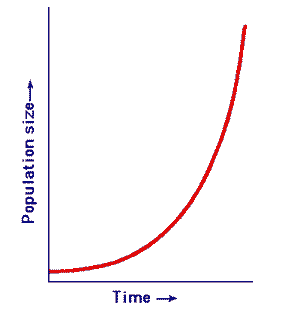 | Exponential growth (Can only happens under ideal conditions with unlimited space, food and no predators) p. 1176, |
Which type of population growth does this graph show?, 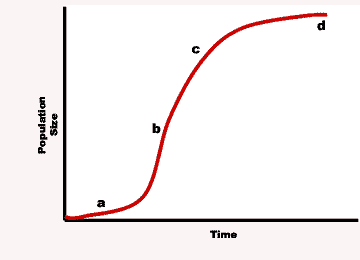 | Logistic growth p. 1178, |
| At which point in the graph below is the population growth rate accelerating?, | Point A (The graph line should be more curved in an upward direction. It looks a little too linear, but I had a hard time drawing it that way) p. 1178, |
| At which point in the graph below is the population growth rate the highest?, | The population growth "rate" is the highest at point B. (You can determine the growth rate by finding the slope of the line tangent to the curve. Remember, slope = rise divided by run. In this case, the rise is the current population. The run is time. Dividing population by time gives you the population growth "rate.") p. 1178, |
| At which point in the graph below is the population growth rate starting to slow down?, | Point C p. 1178, |
| At which point in the graph below is the population the highest?, | The population is the highest at point D (look along the y-axis) p. 1178, |
| At which point on the graph below is the population growth rate the lowest?, | The population growth rate is lowest at point D (notice that the population, even though it is at its highest, has stopped growing) p. 1178, |
| At which point in the graph below is the population at the carrying capacity?, | The population has reached the carrying capacity at point D. Remember, the carrying capacity is the maximum number of individuals that the environment can support. p. 1178, |
Which of these two age structure diagrams shows the typical human age structure of a typical third-world country?,  | A p. 1189, |
| Which of these two age structure diagrams shows the typical human age structure of a first world modernized country?, | B p. 1189, |
| The age structure diagram on the left shows a ____ birth rate and a ____ death rate., | high birth rate and high death rate. p. 1189, |
| The age structure diagram on the right shows a ____ birth rate and a ____ death rate., | low birth rate and low death rate. p. 1189, |
The graph below shows population fluctuation typical of a _____ relationship., 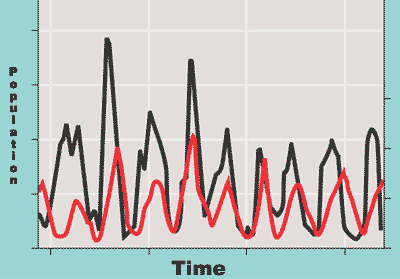 | predator-prey p. 1185, |
Which country below is likely to experience a decline in population due to its age structure?,  | Italy. Notice the small percentage of young people in the population. As they reach child-baring age, the countries birth rate is likely to fall. Conversely, Afghanistan has a large proportion of it's population in child-baring or soon to be child-baring age categories and will likely see rapid population growth unless war and famine cause the death rate to match the birth rate. p. 1189, |
Which survivorship curve would represent the human species? Which would represent a typical fish species?, 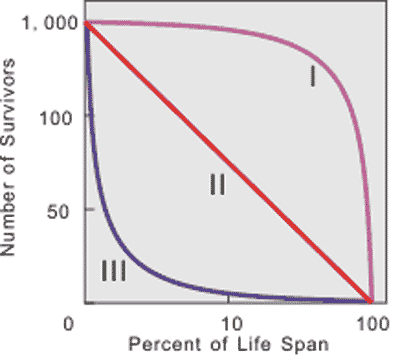 | Humans would be type I due to their fairly high infant survival rate. Fish would be type III because most lay many eggs and generally don't guard them or protect the juveniles, so most fish are eaten when they are small, if they even manage to make it out of their egg. p. 1174, |
| Selection that favors life history traits that maximize reproduction in uncrowded environments are called ____ selection or density-____. | r-selection or density-independent selection p. 1181 |
| Selection that favors life-history traits that allow for survival under crowded competitive conditions is known as ____ selection or density-____. | K-selection or density-dependent selection p. 1181 |
| The maximum population size that can be supported by the available resources, symbolized as K. | carrying capacity p. 1177 |
| The study of populations in relation to the environment, including environmental influences on population density and distribution, age structure, and variations in population size. | population ecology p. 1170 |
| Referring to any characteristic that varies according to an increase in population density. | density-dependent p. 1182 |
| A behavior in which an animal defends a bounded physical space against encroachment by other individuals, usually of its own species. | territoriality p. 1172 |
| Referring to any characteristic that is not affected by population density. | density-independent p. 1182 |
| Disease is a density-_____ factor that limits population growth. | density-dependent p. 1182 |
| Harsh winters would be considered as density-______ factors that limit population growth. | density-independent p. 1182 |
| A(n) _______ is a group of individuals of a single species living in the same general area. | population p. 1170 |
| What is the current human population of the planet (to the nearest billion)? | 7 billion (The book says 6.8 billion, but since this book was published, it has gone over 7 billion. This is pretty scary considering that when Mr. McGee was your age, there were only about 4.5 billion people on the planet) p. 1187 |
| A group of populations of different species living close enough to interact is called a biological ________. | community p. 1194 |
| A symbiotic relationship between two species in which one benefits at the expense of the other is called ____. | parasitism p. 1198 |
| A symbiotic relationship between two species in which one benefits while the other neither benefits nor is harmed is called ____. | commensalism p. 1199 |
| A symbiotic relationship between two species in which both benefit is called ___. | mutualism p. 1199 |
| Mutualism, parasitism and commensalism are all types of ____ relationships. | symbiotic p. 1198 |
| The sum total of a species' use of the biotic and abiotic resources in its environment is called the species' _____. | ecological niche p. 1195 |
| "Habitat" is to "address" as "niche" is to ____. | profession p. 1195 |
| Two species cannot coexist in a community if their ____ are identical. | niches p. 1195 |
| _____ is an interspecific interaction in which one species kills and eats the other species. | Predation p. 1197 |
| The organism from which a parasite derives its nourishment is called the ____. | host p. 1198 |
| A disease-causing agent is called a(n) ____. | pathogen p. 1213 |
| What are the two components of species diversity? | species richness and relative abundance p. 1200 |
Which forest below demonstrates the greatest diversity?,  | Forest A (Although both forests have the same species richness, the relative abundance in forest A is more balanced, giving it an overall higher rate of diversity) p. 1201, |
| Which forest below demonstrates the greatest species richness?, | They are both equal because both forests have 4 different species of plants p. 1200, |
The picture below represents a(n) ____.,  | food chain p. 1202, |
The picture below represents a(n) ____.,  | food web p. 1202, |
| The first (or bottom) level of a food chain is made up of the ____. | primary producers (a.k.a. - autotrophs) p. 1202,  |
| The second level of a food chain is made up of the ____. | primary consumers p. 1202, |
| Most food chains consist of no more than ____ trophic levels. | five p. 1203 |
| A _____ species is a species whose removal would cause a large effect on community structure. | keystone species (keystone species are usually low in abundance but play a pivotal ecological role in the community) p. 1204 |
| _____ species are species, generally introduced into a community by humans, that often times out-compete native species because they lack their own native predators and diseases in their new habitat. | Invasive species p. 1202 |
| The total mass of a population is called the population's _____. | biomass (total dry mass = normal mass minus water mass) p. 1203 |
| The orderly and predictable appearance and replacement of species as a community grows back after a disturbance is called _______. | ecological succession p. 1208,  |
The type of succession taking place in the picture below is _______.,  | primary succession (You are starting from scratch in this type of succession because you don't even have organic soil for life to colonize. Another example where primary succession would have to occur would be after a glacier retreats, leaving just rubble) p. 1208, |
The type of succession taking place in the picture below is _______.,  | secondary succession (After a forest fire, there is still very rich organic soil and probably some trees and seeds that survived. Another example where secondary succession occurs is on abandoned farmland) p. 1208, |
| The dry weight of organic matter comprising a group of organisms in a particular habitat. | biomass p. 1203 |
| A type of succession that occurs where an existing community has been cleared by some disturbance that leaves the soil intact. | secondary succession |
| The number of species in a biological community. | species richness p. 1200 |
| The elaborate, interconnected feeding relationships in an ecosystem. | food web p. 1202 |
| The number AND relative abundance of species in a biological community. | species diversity p. 1200 |
| A type of ecological succession that occurs in a virtually lifeless area, where there were originally no organisms and where soil has not yet formed. | primary succession p. 1208 |
| A species that is not necessarily abundant in a community yet exerts strong control on community structure by the nature of its ecological role or niche. | keystone species p. 1204 |
| A relationship in which two or more different species live in direct and intimate contact with each other is called _____. | symbiosis p. 1198 |
| _____ flows through ecosystems while _____ cycles within them. | Energy, matter p. 1218 |
| In any energy transformation, some energy is always "lost" to the environment as ____. | heat p. 1219 |
| The trophic level that ultimately supports all other trophic levels is the ____, also called the ____. | primary producers, a.k.a. autotrophs p. 1219 |
| All organisms from the second trophic level on are called ____, a.k.a. ____. | heterotrophs, consumers p. 1220 |
| Organisms in the second trophic level are called ____ or ____. | primary consumers, herbivores p. 1220 |
| Another word for detritivore is ____. | decomposer p. 1220 |
| The two main types of decomposers are ____ and ____. | prokaryotes (bacteria) and fungi p. 1220 |
| The amount of light energy converted into chemical energy during a given time period is an ecosystem's _____. | primary production p. 1220 |
| What are the two nutrients that are most likely to be limiting nutrients in an aquatic ecosystem? | nitrogen and phosphorus p. 1223 |
In this pyramid of net production, how much energy will be found at each level if the trophic efficiency is 10%?,  | p. 1226,  |
| In the water cycle, water changes from the liquid to the gaseous form by ____. | evaporation p. 1228 |
| In the water cycle, water changes from the gaseous to the liquid form by ____. | condensation p. 1228 |
| Condensed water in the atmosphere that falls toward Earth is called ____. | precipitation p. 1228 |
| Water evaporates from the surface of leaves in a process called ____. | transpiration p. 1228,  |
| The element that forms the backbone of all organic molecules is ____. | carbon p. 1228 |
| A crucial element needed to make amino acids, proteins and nucleic acids is ____. | nitrogen p. 1229 |
| The atmosphere is approximately 80% _____ gas. | nitrogen p. 1229 |
| In the nitrogen cycle, the conversion by bacteria of nitrogen gas from the atmosphere into forms that can be used by autotrophs to synthesize organic nitrogen compounds, is called ____. | nitrogen fixation p. 1229,  |
Under anaerobic conditions, bacteria can convert the nitrate ion into ____ during the process of denitrifcation.,  | N2 (gaseous nitrogen) p. 1229 & p. 793 |
| Under anaerobic conditions, bacteria can convert the nitrate ion into N2 (gaseous nitrogen) during the process of _______., | denitrification p. 1229 & p. 793 |
| The element that is crucial for the formation of nucleic acids, ATP and phospholipids is _____. | phosphorus p. 1229 |
| The amount of light energy converted to chemical energy (organic compounds) by autotrophs in an ecosystem during a given time period. | primary production p. 1220 |
| A process by which nutrients, particularly phosphorus and nitrogen, become highly concentrated in a body of water, leading to increased growth of autotrophs such as algae and cyanobacteria. | eutrophication p. 1224,  |
| Which type of organism is crucial to the nitrogen cycle? | prokaryotes (different types of bacteria change nitrogen containing molecules from one form to the next in the nitrogen cycle) p. 1229 |
| Which terrestrial ecosystem is the most productive? | tropical rain forests p. 1224 |
| A(n) _______ is a species moved by humans, either intentionally or accidently, from its native location to a new geographic region. | introduced species (also called non-native, exotic, or invasive species) p. 1242 |
| Harvesting by humans of wild plants or animals at rates exceeding the ability of those populations to rebound is called ____. | overharvesting p. 1243 |
| Human practices that use biological resources in a manner that doesn't degrade the environment in the long-run. | Sustainable development p. 1260 |
| A species that is in danger of extinction throughout all or a significant portion of its range. | endangered species p. 1239 |
| Species that are likely to become endangered in the foreseeable future are called ______. | threatened species p. 1239 |
| _____ is rain, snow, sleet, or fog with a pH less than 5.2. | Acid precipitation p. 1244 |
| The burning of fuels can release sulfur oxides and nitrogen oxides that can form ____ when they combine with water in the atmosphere. | acids p. 1244 |
The image below demonstrates the concept of _____.,  | biological magnification of toxins p. 1255, |
What does the graph below suggest?,  | Atmospheric carbon dioxide levels are strongly correlated with global warming p. 1257, |
| Which insecticide underwent biological magnification in the food chain and nearly wiped out some bird species? | DDT p. 1256 |
| Which problem, caused by the release of CFC's, increased the amount of harmful solar radiation reaching Earth's surface? | Thinning of the ozone layer pp. 1258-1259,  |
| Which gas absorbs longer wave radiation from the Earth's surface, slowing the release of heat energy from Earth into space? | carbon dioxide (methane does an even better job of this, but hasn't increased as much and isn't as prevalent as carbon dioxide) p. 1256 |
| Which gas is a dangerous pollutant at ground level, but is needed in the upper atmosphere because it is good at absorbing dangerous solar radiation, blocking most of it from reaching Earth's surface? | ozone (O3) pp. 1258-1259 |
| Which pollutant acts as a catalyst to break down ozone in the upper atmosphere? | CFC's (chlorofluorocarbons) p. 1259 |
| The phenomenon caused by certain gasses in the atmosphere which allow shorter wavelength, higher energy radiation from the sun to pass through and warm the Earth's surface but absorb the longer wavelengths (like infrared) that radiate back toward space from Earth's surface, trapping heat which keeps the Earth's surface warm enough for life to exist. | greenhouse effect p. 1258 |
| A process by which nutrients, particularly phosphorus and nitrogen, become highly concentrated in a body of water, leading to increased growth of autotrophs such as algae. | eutrophication p. 1255, |
| A trophic process in which retained substances become more concentrated with each link in the food chain. | biological magnification (a.k.a. biomagnification or bioaccumulation) p. 1255, |
| Which level of the food chain is most effected by biological magnification? | the top level p. 1255, |
| Which toxic element bioaccumulates in the aquatic food chain and can reach levels that can interfere with the human nervous system if they eat too many top predator fish like tuna or swordfish? | mercury p. 1256 |
| Which industrial pollutant bioaccumulates in the food chain and can act as an endocrine disruptor for animals and humans? | PCBs (polychlorinated biphenyls) p. 1255 |
| What is the main cause of the increase in carbon dioxide concentrations in the atmosphere? | The burning of fossil fuels since the beginning of the industrial revolution p. 1256 |



