| A | B |
|---|
Identify the 3 structures.,  | Neuron - Soma, dendrites, axon |
What is found within a nerve bundle?, 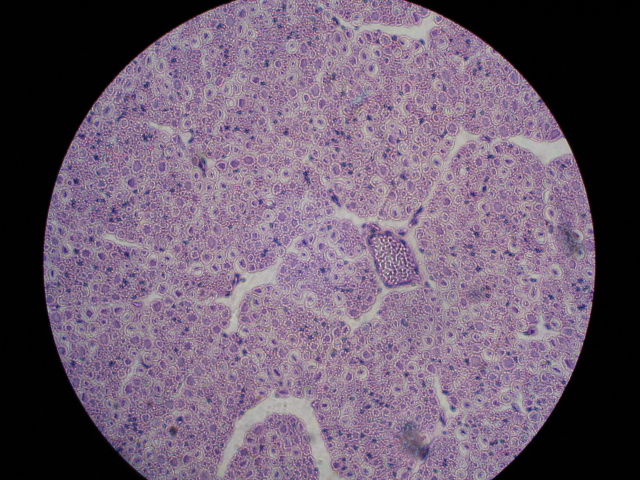 | mylenated axons |
Identify organ and location of white and gray matter.,  | spinal cord; white outside |
Identify region of brain and location of white and gray matter., 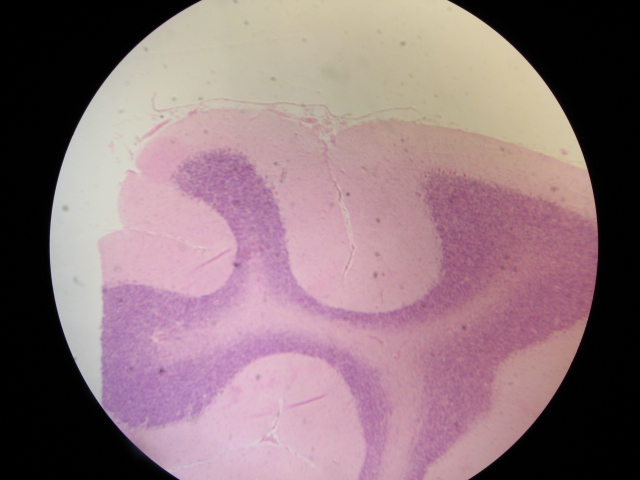 | cerebellum; white inside |
| Reflex Arc | Nervous system's translation of a stimulus into a response. |
| Central Nervous System | Includes the brain and spinal cord. |
| Peripheral Nervous System | Includes nerves and ganglia. |
| Ganglia | Cluster of somas. |
| Soma | Cell body, control center, information processing center |
| Dendrites | Primary location for receiving signals. |
| Axon | Only location of a neuron to produce an action potential/signal. |
| Sensory/Afferent Neurons | Transport sensory message to CNS |
| Motor/Efferent Neurons | Transport motor responses to effectors. |
| Interneurons/Association Neurons | Most abundant; only in CNS; Integrative function - process, store, retrieve. |
| Multipolar Neurons | 1 axon, many dendrites, found in CNS, most common |
| Bipolar Neurons | 1 axon, 1 dendrite; olfaction, hearing, and vision |
| Unipolar Neurons | 1 process that makes a T; no info processing; most neurons in PNS |
| Functional classes of neurons | Sensory, Motor, Interneurons |
| Structural Classes of Neurons | Multipolar, bipolar, unipolar, anaxonic |
| Oligodendrocytes | Make myelin in CNS |
| Ependymal Cells | Produce and circulate CSF |
| Microglial Cells | Macrophages in CNS |
| Astrocytes | Regulate composition of CSF; return neurotransmitters to synaptic knob; repair with scar tissue |
| Schwann Cells | Make myelin in PNS |
| Satellite Cells | Similar to Astrocytes but in PNS |
| Functions of Cerebrospinal Fluid | Protection, Buoyancy, Chemical stability |
| Function of Blood-Brain Barrier | Prevent harmful agents from entering the brain. |
| Function of Meninges | Protection of CNS. |
| Functions of spinal cord | Conduction, locomotion, reflexes |
| Function of myelin sheath | Insulate a nerve signal allowing it to travel faster. |
| Gray Matter | Somas - information processing area. |
| White Matter | Myelinated axons - avenues of communication. |
| Largest part of the brain. | Cerebrum |
| Area of brain that contains majority of nerves. | Cerebellum |
| Majority of gray matter surrounding the brain. | Cerebral cortex. |
| Medulla Oblongata | Cardiac, vasomotor, respiratory centers |
| Pons | relays signals from cerebellum to cerebrum; respiration, swallowing |
| Cerebellum | balance, equilibrium, motor controls |
| Thalamus | Filters all sensory info going to Cerebrum. |
| Hypothalamus | ANS, endocrine, thermoregulation, hunger |
Identify the 4 structures you can see., 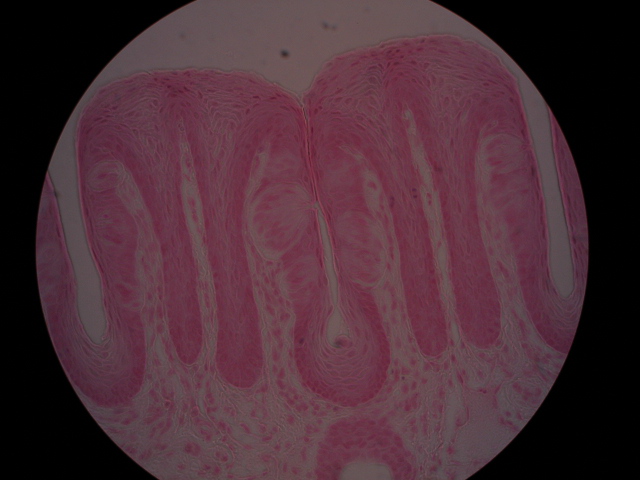 | Lingual papillae, taste bud, taste cell, taste pore |
| Polarized | slightly negative charge inside vs outside cell. |
| Action potential | voltage shift from negative to positive back to negative. |
| Threshold | minimum voltage needed to created an action potential. |
| Refractory period | gates can not be stimulated to produce another action potential because it is returning to negative charge. |
| Chemical Synapse | location between a neuron and another cell that uses neurotransmitters. |
| Excitatory Postsynaptic Potential | creates a positive voltage change in postsynaptic neuron with Na inflow. |
| Inhibitory Postsynaptic Potential | creates hyperpolarization with Cl inflow or K outflow. |
| Summation | net postsynaptic potential in trigger zone wins |


