| A | B |
|---|
 | Caspar Friedrich, Winter Landscape, Romanticism |
 | Jacques Louis David, Oath of the Horatii, Neoclassicism |
 | Durer, The Four Horsemen of the Apocalypse, Northern Renaissance |
 | Watteau, The Halt During the Chase, Rococco |
 | Michaelangelo, The Sistine Chapel, Italian Renaissance |
 | Rembrandt, The Night Watch, Dutch Baroque |
 | Rembrandt, Self Portrait, Dutch Baroque |
 | Vermeer, Young Woman with a Pitcher, Dutch Baroque |
 | Raphael, The School of Athens, Italian Renaissance |
 | Eugene Delacroix, Liberty Leading the People, Romanticism |
 | Perugino, Christ Giving the Keys to Saint Peter, Italian Renaissance |
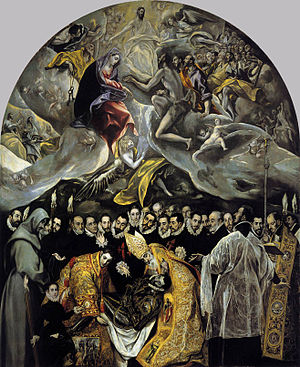 | El Greco, the Burial of Count Orgaz, Mannerism |
 | Gainsborough, the Blue Boy, Rococo |
What are some key indicators that place this work in its appropriate style?,  | Botticelli, The Birth of Venus, Italian Renaissance. This pyramdically structured work is an idealized nude figure from classical mythology--all indicators of Renaissance art. |
 | Hieronymus Bosch, The Garden of Earthly Delights, Northern Renaissance |
 | Jan van Eyck, The Arnolfini Wedding Portrait, Northern Renaissance |
 | Jan van Eyck, The Virgin of Chancellor Rolin, Northern Renaissance |
What are some key indicators that place this work in its appropriate style?,  | Pieter Bruegel the Elder, Dutch Proverbs, Northern Renaissance--notice the realism, the emphasis on ordinary scenes from life, a kind of genre painting. |
This is an example of the kind of art that emphasized scenes of ordinary people from everyday life.,  | Pieter Bruegel the Elder, Peasant Wedding, Northern Renaissance. This style, from the Northern Renaissance, is called genre painting. |
 | Masaccio, Tribute Money, early Italian Renaissance |
 | Happy trees!! Bob Ross, Landscape,  |
 | Diego Velazquez, Las Meninas, Spanish Baroque |
As well, what's the name of the technique of fine shading for soft transitions as seen here?,  | Da Vinci, Mona Lisa, Italian Renaissance. The technique is "sfumato". |
 | Peter Paul Rubens, Bathsheba at the Fountain, Flemish Baroque |
 | Michaelangelo, Sistine Chapel, Italian Renaissance |
 | Jan van Eyck, Arnolfini Wedding Portrait, Northern Renaissance |
Also, what's the Renaissance technique of using lines that converge into a vanishing point to give depth to the painting?,  | Pietro Perugrino, Christ Delivering the Keys to St. Peter, Italian Renaissance. The depth method is called "perspective". |
 | Jean-Antoine Watteau, Pilgrimage to Cythera, Rococco |
 | Thomas Gainsborough, Blue Boy, Rococco |
 | Rembrandt, Night Watch, Dutch Baroque |
 | Jan van Eyck, The Virgin of Chancellor Rolin, Northern Renaissance |
This new urban space, derived from the old agora, was encouraged by Renaissance urban architects for public activities.,  | piazza, or plaza |
As well, to which historical event does this work refer to?,  | Francisco Goya, The Third of May, Romanticism. The painting is a response to the Napoleonic occupation of Spain. |
As well, what's the method, seen here, to contrast lightness and darkness for effect and a sense of volume?,  | Da Vinci, Madonna of the Rocks, Italian Renaissance. The method is called chiaroscuro. |
As well, to what historical development was this artist responding?,  | Joseph M.W. Turner. Rain, Steam and Speed. Romanticism. This is a response to England's industrial revolution. |
As well, what 2 empires did this person in this portrait rule over?,  | Titian, Charles V, late Italian Renaissance, 1533. Charles V ruled over the Holy Roman and Spanish Hapsburg empires. |
For which city was this statue dedicated? To what city is the statue facing?,  | Michaelangelo, David, Italian Renaissance. The statue, dedicated to Florence, faces rival Rome to the south. |
What was the term for the mathematical proportion upon which this work was based?,  | Leonardo da Vinci, Vitruvian Man, Italian Renaissance. Da Vinci wanted the figure to demonstrate the Golden Mean, a.ka. pi. |
What's the name for this kind of painting here, done as a mural on plastered walls?,  | Da Vinci, the Last Supper, Italian Renaissance. This kind of mural is called a fresco. |
What's the kind of perspective used for the skull that creates an illusion?,  | Hans Holbien, The French Ambassadors, Northern Renaissance. The illusion is created by anamorphic perspective. You can only truly see the skull from a side angle. |
| Ideal beauty, religious and mythological scenes, oil paintings and fresco: are these traits of the Italian or Northern Renaissance style? | These are traits of the Italian Renaissance style. |



