| A | B |
|---|
| This powerful family, often ruling "behind the scenes", dominated Florence economically and culturally during much of the fifteenth to seventeenth centuries. | The Medici family, whose notable chiefs included Cosimo (1389-1464) and Lorenzo the Magnificent (1449-1492). Both supported civic improvements and the fine arts. |
| Which city state was governed by a Great Council of leading families that elected a "doge" or leading magistrate? | Venice. Its centralized power was a reflection of the need to plan carefully in a city built on water. |
| In the Hundred Years War, this peasant girl presented herself at the court of dauphin as the heaven-sent savior of France | Joan of Arc, who would become a national martyr after being burned at the stake in 1431. |
What popular theme of the 14th century does this image illustrate?, 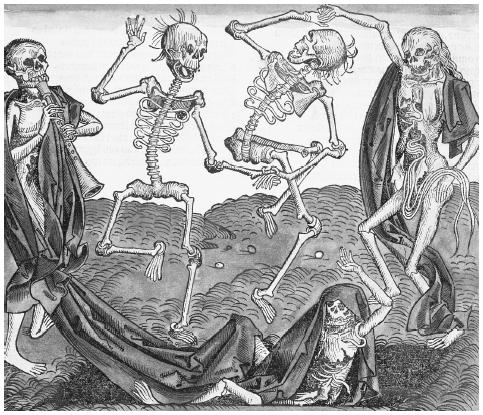 | This is the "Dance of the Dead", a common theme in which showed how the Black Death affected everyone equally. |
| This kind of small, fast sailing ship, outfitted with a sail that could tack against the wind, made possible the exploration of the West African coast and beyond in the 15th century. | This was the caravel, and the triangular sail was called a "lateen" sail, adopted from Arab civilization. |
| This English monarch, first of the Tudor dynasty, assumed power after the War of the Roses in 1485. | Henry VII (r. 1485-1509) became regarded as an able monarch who presided over the economic expansion of England. |
| Their marriage in 1469 was a critical step in the political unification of the Iberian peninsula. | Ferdinand of Aragon and Isabella of Castile united their kingdoms and began to carry out the Reconquista of Spain. |
| What was the Conciliar Movement? | This movement within the Great Schism sought to expand the power of the council of cardinals and reduce the arbitrary power of the pope. |



