| A | B |
|---|
| hydrogen bond | a weak chemical bond between a hydrogen atom in one polar molecule and an electronegative atom in a second polar molecule. |
| heat capacity | the quantity of heat energy required to increase the temperature of a material or system; typically referenced as the amount of heat energy required to generate a 1°C rise in the temperature of 1 g of a given material. |
| water cycle / hydrologic cycle | the constant circulation of water from the sea, through the atmosphere, to the land, and its eventual return to the atmosphere by way of transpiration and evaporation from the land and evaporation from the sea. |
| closed system | a system in which material moves from place to place but is not gained or lost from the system. |
| evaporation | the change of state of matter from a liquid to a gas. Heat is absorbed. |
| precipitation | water that falls to the surface from the atmosphere as rain, snow, hail, or sleet. |
| groundwater | the part of the subsurface water that is in the zone of saturation, including underground streams. |
| porosity | a measure of the percentage of pores (open spaces) in a material. |
| permeability | a measure of how easy it is to force water to flow through a porous material. |
| saturated zone | the zone, beneath the water table where all of the pores are filled with water. |
| water table | the surface between the saturated zone and the unsaturated zone (zone of aeration). |
| transpiration | the process by which water absorbed by plants, usually through the roots, is emitted into the atmosphere from the plant surface in the form of water vapor. |
| reservoir | a place in the Earth system that holds water. |
| flux | the rate of movement of water from one reservoir to another. |
| infiltration | some of the rain that falls on Earth’s surface sinks directly into the soil. |
| soil moisture | water, in the form of liquid, vapor, and/or ice, resides in Earth’s soil layer. It is the water that remains in the soil after rainfall moves downward toward the groundwater zone. Soil moisture is available for plants. What is not used by plants gradually moves back up to the soil surface, where it evaporates into the atmosphere. |
| calving | some glaciers end in the ocean. As the glacial ice moves forward into the ocean water, it breaks away from the glacier in huge masses, to float away as icebergs, which gradually melt. |
| the NINE reservoirs are | oceans, atmosphere, clouds, glaciers, soil moisture, groundwater, lakes, rivers, vegetation |
| the 15 processes of the water cycle are | • evaporation from the ocean surface • precipitation onto the ocean surface • evaporation from the land surface • precipitation onto the land surface • precipitation onto glaciers • condensation to form clouds • melting of glaciers • calving of glaciers • surface runoff into rivers • surface runoff into lakes • infiltration of surface water • groundwater flow • river flow • transpiration from plants • uptake of water by plant roots |
What is happening at each letter?, 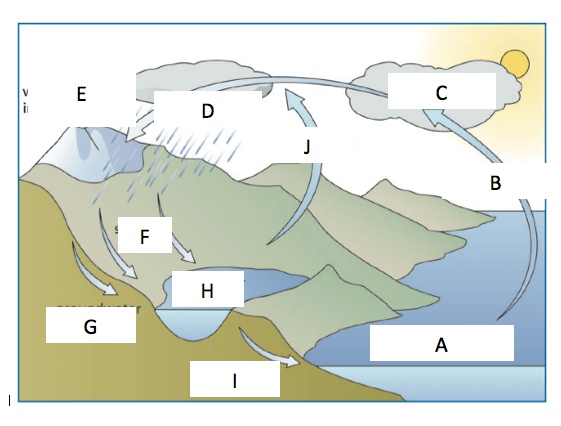 | Answers:, 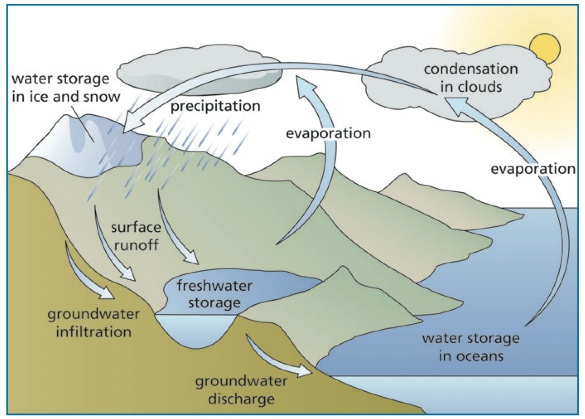 |
| tributary system | a group of streams that contribute water to another stream. |
| trunk stream | a major river, fed by a number of fairly large tributaries; the main stream in a river system. |
| distributary system | an outflowing branch of a river, such as what characteristically occurs on a delta (a landform that forms at the mouth of a river). |
| drainage basin (or watershed) | the area from which all of the rain that falls eventually flows to the same final destination, usually the ocean. |
| drainage divide | the boundary between adjacent drainage basins - like hills and mountains. |
| erode | to wear away soil and rock by the action of streams, glaciers, waves, wind, and underground water. |
| land uses in HoCo | residential, commercial, office, industrial, transportation, forests, rural residential, rural conservation, environmental protection, public management-water/sewage |
| watersheds in HoCo | Patapsco, Patuxent River, Deep Run, Hammond Branch, Cattail Creek, Middle Patuxent River, Little Patuxent River, Dorsey Run |
| watershed | the area where water leads to a body of water |
| where does HoCo's watershed go? | to the Chesapeake Bay |
| what can effect the watershed? | pollution/chemicals, precipitation, runoff, sewage, dams, land use, topography/terrain, agriculture |
| aquifer | underground soil or rock through which groundwater can easily move |
| atoms | the basic unit of matter that make up everything |
| molecules | this is formed when two or more atoms join together chemically |
what does this image show?,  | a meandering river |
what does this image show?, 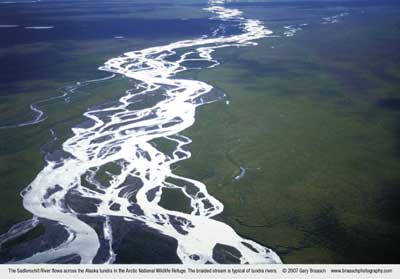 | a braided stream |
| transpiration | evaporation of water from plant leaves. |


