| A | B |
|---|
| a type of cell division where two identical cells are made | mitosis |
| the nuclear membrane fizzles away and the chromosomes condense | prophase |
| as mitosis ends, _______ begins | cytokenesis |
| during ________, the sister chromatids line up and meet in the middle | metaphase |
| the longest phase of the cell cycle, where growth of the cell happens | interphase |
| the chromatids are pulled apart along the spindle fibers and are now called chromosomes | anaphase |
| the number of chromosome pairs humans have | 23 |
| chromosomes are now at the opposite poles, nuclear membrane begins to reform, mitosis is complete, but the cell hasn't finished dividing yet | telophase |
| cell membrane is pinched in half by a thread of protein and two identical cells are formed | cytokenesis |
| What are the stages of the cell cycle? | interphase, mitosis, cytokinesis |
| What are the phases of mitosis? | prophase, metaphase, anaphase, telophase |
| When chromosomes make an exact copy of themselves, what are they called? | sister chromatids |
What does this picture show?,  | cytokinesis |
What does this picture show?, 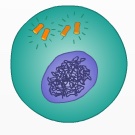 | interphase - the first stage of the cell cycle |
What does this picture show?, 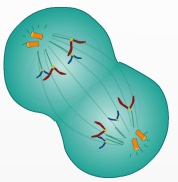 | anaphase - the third phase of mitosis |
What does this picture show?, 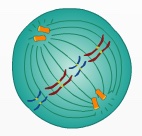 | metaphase - the second phase of mitosis |
What does this picture show?, 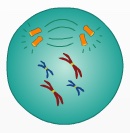 | prophase - the first phase of mitosis |
What does this picture show?, 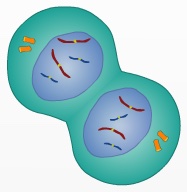 | telophase - the fourth/last phase of mitosis |
What does this picture show?, 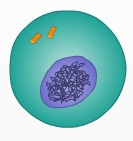 | the parent cell |
| What are the three phases grouped together in interphase? | G1, S, and G2 |
| What happens in Interphase G1? | the cell increases in size and makes new proteins and organelles |
| What happens in Interphase S? | replication (copying) of chromosomes takes place |
| What happens in Interphase G2? | many organelles and molecules required for cell division are produced |
| What is the longest phase of mitosis? | prophase |
| What happens during Mitosis - Prophase? | Chromosomes condense and become visible; centrioles separate and move to opposite sides of the nucleus |
| What happens during Mitosis - Metaphase? | chromosomes line up across the center of the cell |
| What happens during Mitosis - Anaphase? | chromosomes move until they form two groups near the poles (opposite ends) of the spindle |
| What happens during Mitosis - Telophase? | a nuclear envelope re-forms around each cluster of chromosomes, the nucleolus becomes visible in each daughter nucleus |
| When does Cytokinesis occur? | at the same time as the telophase |
| What is cytokinesis? | the division of the cytoplasm |
| a group of proteins that regulate the timing of the cell cycle in eukaryotic cells | cyclins |
| What proteins respond to events INSIDE the cell? | internal regulators |
| What proteins respond to events OUTSIDE the cell? | external regulators |
| What are the two tiny structures located in the cytoplasm near the nuclear envelope at the beginning of prophase? | cenrioles |
| What is a spindle? | a fanlike microtubule structure that helps separate the chromosomes |
| the second and shortest phase of mitosis | metaphase |
| the phase of mitosis in which the duplicated chromosomes separate from each other | anaphase |
| the phase of mitosis in which two distinct nuclei form | telophase |
| the first and longest phase of mitosis | prophase |
| What divides during cytokinesis? | cytoplasm |
| What is the structure that forms in the cell plate? | cell wall |
| What is the process in which two daugther cells are formed? | cytokinesis |
| What is the phase in which the chromosomes line up in the middle of the cell? | metaphase |
| What is the phase in which many organelles and molecules needed for cell division are formed? | G2 phase |
| What is the time period between cell divisions? | interphase |
| What is the fan-like microtubule structure that helps separate the chromosomes? | spindle |
| What is the series of events that cells go through as they grow and divide? | cell cycle |
| What is the protein that regulates the timing of the cell cycle in eukaryotic cells? | cyclin |
| What is the process in which the cell nucleus divides? | mitosis |
| What is the area where a pair of chromatids are attached? | centromere |
| What is the phase of mitosis that ends when the chromosomes stop moving? | anaphase |
| What do the two chromosomes consist of at the beginning of cell division? | chromatids |
| What is cancer? | a disease of the cell cycle |
| M phase is also know as________ | mitosis |
| What forms miway between the divided nucleus during cytokinesis in plant cells? | cell plate |
| A cleavage furrow forms in an _____. | animal cell |
| A cell plate forms in a ____. | plant cell |
| How many cell divisions are in mitosis? | One (1) |
| How many daughter cells are created in mitosis? | Two (2) |
| What is the function of mitosis? | To grow and regenerate cells |
| What specialized structure is in a plant cell, but NOT in an animal cell during cell division? | plant cells have cell plates |
| What specialized structure is in an animal cell, but NOT in a plant cell during cell division? | animal cells have centrioles |
| What are two reasons why cells divide rather than continue to grow indefinitely | a. The larger a cell becomes, the more demands the cell places on its DNA. b. The larger a cell becomes, the more trouble the cell has moving nutrients and wastes across the cell membranes. |
| As a cell increases in size, it usually makes extra copies of its DNA | FALSE |
| What determines the rate at which food and oxygen in a cell are used up and waste products produced. | the cell's volume |
| How can you obtain a cell's ratio of surface area to volume | Divide the surface area by the volume. |
| If a cell's surface area is 6 cm cubed and its volume is 1 cm cubed, then what is its ratio of surface area to volume? | 6/1 or 6:1 |
| As a cell grows in size, does its volume increase or decrease? | As a cell grows in size, its volume increases much more rapidly than its surface area. |
| What happens to a cell's ratio of surface area to volume as the cell's volume increases more rapidly than its surface area? | The ratio decreases |
| How does cell division solve the problem of increasing size | cell division reduces cell volume |
| In eukaryotic cells, what are the two main stages of cell division | mitosis and cytokinesis |
| What happens in the mitosis - interphase - G1 phase? | cell growth |
| What happens in the mitosis - interphase - S phase? | DNA replication |
| What happens in the mitosis - interphase - G2 phase? | preparation for mitosis |
| What is DNA | DNA stores information and transmits information from a parent cell to a daughter cell during mitosis. DNA is a nucleic acid. |
| What are the four nucleotides in DNA | Adenine, Cytosine, Guanine, Thymine |
| What nucleotide pairs with adenine? | thymine |
| What nucleotide pairs with cytosine? | guanine |
| What nucleotide pairs with guanine? | cytosine |
| What nucleotide pairs with thymine? | adenine |
| How is DNA arranged? | in a double helix (a twisted ladder) |
| The rungs of DNA are made of what? | nitrogenous bases |
| The backbone of DNA is made of what? | phosphate and sugar |
| What are the two types of nitrogen bases? | purines and pyrimidines |
| Which nitrogen base is large and contains two rings of carbon | purines |
| Which nitrogen base is small and contains one ring of carbon? | pyrimidines |
| What is binary fission | a type of asexual reproduction in which an organism replicates its DNA and divides in half, producing two identical daughter cells |
| Mitosis happens in what kind of cells? | somatic cells (non-sex cells) |
| What are the three types of binary fission? | simple, transverse, and longitudinal binary fission |
| When does binary fission occur? | in bacteria |
| What is asexual reproduction? | reproduction by a single organism |
What does the purple shape in this diagram represent?, 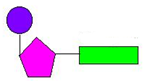 | Deoxyribose (sugar) |
| What is DNA replication? | before a cell divides, it duplicates/replicates its DNA in a copying process to make sure each resulting cell will have a complete set of DNA molecules |
| What are the four bases in DNA? | Adenine, Thymine, Guanine, Cytosine |
| What does the blue circle in this diagram represent?, | Phosphate |
| What does the green rectangle in this diagram represent?, | Nitrogenous Base |
| Which are purines (double ring bases)? | adenine and guanine |
| Which are pyrimidines (single ring bases)? | thymine and cytosine |
| How are the DNA nucleotides linked together? | nucleotides are linked together by covalent bonds into a single strand |
| How are adenine and thymine held together? | A-T are held together with TWO hydrogen bonds |
| How are cytosine and guanine held together? | C-G are held together with THREE hydrogen bonds |
| What is the Base Pairing Rule of DNA? | A on one side of the ladder ALWAYS pairs with T on the other side of the ladder G on one side of the ladder ALWAYS pairs with C on the other side of the ladder. |
What connects thymine and adenine?,  | hydrogen bonds |
| What color is the phosphate on the DNA strand in the diagram?, | light blue |
| What color is the Deoxyribose (sugar) on the DNA strand in the diagram?, | blue |


