| A | B |
|---|
| A carrot has a diploid number of 18. What is it's haploid number? | 9 |
| Gametes are produced by the process of ___. | meiosis |
| Another word for sex cell is ___. | gamete |
| During which stage of meiosis do chromosomes form tetrads? | prophase I |
| During which stage of meiosis do sister chromatids separate from each other? | anaphase II |
| What is the diploid number of chromosomes in humans? | 46 (also written as 2n=46) |
| What is the haploid number for humans? | 23 (also written as n=23) |
| _________ chromosomes are chromosomes that have the same types of genes, but are not identical. | Homologous |
| _________ are chromosomes that have the same types of genes, and are identical. | Sister chromatids |
| A(n) _____ is a segment of DNA that has the instructions for making one protein. | gene |
| A chromosome is made of ___ DNA molecule(s) | one |
| When two homologous chromosomes are lined up right next to each other during meiosis, they are referred to as a(n) ___. | tetrad |
| When homologous chromosomes are lined up next to each other during meiosis, they might swap pieces of DNA. This phenomenon is called ___. | crossing over |
When chromosomes are lined up like this during meiosis, what are they referred to as?, 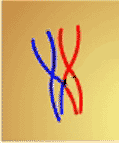 | A tetrad, |
Which process from meiosis is shown below and during which stage would it occur?, 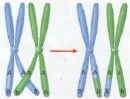 | The picture shows "crossing over" and it usually happens during prophase I., |
| When Gregor Mendel crossed true-breeding tall plants with true-breeding short plants, the offspring were ___. | all tall |
| If the offspring from a true-breeding tall plant and a true-breeding short plant are allowed to self-pollinate, they will produce offspring in the F2 generation that are ___. | about 75% tall and 25% short (Remember, it asked about the F2 generation. The true-breeding parents would be the P generation. Their offspring who were allowed to self-pollinate were the F1 generation. The offspring that resulted from the self-pollination were the F2 generation) |
| Plants with the ___ form of a trait are always true-breeding. | recessive |
| Plants with the ____ form of a trait can be true-breeding while other plants with that trait might not be true-breeding. | dominant |
| When alleles ___ from each other, they separate. | segregate |
| Different forms of the same gene are called _____. | alleles |
| The types of alleles that an organism inherits is known as the ______. | genotype (example = Bb) |
| The physical expression of two alleles is known as the organism's _____. | phenotype |
| If B = brown eyes and b = blue eyes, what will be the color of your eyes if your genotype is BB? | Brown eyes |
| If B = brown eyes and b = blue eyes, what will be the color of your eyes if your genotype is Bb? | Brown eyes (remember that B is dominant) |
| If B = brown eyes and b = blue eyes, what will be the color of your eyes if your genotype is bb? | blue eyes |
| If B = brown eyes and b = blue eyes, what would the organism's genotype be if the organism was heterozygous? | Bb (remember that 'hetero' means 'mixed') |
| If B = brown eyes and b = blue eyes, what would the organism's genotype be if the organism is homozygous dominant? | BB (remember that 'homo' means 'same') |
| If B = brown eyes and b = blue eyes, what would the organism's genotype be if the organism is homozygous recessive? | bb (remember that 'homo' means 'same') |
| Another word for heterozygous is ____. | hybrid |
| Another word for homozygous is ____. | purebred |
| Another word for purebred is ____. | homozygous, 
|
| Another word for hybrid is ____. | heterozygous,
|
| The process of making proteins inside cells is called ______. | protein synthesis |
| Inside which organelle is DNA located? | nucleus (Remember, prokaryotes don't have a nucleus, so their DNA is located out in the cytosol/cytoplasm) |
| On which organelle are proteins made? | ribosomes (This is true of both prokaryotes and eukaryotes. Prokaryotic ribosomes are a little bit smaller, but otherwise very similar to the eukaryotic ribosome),
|
| The process of making a strand of m-RNA in the nucleus is called _____. | transcription |
| Which nucleotide do you find in RNA but not DNA?,
| uracil |
| Uracil bonds to _____ at the nitrogenous base. | adenine |
| The process of using the code on RNA to make a long chain of amino acids in the correct order to form a protein is called _____. | translation |
| Which type of molecule brings amino acids to the site of protein synthesis? | transfer RNA (t-RNA) |
| Which molecule attaches to a ribosome and serves as a code for putting amino acids together? | messenger RNA (m-RNA) |
| How many nucleotides are needed to code for 1 amino acid?,
| 3 |
| How many different types of amino acids are used to make proteins? | 20 |
| Each set of 3 nucleotides on a strand of m-RNA is called a(n) _____.,
| codon |
| How many nucleotides are found at the bottom of a molecule of t-RNA and are involved with bonding to m-RNA? | 3 (The part labeled B in the diagram below), 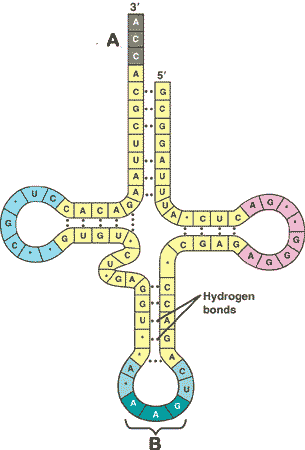 |
| How many amino acids are found attached to a molecule of t-RNA? | 1,  |
| A change in the sequence of nucleotides in a molecule of DNA is called a(n) ____.,
| mutation |
| Mutations that are harmful are usually weeded out by ______. | natural selection |
| Mutations in a gene that are helpful usually become part of the gene pool as a new ____. | allele (a different form of a gene) |
| Which enzyme is required for transcription? | RNA Polymerase (remember, you are making RNA during transcription) |
| Genes contain instructions for assembling ___. | proteins |
| Proteins are made out of ____. | amino acids |
The picture below is called the ____.,  | genetic code (All organisms, from prokaryotic bacteria all the way up to humans, use this same genetic code), |
| What is the name of the organelle that can modify proteins after they have been made in the rough ER? | golgi |
| A mutation that involves one or a few nucleotides is called a(n) ____ mutation | point |
| A type of point mutation that causes a change in every amino acid following the mutation is called a(n) ____ mutation. | frameshift |
| A point mutation will cause the cell to make an incomplete protein if the mutation results in an early ____ codon. | stop |
| A picture of all 46 chromosomes paired in homologous pairs is called a(n) _____. | karyotype,  |
| The failure of chromosomes to separate properly during meiosis is called ___ . | nondisjunction,  |
The type of mutation shown below is a(n) _____.,  | chromosomal deletion, |
The type of mutation shown below is a(n) _____.,  | chromosomal duplication, |
The type of mutation shown below is a(n) _____.,  | chromosomal inversion, |
The type of mutation shown below is a(n) _____.,  | chromosomal translocation, |
A picture like the one below is called a(n) ____.,  | karyotype, |
| What would be the sex of the person who owns these chromosomes?, | male (notice the X and the Y chromosome at the last pair), |
| A point mutation that changes a nucleotide in a codon, but doesn't change the resulting amino acid is called a ____ mutation. | Silent mutation (Silent mutations are almost always caused by a base-pair substitution that causes the 3rd nucleotide in a codon to change. As you can see in the genetic code chart below, changing the third base often times does not change the amino acid that is called for.),  |
| A point mutation that ends up causing a stop codon to be read earlier than normal so that the resulting protein is smaller than it should be is called a(n) ____ mutation. | Nonsense mutation (because the protein will be non-functional and its structure will make no sense) |
| The type of inheritance where neither allele is dominant and they tend to produce a mix of the two traits such as blue + white = light blue would be _____. | incomplete dominance |
| The type of inheritance where both alleles are dominant, such as red fur + white fur = red and white fur hairs in roan cattle is known as ____. | codominance |
| The type of inheritance where there is more than two alleles for a single trait, such as A, B, and O alleles for blood type, is known as ____. | multiple alleles |
| Genes that are located on the 23rd pair of chromosomes (but only on the X, not the Y chromosome) are known as ____ genes. | sex-linked |
| If you have an X and a Y chromosome, what is your gender? | male |
| If you have two X chromosomes, what is your gender? | female |
| A trait, like human skin color, that involves several different genes is called a(n) _____ trait. | polygenic trait (remember, "poly" means many and "genic" refers to genes) |
The following diagram is an example of a(n) ___.,  | pedigree, |
| Different forms of the same gene are called _____. | alleles |
| A dihybrid cross between 2 individuals that are heterozygous for two independently assorting characterisitics (such as seed color and seed shape), produces the classic ________ ratio. | 9:3:3:1 ratio,  |
| The monomers of DNA are ____. | nucleotides,
|
| How many different types of nucleotides are found in a molecule of DNA?,
| four |
| In DNA, which nucleotide always bonds to adenine (A) across the middle where the nitrogenous bases meet? | thymine (T) |
| How many chromosomes do human sex cells have? | 23 total (1 of each type) |
| A segment of DNA that holds the code for a particular protein or trait is called a ____. | gene |
| The process of making a copy of a strand of DNA is called ___. | DNA replication |
| Which enzyme adds nucleotides to the sides of the unzipped DNA molecule during DNA replication? | DNA polymerase |



