| A | B |
|---|
| Define the following term: Atom | The smallest chemical unit of matter |
| Define the following term: Molecule | Two or more atoms linked together to make a substance with unique properties |
| Define the following term: Photosynthesis | The process by which green plants and some other organisms use the energy of sunlight and simple chemicals to produce their own food |
| Define the following term: Metabolism | The sum total of all processes in an organism that convert energy and matter from outside sources and use that energy and matter to sustain the organism’s life functions |
| Define the following term: Receptors | Special structures that allow living organisms to sense the conditions of their internal or external environment |
| Define the following term: Precocial | A term used to describe offspring that are born able to hear, see, move about, regulate body temperature, and eliminate waste without a parent’s help |
| Define the following term: Altricial | A term used to describe offspring that are born without at least one of the following abilities: hear, see, move about, regulate body temperature, or eliminate waste |
| Define the following term: Cell | The smallest unit of life in creation |
| All life forms contain deoxyribonucleic (dee ahk’ see rye boh noo klay’ ik) acid, which is called ???. | DNA |
| All life forms have a method by which they extract energy from the surroundings and convert it into ?????? that sustains the | energy |
| All life forms can sense changes in their surroundings and ??????? to those changes. | respond |
| All life forms ?????????. | reproduce |
| What does DNA provide to a living organism? | information |
| Compared to other molecules, is DNA big or small? | BIG |
| Does DNA store its information more efficiently or less efficiently than a computer? | DNA is significantly more efficient at information storage than the best computer human science can make. |
| DNA is made up of two basic parts: the backbone and the nucleotide bases. Which part stores the information? | The nucleotide bases store the information. Remember, the sequence of adenine, thymine, guanine, and cytosine is the code that stores the information. |
| DNA is made up of two basic parts: the backbone and the nucleotide bases. Which part forms the double-helix structure? | The backbone forms long ribbons that twist to make the double helix structure. |
| Which nucleotide base will link to adenine? | Thymine links to adenine,. |
| Which nucleotide base will link to cytosine? | Guanine links to cytosine. |
| One half of a portion of DNA has the following sequence: cytosine, guanine, adenine, guanine, thymine, thymine | guanine, cytosine, thymine, cytosine, adenine, adenine |
| What is the name of the chemical that plants make for food? | Plants use photosynthesis to make their own food, glucose. |
| What is the name of the chemical that plants often store their food as? | Plants often store food as starch. |
| For most organisms, metabolism requires food and something else. What is that something else? | Metabolism requires food and oxygen. |
| Metabolism produces energy and usually two other things. What are they? | Metabolism usually produces energy, carbon dioxide, and water. |
| An organism’s receptors no longer work. Which of the four criteria of life will the organism not be able to perform? | The organism will not be able to sense and respond to change. |
| Consider the difference between a shark and an anchovy. Both are fish. The first is a fierce hunter that rarely is eaten by any other animal. The second is a major source of food for many other fish in the sea. Which would you expect to have more offspring: two shark parents or two anchovy parents? | The anchovy parents will have many more offspring, because so many anchovies get eaten that many must be born to “replace” them. |
| Every once in a while, a female cat will be born sterile. This means that the cat cannot have kittens. Does this mean that the cat is not alive, since it cannot reproduce? | No, it does not. The cat is still alive, because its cells can reproduce. |
Indicate what the arrows are pointing at in the cell drawn below:, 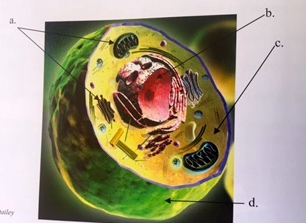 | a. organelles b. nucleus c. cytoplasm d. membrane |
| In which organelle is most of the DNA stored? | DNA is stored in the nucleus. |
| How many basic kinds of cells are there? Name them. | There are three basic kinds of cells: plant cells, animal cells, and cells from bacteria. |
| If a scientist uses a microscope to examine a cell from a mouse, a cell from a leaf, and a cell from a cat, how many different basic kinds of cells will she see? | The scientist will see two basic kinds of cells. The leaf cell will be a plant cell, and the mouse cell and cat cells will both be animal cells. |



