| A | B |
|---|
| exposition | the basic situation (introduces the reader to the situation),  |
| rising action | where conflict emerges and builds, 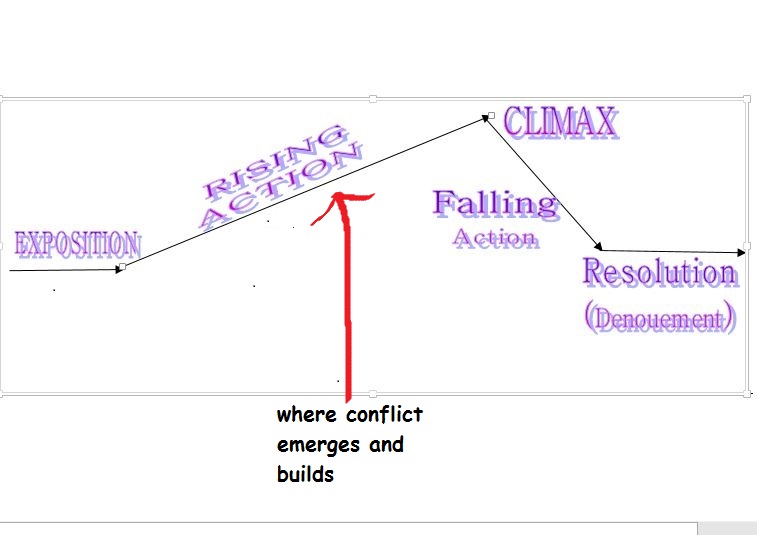 |
| climax | moment of great emotional intensity or suspense in a plot; high point of the action; turning point, 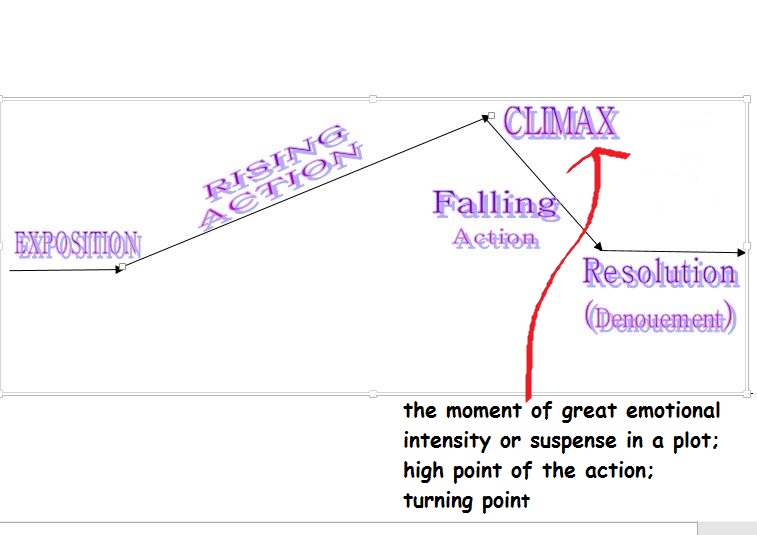 |
| falling action | where characters face the consequences of the decision made in the climax, 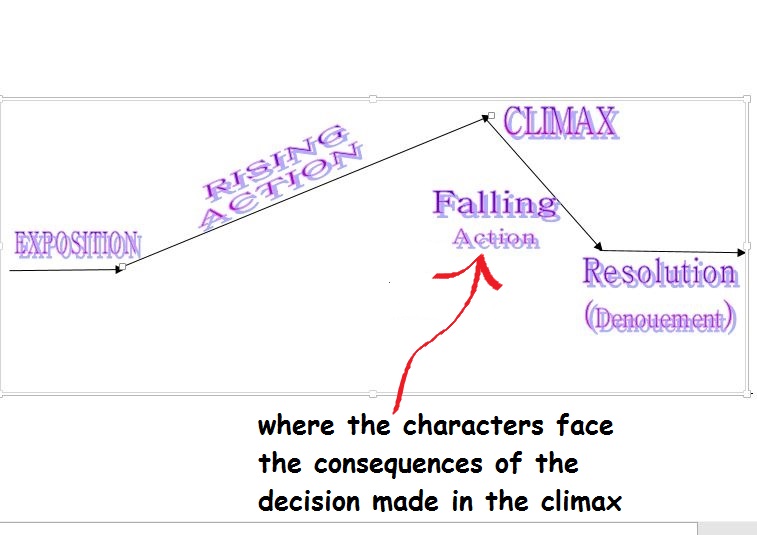 |
| resolution | the conclusion of the story, where all or most of the conflicts have been settled,  |
| oxymoron | a figure of speech in which two opposite ideas are joined to create an effect. The common oxymoron phrase is a combination of an adjective proceeded by a noun with contrasting meanings, e.g. “cruel kindness” or “living death”. |
| dramatic irony | irony where a character in a play or story thinks one thing is true, but the audience/reader knows better |
| aside | a brief remark by a character revealing his thoughts or feelings to the audience, unheard by the other characters |
| soliloquy | a lengthy speech in which a character – usually alone on stage – expresses his or her thoughts to the audience. |
| sonnet | a sonnet has 14 fourteen lines and is written in iambic pentameter. |
| protagonist | main or central character in the story, the one who initiates or drives the action |
| antagonist | the character who blocks the protagonist or causes problems for the protagonist |
| comic relief | the inclusion of a humorous character, scene, or witty dialogue in an otherwise serious work, often to relieve tension |
| couplet | a successive pair of lines in a poem. |
| foil | A foil is another character in a story who contrasts with the main character, usually to highlight one of their attributes |
| pun | a play on words in which a humorous effect is produced by using a word that suggests two or more meanings or by exploiting similar sounding words having different meanings |
| dialogue | is a conversation between two or more people in a work of literature |
| tragic hero | a literary character who makes an error of judgment or has a fatal flaw that, combined with fate and external forces, brings on a tragedy |
| situational irony | contrast between what is expected and what actually happens; when a character expects one thing to happen but something entirely different does |
| tragedy | A drama or literary work in which the main character is brought to ruin or suffers extreme sorrow, especially as a consequence of a tragic flaw, moral weakness |
| monologue | like a soliloquy, is a lengthy speech. However a monologue is addressed to other characters on stage, not to the audience |



