| A | B |
|---|
| Talent Release Form | A legal document, completed by the talent, that gives the production company permission to use the person’s (talent) name, image, and voice |
| Shot List | An itemized record or list of the shots in a production, includes the exact locations of the shots |
| Script | The written text of a play, movie, or broadcast |
Storyboard, 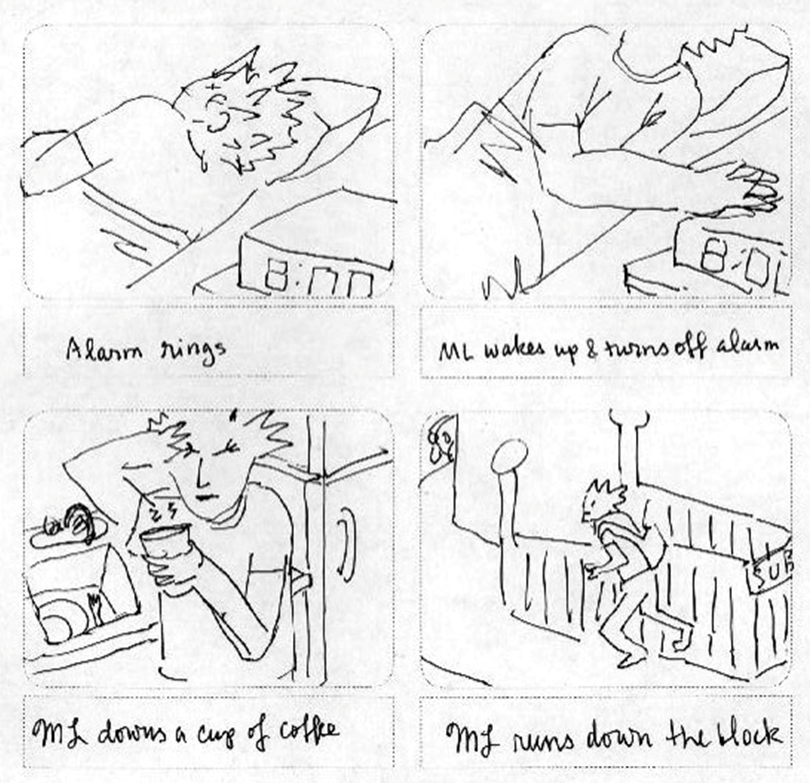 | A sequence of drawings, usually with some stage directions and dialogue, representing the shots planned for a movie or television production |
RCA Cable, _Cable.png) | Sometimes called a phono connector or cinch connector, a type of electrical cable commonly used to carry audio and video signals, known for its distinct red, white, and yellow connectors |
BNC Cable, 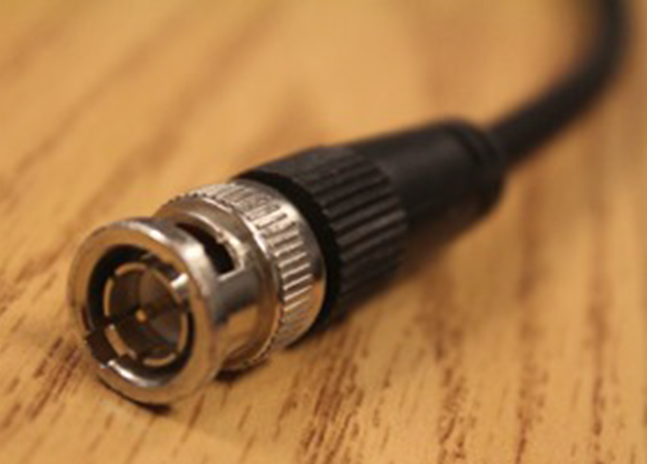 | A miniature quick connect/disconnect connector used for coaxial cable, connection is achieved with only a quarter turn of the coupling nut |
HDMI Cable, 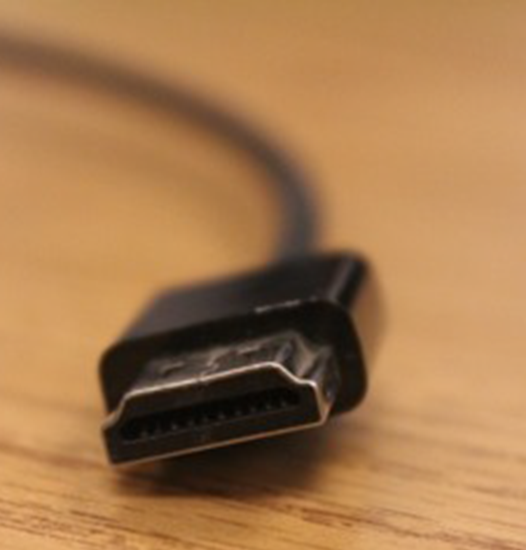 | Is a compact audio/video interface for transmitting uncompressed digital data |
Coaxial (F) Cable, _Cable.png) | A common cable type used in the cable and satellite TV industry, characterized by a protruding center wire |
RGB Cable, _Cable.png) | An outdated cable type, used only with analog video monitors, has three distinct connectors |
Firewire Cable, 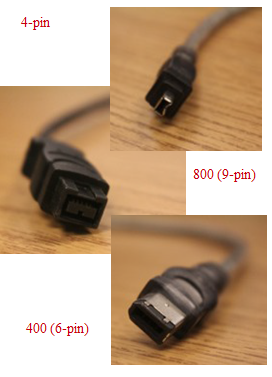 | Method of transferring information between digital devices, especially audio and video equipment, also known as IEEE 1394 |
Video Switcher, 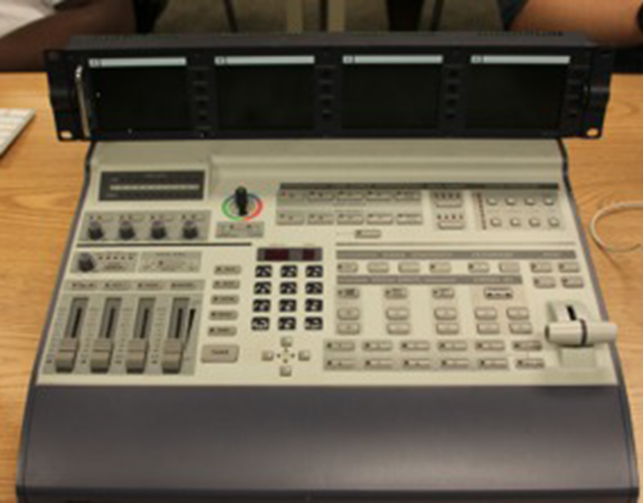 | Sometimes called a video mixer or production switcher) is a device used to select between several different video sources and in some cases composite (mix) video sources together to add special effects, similar to what a mixing console does for audio |
| Natural Sound | Produced by natural sources in their normal environment |
| Recording Narration (Voiceover) | The voice of an unseen narrator speaking (as in a motion picture or television commercial) |
| B-roll | Supplemental or alternate film footage intercut with the main shot in a video production |
| Extreme Close-up Shot | A type of shot that tightly frames the subject person or object, eliminating the background |
| Extreme Wide Shot | A broad view of the subject’s surroundings; so much so, that the subject may not even be visible, used to give the view a sense of the setting or place |
| Key Light | The main source of light in a photograph or film |
| Fill Light | A supplementary light used with the key light to soften shadows |
| Back Light | A lighting effect where the light source is behind the subject, thus placing the subject between the light source and the viewer |
| Establishing Shot | Comes early in the shoot. it sets up, or establishes the context for a scene by showing the relationship between its important figures and objects |
| Take | A scene or sequence of continuously recorded visions and/or sounds |
| Depth of Field | The distance between the nearest and the furthest objects that give an image judged to be in focus in a camera |
| Field of View | The area that is visible as seen through the camera |
| Telephoto Lens | A lens with a longer focal length than standard lens, giving a narrow field of view and a magnified image |
| Macro Lens | A lens type for taking photographs unusually close to the subject |
| Fish Eye Lens | An ultra wide-angle lens that produces strong visual distortion intended to create a wide panoramic or hemispherical image |
| Aperture | An adjustable opening in a camera, that limits the amount of light passing through a lens or onto a mirror |
| Compositing | The combining of visual elements from separate sources into single images, often to create the illusion that all those elements are parts of the same scene |
| Chroma Key | A special effects / post-production technique for compositing (layering) two images or video streams together, involves replacing a particular color in an image with a different image |
| Nested Sequences | A sequence that is edited into another sequence |
| Rotoscoping | An animation technique in which live action video is traced to create animation that mimics the live action |
| Masking | Showing or hiding specific area(s) of a video clip |
| Titles | Block of text with or without an accompanying graphic |
| Still | An ordinary static photograph, or a single shot from a movie |
| Crawl | Also known as “crab,” a camera technique where the camera moves parallel with a moving subject |
| Superimposition | To lay or place an image on or over another image |
| Cutaway | Sometimes referred to as a “cut,” the instantaneous transition from one shot to the next |
| Transition | The way in which two video shots or audio clips are linked together; for example, dissolve, wipe |
| Dissolve | Video transition in which one shot fades into the next |
| Wipe | Video transition in which parts of one shot are successively replaced by equivalent parts of the next shot |
| Assembly Cut | The first stage of the editing process, footage is organized into scenes assembled roughly, with editor's choice on takes, no music or effects are included |
| Rough Cut | The second stage of the editing process, takes are replaced as needed, based on the director's notes, film is reviewed and scenes/dialogue removed in order to get the film to an appropriate length, Music and story-critical sound effects are added |
| Final Cut | The third stage of the editing process, visual effects are needed, they are created, finalize music, screening to get general feedback and all other issues are corrected |
| Render | The process of finalizing a video file from different elements that include edited video files and special effects |
| Codec | Short for compressor/decompressor, used to reduce the size of a digital file |


