| A | B |
|---|
| Chemical property | the ability of a substance to undergo chemical reactions and form new substances |
| Chemical reaction | the changing of substances to other substances by breaking bonds |
| Chemical symbol | a one or two letter representaion of an element |
| Compound | a substance that can be separated into simpler substances only be chemical means |
| Distillation | a purification process in which a liquid is evaporated and then condensed again |
| Element | the simplest form of matter, cannot be separated into simpler substances by normal chemical means |
| Gas | matter than has no definite shape or volume, takes the shape of its container |
| Homogeneous mixture | a uniform mixture |
| Liquid | matter with a fixed volume that takes the shape of its container |
| Matter | things that take up space and have mass |
| Mixture | a blend of two or more substances that are not chemicaly combined |
| Phase | a point when all of a substance is in the same state |
| Physical change | altering a substance without changing its chemical composition |
| Physical poperty | anything that can be observed or mesured without changing the substance's chemistry |
| Solid | Matter that has a definite shape and volume |
| Solution | A uniform mixture |
| Substance | an element or compound with definite composition |
| Vapor | A gas that is normaly in liquid or solid state at room temperature |
| Boiling point | the point at which a liquid begins to convert into a gas |
| Melting point | The point at which a solid begins to turn into a liquid |
| Freezing point | the point at which a liquid begins to turn into a solid |
| Vaporization | When a liquid converts into a gas |
| Condensation | When a gas converts into a vapor |
| Sublimation | when a solid converts directly into a gas |
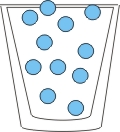 | Gas |
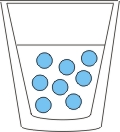 | Liquid |
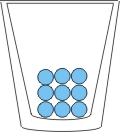 | Solid |
| When heating a test tube... | (1) use a test tube holder (2) wave it over the flame (3) point it on an angle away from people |
| The chemical symbol for magneisum is | Mg |
| The chemical symbol for tin is | Sn |
| Ga is the chemical symbol for | gallium |
| Sm is the chemical symbol for | samarium |
| Gases are compressible because | they have lots of empty space |
| Matter that has a definite volume | solid and liquid |
| Matter that takes the shape of its container | gas and liquid |
| The particles of a gas are | far apart and moving very fast |
| The particles of a solid are | close together and moving slowly |
| If you break glass in the lab | (1) tell the teacher (2) block off the area |
| If you have a fire on your benchtop | (1) turn off all gas (2) tell the teacher (3) smother the fire with wire gauze, the fire blanket, or a fire extinguisher |
| There are ___ elements in the compound NaOH | 3 |
| Salt is a(n) | substance, compound |
| Air is a(n) | mixture, homogeneous |
| Baking bread is a(n) | chemical change |
| Cracking ice is a(n) | physical change |
| Some physical properties of water | it's a liquid at room temperature, it's colorless, it freezes at 0oC, it boils at 100oC, when it freezes it expands... |
| The flat part in a heating or cooling curve is | the point where all the energy added or removed changes the particle movement instead of the temperature |
| During the flat part in a heating or cooling curve | the substance is in 2 states at once |
| If you think your partner accidentally got chemical in their mouth | just tell the teacher- nothing else |
| If you spill chemical on yourself in lab | (1) tell the teacher (2) identify the chemical (3) rinse the area for at least 5 minutes |
| Sterling si;ver (Ag + Cu) is an example of a ___ mixture | homogeneous |



