| A | B |
|---|
| Pentheus Room | 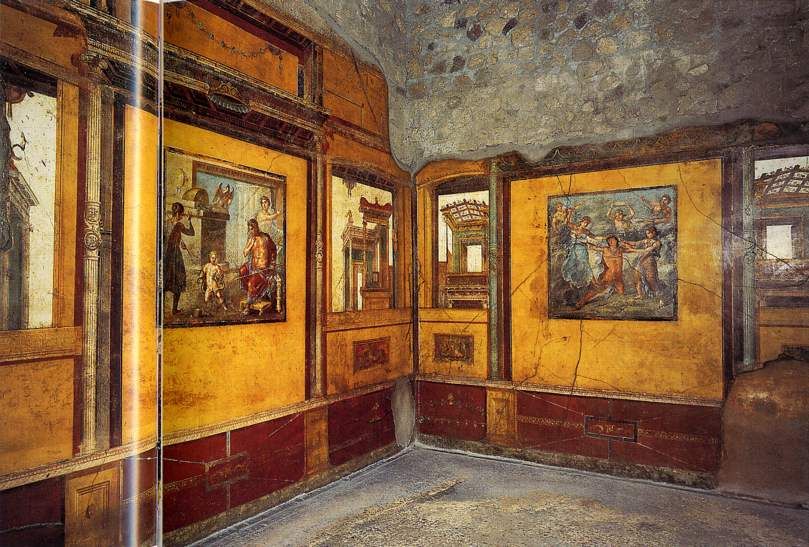 |
| Column of Trajan (image) | 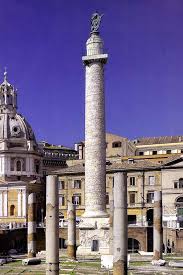 |
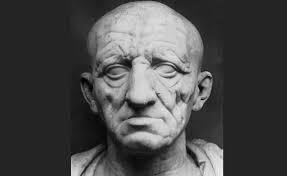 | Head of a Roman patrician |
| fresco | a painting technique in which water-based paint is applied onto a freshly plastered wall |
| contrapposto | a body gracefully arranged on tilted shoulders and hips and bent knees |
| coffer | in architecture, a sunken panel in a ceiling |
| Ludovisi Battle Sarcophagus | illustrates a Roman victory over barbarians |
| Athena Battling Alkyoneos | shows the victory of the gods over the giants |
| Augustus of Prima Porta | express a parallel with the works of the Greek Classical period |
| Alexander Mosaic | it was found on the floor of a villa at Pompeii |
| Impluvium | a place to gather rainwater for household use |
| Column of Trajan | had many functions but acting as the point in a sundial |
| Treasury at Petra, Jordan | dated between c. 400 B.C.E. and 100 B.C.E. |
| the volcanic explosion of Vesuvius in 79 C.E. | destroyed the city of Pompeii |
| Roman art | was used to emphasize the power of the state |
| Romans could build impressive structures | due to the introduction of new methods and materials |
| Roman sculptors | adopted the contrapposto to compose Imperial sculptures |
| different Pompeian wall painting styles | can reconstruct an early history of Roman painting |
| The Colosseum | meant for dangerous spectacles but not religious persecution |
| a Roman arch | architectural device, replaced post-and-lintel |


