| A | B |
|---|
| Medieval art | predominantly expresses religion and court life |
| Constantine | granted benefits to Christians |
| the long nave of a Christian church | holds the altar and highlights the priest |
| basilica | an axially planned church in Christian architecture |
| axial plan | a church with a long nave centered in the apse |
| narthex | it serves as vestibule of a church |
| transept | an aisle perpendicular to the nave in a church |
| gospels | the first four books of the New Testament |
| apse | the endpoint of a church where the altar is located |
| as in the Jewish tradition | men and women stood separately in a Christian religious ceremony |
| catacombs | held most Christian art in the early centuries |
| upon Christianity's recognition as official religion of the Roman Empire | Christ took on imperial imagery |
| in early Christian art | artists relied on their imagination to recreate different Bible episodes |
| the Good Shepherd fresco | exemplifies the parallel between Old and New Testament stories existing in early Christian art |
| Peace of the Church | 313 C.E. |
| two types of early Christian churches | centrally planned and axially planned |
| An example of spolia in Santa Sabina | to reuse a number of Roman columns from pagan temples |
| Christianity | was an underground religion at first |
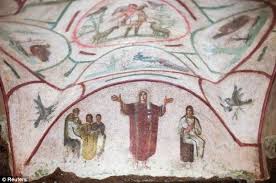 | orant figure in the Catacomb of Priscilla |
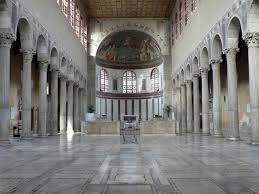 | Church of Santa Sabina |


