| A | B |
|---|
| Byzantine paintings | are traditional and quite standardized |
| most Byzantine manuscripts | employ the use of gold and were a status symbol |
| a great innovation in Byzantine architecture | was the invention of the pendentive |
| the Eastern half of the Roman Empire | is today called the Byzantine Empire |
| Byzantine builders invented | the pendentive |
| Constantinople | one of the most resplendent cities in history |
| the Hagia Sophia was constructed as | a combination of the central and basilican plan |
| Byzantine mosaics are characterized by | their glowing golden colors |
| Russia carried the Byzantine artistic tradition | after the fall of the Byzantine empire in 1453 |
| Theotokos | the Virgin Mary in her role as the Mother of God |
| codex | a manuscript book |
| icon | a devotional panel depicting a sacred image |
| pendentive | a triangle shaped construction between a flat wall and the base of a round dome |
| eucharist | the bread sanctified by the Christian priest |
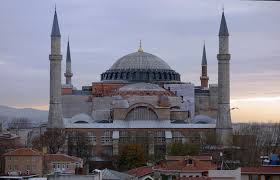 | Hagia Sophia |
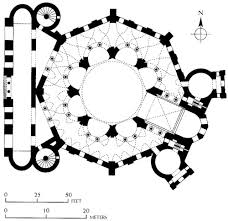 | San Vitale ground plan |
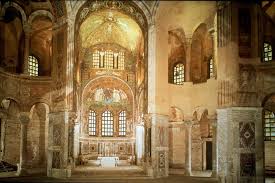 | San Vitale interior |
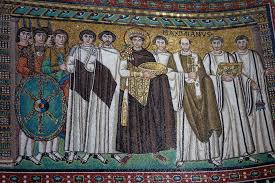 | Justinian and Attendants |
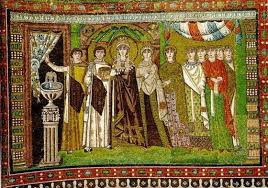 | Theodora and Attendants |
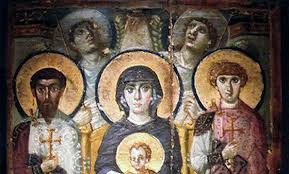 | Virgin and Child between Saints Theodore and George |


